
Two drug classes can slow the road to dialysis. In 2026, Medicare is paying less for one of them than at any point in its history, and more people qualify for coverage than most articles admit. That combination is unusual, and it is easy to get wrong in both directions: assuming the drugs are out of reach, or assuming the new federal price is the number you hand over at the counter.
Start with the two figures that matter. On January 1, 2026, the Medicare price ceiling for a 30-day supply of Jardiance fell from a $573 list price to $197, and Farxiga’s fell from $556 to $178.50 (CMS, Medicare Drug Price Negotiation Program, negotiated prices for 2026). What you personally pay is a different number, shaped by your plan’s deductible, its coinsurance and how far into the year you are.
Below: who qualifies under current labeling and the latest guideline draft, what those prices do and do not do, which of these drugs is genuinely expensive in 2026 (it is not the one most people assume), and the paperwork moves that decide whether the prescription gets filled at all.
| The five answers up front 1. Jardiance and Farxiga both have Medicare price ceilings in 2026: $197 and $178.50 per 30-day supply. Every Part D plan, including Medicare Advantage plans with drug coverage, has to apply them. 2. Your copay is usually lower than that ceiling once the deductible is met. On a 20 to 25 percent coinsurance tier, expect somewhere in the region of $35 to $50 a month. 3. Semaglutide (Ozempic) carries a kidney approval but has no Medicare price ceiling until January 1, 2027, when it becomes $274. That is why GLP-1s feel expensive in 2026 and should not in 2027. 4. Manufacturer copay cards are built for commercially insured patients. Handing one to a pharmacy alongside your Medicare card is a compliance problem, not a loophole.5. The disqualifiers matter as much as the qualifiers: kidney function below the label’s starting threshold, polycystic kidney disease, dialysis, type 1 diabetes for this drug class, and pregnancy. |
Who qualifies: four doors into these drugs
Eligibility is not one checklist. There are four separate clinical routes into an SGLT2 inhibitor, and a fifth into a GLP-1. Which door you come through changes what your doctor has to document and, sometimes, what your plan will cover without an argument.
The class-wide recommendation from KDIGO, the international kidney guideline body, is broad: treat adults with chronic kidney disease and type 2 diabetes or heart failure with an SGLT2 inhibitor regardless of how much protein is in the urine, and treat people with heavy protein in the urine even without diabetes (KDIGO 2024 CKD guideline, and the October 2026 draft update, which restates the same positions with more detail).
The most common route by far is type 2 diabetes alongside kidney disease, and that combination has its own logic: our overview of diabetes and chronic kidney disease explains why the two travel together and what typically changes in the first year after diagnosis.
| Door | Typical patient | What supports coverage | Number that matters |
| 1. CKD with type 2 diabetes | Albuminuria with eGFR anywhere from 20 to 75 | The most established route. Both drugs carry a label indication for CKD at risk of progression, and KDIGO gives it the strongest grade. | Start at eGFR 20 or above (empagliflozin) or 25 or above (dapagliflozin) |
| 2. CKD with protein in the urine, no diabetes | UACR of 200 mg/g or higher, with or without diabetes | DAPA-CKD and EMPA-KIDNEY both enrolled people without diabetes and the benefit held; dapagliflozin carries a CKD indication that is not restricted to diabetes. | UACR 200 mg/g or higher is the familiar threshold |
| 3. CKD with heart failure | Breathlessness, fluid overload, a reduced or preserved ejection fraction | Two indications satisfied by one tablet. Both drugs reduce heart failure hospitalization, and heart failure alone is enough to qualify for the class. | Any ejection fraction, not just reduced |
| 4. Type 2 diabetes with high cardiovascular risk, before CKD starts | Diabetes plus established cardiovascular disease or multiple risk factors | The original prevention route. Treating here is how the CKD that has not yet appeared is delayed. | eGFR still normal or mildly reduced |
| 5. GLP-1 route: type 2 diabetes with CKD | Diabetes with CKD who remain at high risk of cardiovascular or kidney events, or who are above their glucose target | Only one GLP-1, semaglutide injection, has a kidney indication (added January 2025 after the FLOW trial). The October 2026 KDIGO draft recommends a GLP-1 with proven cardiovascular or kidney benefit in this group. | Not a substitute for an SGLT2 inhibitor; usually layered on top |
The two lab numbers that decide your eligibility
Your eGFR estimates how much filtering capacity you have left. Your UACR measures how much protein is leaking through. Kidney risk is a grid built from both, which is why one number alone cannot tell you whether you are the patient these drugs were studied in. A person with an eGFR of 70 and heavy protein sits in a higher risk box than a person with an eGFR of 50 and no protein.
This is worth understanding because it explains two things patients find odd. First, why a doctor prescribes a kidney-protecting drug to someone whose kidney number looks almost normal: the protein leak is the warning. Second, why the drug may be started at an eGFR of 30 but not at an eGFR of 18, even though the tablet is the same tablet. If you want to read your own results, our guides on UACR test results and what the numbers mean and eGFR versus creatinine versus UACR go through the arithmetic line by line.
Who should not start, and why the label says so
This is the section most cost articles skip, and it is the one that saves people a wasted month of paperwork.
- Kidney function below the starting threshold. Empagliflozin is not recommended for initiation below an eGFR of 20, and dapagliflozin below 25 (FDA labeling). If you are already taking the drug and your eGFR drops below that line, the label allows you to continue, and the October 2026 KDIGO draft makes the same point as a practice point: keep going below 20 once started.
- Polycystic kidney disease, or recent immunosuppression for kidney disease. Both labels state the drugs are not recommended here and are not expected to work, because the mechanism that protects a filtering unit does not address a cyst-driven or immune-driven problem. Our guide to polycystic kidney disease covers what does help in that situation.
- Dialysis. The pivotal trials did not enroll people on dialysis, so there is no evidence base to stand on and coverage becomes an individual conversation.
- Type 1 diabetes. SGLT2 inhibitors are not approved for type 1 diabetes, and the class carries a ketoacidosis risk that is higher in that population. Type 1 diabetes runs on different rules for exactly this reason. This is one of the few places where finerenone, not an SGLT2 inhibitor, now has an approval: Bayer received FDA approval in September 2026 for finerenone to reduce albuminuria in adults with CKD associated with type 1 diabetes.
- Pregnancy, or planning a pregnancy. The October 2026 KDIGO draft is direct about this: discuss pregnancy intentions, use contraception where appropriate, and stop these agents promptly if pregnancy is confirmed or suspected.
- Recurrent genital fungal infections or a tendency to low blood pressure. Not absolute contraindications, but reasons to start with a conversation about volume status and hygiene rather than a shrug.
| One myth worth killing A history of urinary tract infection is not a contraindication. The October 2026 KDIGO draft says so explicitly as a practice point, and it is a common reason patients talk themselves out of a drug that would protect their kidneys. |
What the evidence shows, and what the percentages mean
Four large randomized trials and one heart failure trial define this field. The percentages below are relative risk reductions for each trial’s own primary endpoint, and the endpoints are not identical, so the bars should not be read as a league table.
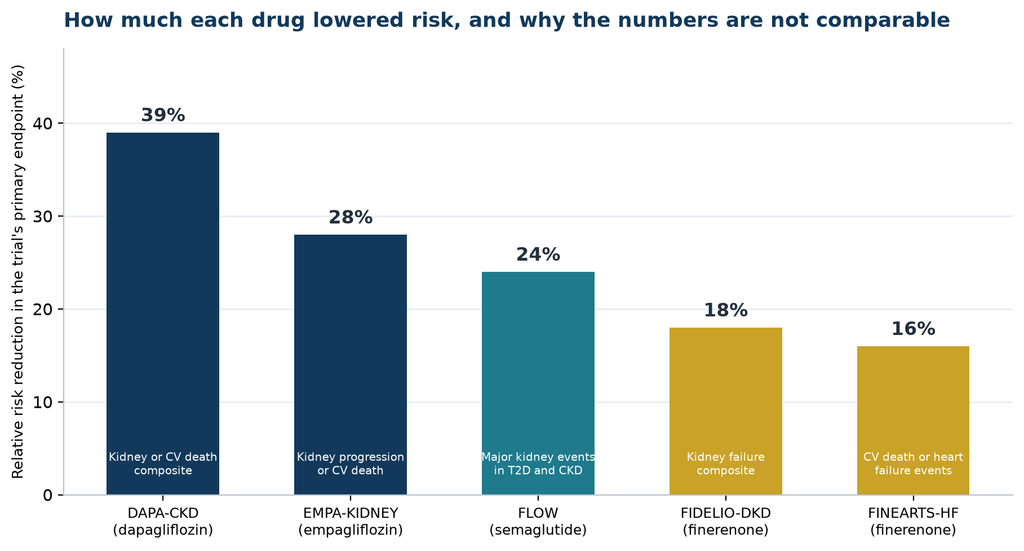
Figure 1. Relative risk reductions for the primary endpoint in five landmark trials. Endpoints differ between trials, so the figures are not directly comparable and should not be used to rank one drug above another.
| Trial | Drug | Population | Primary result |
| DAPA-CKD (NEJM, 2020) | Dapagliflozin | 4,304 adults with CKD, with or without type 2 diabetes, UACR 200 to 5,000 | 39 percent lower risk of the kidney or cardiovascular death composite (hazard ratio 0.61). Roughly 19 people treated for 2.4 years to prevent one event. |
| EMPA-KIDNEY (NEJM, 2023) | Empagliflozin | 6,609 adults with a wider range of CKD, including people with little protein in the urine | 28 percent lower risk of kidney progression or cardiovascular death (hazard ratio 0.72). |
| FLOW (NEJM, 2024) | Semaglutide 1 mg weekly | 3,533 adults with type 2 diabetes and CKD | 24 percent lower risk of major kidney events (hazard ratio 0.76). Slower annual eGFR decline by 1.16 mL/min/1.73 m2. |
| FIDELIO-DKD (NEJM, 2020) | Finerenone | Adults with CKD and type 2 diabetes, already on an ACE inhibitor or ARB | About 18 percent lower risk of the kidney failure composite (hazard ratio 0.82). |
| FINEARTS-HF (NEJM, 2024) | Finerenone | About 6,000 adults with heart failure and ejection fraction of 40 percent or above | 16 percent lower risk of cardiovascular death and total heart failure events (rate ratio 0.84). |
Three things follow from this evidence that patients rarely hear stated plainly.
- These drugs slow decline. They do not reverse it. No trial shows kidneys recovering to normal. What the trials show is fewer people reaching dialysis, fewer cardiovascular deaths and a flatter decline over two to three years. That is a large benefit and it is a modest promise.
- The early drop in eGFR is expected. Starting an SGLT2 inhibitor often produces a small dip in kidney function within weeks, because the drug lowers pressure inside the filtering units. The KDIGO draft says this dip is common, often reverses, and is not by itself a reason to stop. It is the single most useful sentence a patient can hear in month one.
- The absolute benefit depends on your baseline risk. Nineteen people treated to prevent one event over 2.4 years in DAPA-CKD is a strong result in a group selected for high risk. If your risk is lower, the same drug does less in absolute terms even though the relative reduction looks the same.
The wider diabetes pipeline moves faster than the kidney literature, and it is worth knowing what else is arriving: what changed in diabetes treatment in 2026 is the current overview.
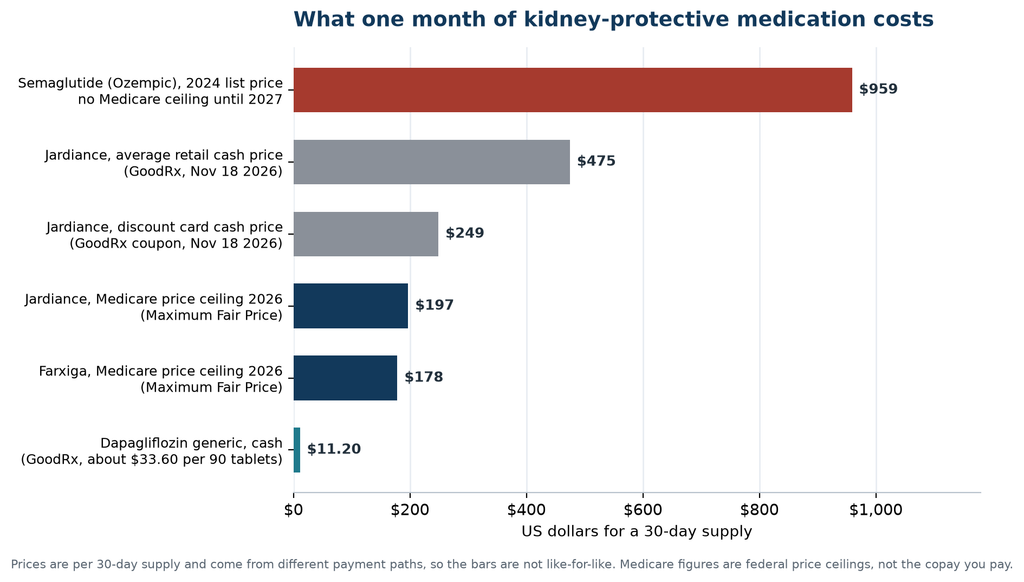
Figure 3. Price and cash benchmarks for a 30-day supply in 2026. Bars come from different payment paths, so they are not like-for-like. The Medicare figures are federal ceilings, not the copay you pay.
The price cliff: what actually changed on January 1, 2026
What a maximum fair price is, and what it is not
The Inflation Reduction Act let Medicare negotiate prices directly for the first time. The result is called the Maximum Fair Price: the most a Part D plan and its pharmacies can be charged for a 30-day supply of a selected drug. Jardiance and Farxiga were both in the first group of ten, and their ceilings took effect on January 1, 2026.
Three things a maximum fair price is not.
- It is not your copay. Your share is calculated from that price using your plan’s cost-sharing design: deductible first, then a copay or a percentage, until the annual out-of-pocket cap.
- It is not a guarantee of access. Plans still run the benefit. Prior authorization, step therapy and formulary tier placement all survive a price cut, because price negotiation and coverage review are separate machinery. A board-certified internist, Dr. Kyle Hoedebecke, described the practical version of this in a 2026 cost explainer: plans commonly want documentation of the diagnosis, the kidney numbers and prior medication trials before they approve (SingleCare, July 2026).
- It does not apply to commercial insurance or cash purchases. If you are under 65 on an employer plan, or you pay cash, this price is not yours.
What you are likely to pay, phase by phase
Part D in 2026 has three phases. The deductible can be as high as $615 and some plans charge all of it. In the initial coverage phase, the standard benefit design is 25 percent coinsurance, though many plans use fixed copays or a lower percentage for preferred tiers. Once your true out-of-pocket spending reaches $2,100, you pay nothing for covered drugs for the rest of the year (CMS, CY2026 Rate Announcement).
| Stage of your year | What you pay | Worked example with Jardiance at a $197 ceiling |
| Deductible phase | The full negotiated cost of the drug until the deductible is met | With a $615 deductible, you pay $197 in January, $197 in February, and the remainder in March. Three fills, and then cost sharing begins. |
| Initial coverage | Your plan’s copay, or a percentage of the negotiated price | On an 18 percent coinsurance tier, about $36 a month. On a 25 percent tier, about $49 a month. |
| Catastrophic coverage | $0 for covered drugs once true out-of-pocket spending hits $2,100 | Relevant if you take several brand drugs, not usually if this tablet is your only one. |
| If you have Extra Help | No premium and no deductible in most cases, with a fixed low copay per fill | About $12.65 for a brand fill in 2026, rising to $14.40 in 2027 (Medicare.gov). |
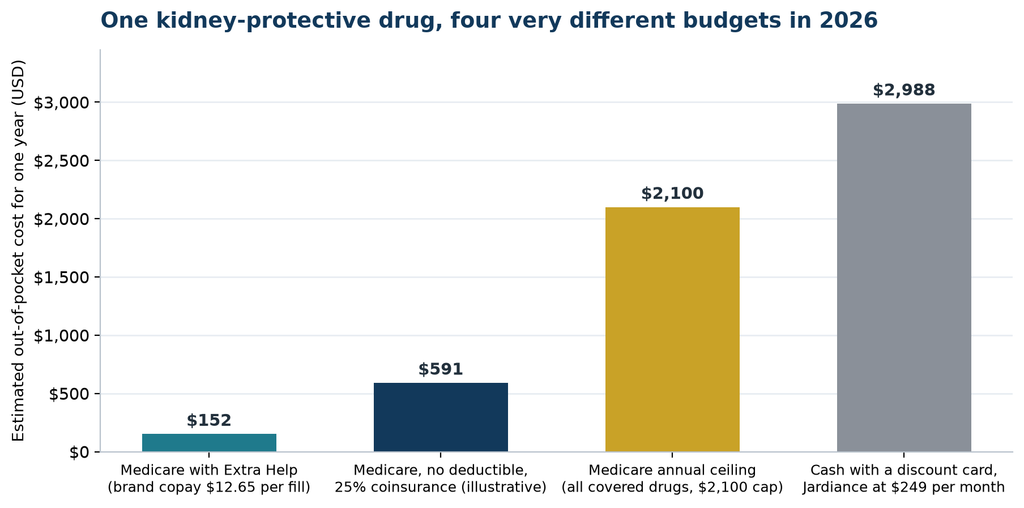
Figure 2. Illustrative annual out-of-pocket cost for one kidney-protective drug under four payment paths in 2026. Assumptions: 12 monthly fills, no other prescriptions, 25 percent coinsurance in the initial coverage phase, and no deductible. Real plans vary.
Notice what the chart makes obvious. The difference between a well-designed plan and a badly matched one, for the same tablet, is several hundred dollars a year. During open enrollment, that is the number to optimize, not the premium alone. If you want the deeper version of this exercise, our walkthrough on how to manage diabetes and protect your kidneys covers the monitoring that goes with these prescriptions.
The 2027 numbers to plan around now
Negotiated prices are indexed to inflation, and the Part D parameters move every year. Do not build a long-term budget on 2026 figures.
| Item | 2026 | 2027 |
| Jardiance ceiling, 30 days | $197.00 | $202.33 |
| Farxiga ceiling, 30 days | $178.50 | $183.33 |
| Semaglutide ceiling, 30 days | Not yet in effect | $274.00 |
| Part D deductible, maximum | $615 | $700 |
| Part D out-of-pocket cap | $2,100 | $2,400 |
| Extra Help brand copay, per fill | About $12.65 | Up to $14.40 |
The surprise: in 2026, semaglutide is the expensive one
Semaglutide earned a kidney indication in January 2025, based on FLOW. It is the first GLP-1 approved to reduce the risk of kidney disease worsening, kidney failure and cardiovascular death in adults with type 2 diabetes and CKD. That makes it genuinely important, and it is why so many people now ask about Ozempic in the same breath as Jardiance.
But semaglutide sits in the second round of Medicare negotiation, not the first. Its negotiated price of $274 per 30-day supply does not take effect until January 1, 2027 (CMS, negotiated prices for 2027, announced November 25, 2025). Through 2026, cost sharing for Ozempic is calculated against a far higher price. A 25 percent coinsurance tier on a drug with a 2024 list price of $959 is a materially different monthly commitment from the same tier on a $197 tablet.
This produces the single most common misreading of the topic. People read that kidney drugs got cheaper in 2026, ask about a GLP-1, and discover the quote is three or four times the SGLT2 inhibitor. Nothing has gone wrong. The two price events are a year apart.
Two practical consequences. If your clinical goal is kidney protection and you are choosing a starting point, the SGLT2 inhibitor is both the guideline first step and, in 2026, the cheaper one. If semaglutide is the right drug for you on other grounds, ask your prescriber and plan what the 2027 price change means for your specific tier, and whether a 90-day fill in late 2026 or an early-2027 fill serves you better.
| A program that does not solve the kidney question CMS runs a separate, time-limited demonstration that offers certain GLP-1 medicines for weight management at a flat $50 monthly copay, launched July 1, 2026 for eligible Part D enrollees. Two limits matter here: it covers weight management indications rather than CKD, and the $50 does not count toward your Part D out-of-pocket total. It is worth checking on Medicare.gov if you also have obesity, but it is not a route to cheap kidney protection. |
The generic dapagliflozin twist nobody explains
In April 2026 the FDA approved the first generic versions of Farxiga, and multiple manufacturers entered. On paper this should make dapagliflozin the cheapest kidney-protective drug in America. In the cash market it already is: on a date-stamped GoodRx check in mid-November 2026, dapagliflozin 10 mg cost about $33.60 for 90 tablets, which is a little over $11 for a 30-day supply, against a Medicare ceiling of $178.50 for the brand.
That comparison is real but it is not a like-for-like swap, and three things explain why.
- The label on a specific bottle may be narrower than the brand’s. The FDA’s April 2026 announcement described the first generic approvals in terms of type 2 diabetes and heart failure risk reduction in people with type 2 diabetes. The branded product’s CKD indication is a separate piece of labeling. Whether the bottle in front of you is labeled for CKD depends on the product, so ask the pharmacist to check the exact package insert rather than assuming.
- Cash does not count toward your cap. Every dollar you pay through Part D moves you toward the $2,100 ceiling. A cash purchase does not, and a pharmacy cannot bill your plan and a discount card for the same fill.
- Plans negotiate their own generic pricing. Some Part D plans now pay for generic dapagliflozin at a low tier with a small copay, which is the best of both worlds. Others price it close to the brand. This is a formulary question, and the answer changes by plan.
| A decision rule for the counterIf your Part D copay for this drug is higher than the cash price and this is your only prescription, paying cash and saving the difference is rational. If you take several brand drugs and are working toward the $2,100 cap, staying inside Part D is usually better, because cash spending is invisible to the cap. Run both numbers before you decide, and ask the pharmacist to price it both ways. |
Savings cards, discount cards, and the mistake that can cost you
Three different things get called a coupon. One is not allowed on a Medicare claim at all, one is allowed but is a separate cash transaction, and one is an application process rather than a discount.
- Manufacturer copay cards: not for Medicare. The Jardiance and Farxiga savings programs are limited to commercially insured patients, and federal law treats manufacturer support for federal health program beneficiaries as a potential kickback under the anti-kickback statute (42 U.S.C. 1320a-7b). If a card worked at the counter, that is a billing error, not a win, and it can be reversed later.
- Pharmacy discount cards: legal, but a different transaction. A GoodRx-style price is a cash price. It cannot be combined with your Part D coverage, it earns no credit toward the deductible or the cap, and it is not insurance.
- Manufacturer patient assistance programs: possible, income-tested. Boehringer Ingelheim and AstraZeneca both run assistance programs for people who cannot afford their medicine. Eligibility rules and income cut-offs change annually, so check the current terms on the manufacturer site rather than relying on an old blog post.
The largest lever is not any of these. It is Extra Help, the Medicare low-income subsidy. In 2026 the income limit is $23,940 for an individual and $32,460 for a married couple, with resource limits of $18,090 and $36,100 (Medicare.gov). If you qualify, your premium and deductible drop to zero in most cases and your brand copay becomes a fixed low amount per fill. If you were turned down in a previous year, it is worth reapplying after any change in income, because the application can also start a Medicare Savings Program review.
One more tool that costs nothing: the Medicare Prescription Payment Plan. It does not lower your bill. It spreads your out-of-pocket costs across the calendar year in interest-free installments, which matters most in January and February when the deductible lands on top of everything else. Anyone with Part D can opt in.
Prior authorization without the runaround
Price negotiation did not remove prior authorization, and it was never meant to. A plan can still ask your prescriber to justify the drug, and some still require a trial of an older diabetes medicine first. When a prescription stalls, the cause is usually documentation, not medicine.
Here is the set of facts a plan’s reviewer needs. Give these to your prescriber’s office as a short message rather than asking them to work it out.
- The diagnosis, with the CKD stage and both lab values: eGFR with its date, and UACR with its date.
- The indication you are being treated under, stated in the language of the label: CKD at risk of progression, heart failure, or type 2 diabetes with cardiovascular risk factors.
- The drug name, dose and quantity, written as the label uses it (10 mg once daily for CKD or heart failure).
- The foundation therapy you are already on, usually an ACE inhibitor or an ARB, with the dose and the reason if you cannot take one.
- For a step therapy request: a one-line clinical reason why the preferred drug is unsuitable for you, for example an eGFR that makes metformin inappropriate or a prior intolerance.
- A request that the review cite the specific FDA-labeled indication and the current KDIGO recommendation rather than a generic policy line.
- If the plan is an MA-PD plan, the same package goes to the plan, not to original Medicare.
If the answer is no, the sequence is: a coverage determination request, then a redetermination, then an independent review by the plan’s external reviewer. In parallel, call 1-800-MEDICARE and ask them to review the denial, and if you are mid-year, remember that a plan that will not cover the drug is a reason to compare plans during the annual enrollment window of October 15 to December 7.
| Check the price was actually applied If a 2026 explanation of benefits shows a Jardiance or Farxiga charge calculated on more than $197 or $178.50 per 30-day supply, the negotiated price may not have been applied. Ask the plan in writing to confirm the Maximum Fair Price was used, and keep the response. This is a reconciliation question, not an accusation, and it is worth asking before the year closes. |
What patients actually report
Price tables do not capture what happens at the counter. These are paraphrased reports from public forums, included because they show the frictions that official pages leave out. They are individual accounts, not evidence, and no clinically meaningful conclusion should be drawn from any of them.
- The saving did not always arrive as a smaller copay. In a January 2026 discussion on r/medicare about whether negotiated prices were visible yet, one enrollee reported their Farxiga copay falling from $47 to about $32 a month, and explained why: their plan had changed that tier from a fixed copay to a percentage of the drug’s cost. Another enrollee in the same thread said the opposite, reporting a 2026 Farxiga quote of $92.74 a month against $47 the year before, alongside a new deductible. Same drug, opposite direction. See the r/medicare thread from January 2026.
- Plan estimates and pharmacy bills diverged. In February 2026 an enrollee reported being charged about $545 for 90 days of Farxiga when the Medicare plan finder had shown roughly $400, a gap they attributed to stale pricing data. The lesson is to get the pharmacy to run the claim before you commit to a plan, not after. The thread is here.
- Pharmacists see the generic and brand collide. In a January 2026 r/pharmacy discussion about the negotiated drugs, one pharmacist described billing generic dapagliflozin and finding reimbursement almost identical to the brand while acquisition cost was lower, and a second described a plan refusing the brand and directing them to bill the generic. This is the machinery behind the generic twist described above. Discussion here.
- The eGFR dip frightens people, and sometimes recovers. In a kidney disease forum, one person with FSGS described their eGFR falling from 42 to 36 after starting Farxiga, then sitting at 46 about a year later with, in their words, practically no protein spillage. That arc matches what the trials and the KDIGO draft describe, and it is the reassurance many patients never receive. Thread here.
- Before 2026, the Medicare price was genuinely brutal. In a mid-2025 r/diabetes_t2 thread titled around the cost of Jardiance, one Medicare enrollee described paying $850 for the first three months and then $224 a month, and said the manufacturer card could not be used. Another in the same thread reported a $47 monthly copay. The spread between those two experiences is the reason the 2026 ceiling matters. Thread here.
| How to read forum evidence Public forum posts are unverified, unrepresentative and sometimes mistaken, and they are not a substitute for advice from your own clinician or plan. They are used here only to illustrate the range of real-world billing experiences. Individual clinical outcomes described by strangers on the internet should never be used to make a treatment decision. |
Where finerenone fits, and why the third pillar costs more
Kidney protection in 2026 is a layered regimen, not a single prescription. The usual build is a foundation of an ACE inhibitor or ARB at the maximum tolerated dose, an SGLT2 inhibitor, and then, depending on the patient, finerenone and a GLP-1. Each layer addresses a different mechanism, which is why the combinations accumulate benefit and also accumulate side effects to monitor.
| Layer | What it does | Cost reality in 2026 |
| ACE inhibitor or ARB | Lowers pressure inside the glomerulus and reduces protein leak. The foundation, and usually generic and inexpensive. | Generic, typically a few dollars a month |
| SGLT2 inhibitor | Reduces intraglomerular pressure through natriuresis and osmotic diuresis. Works whether or not you have diabetes. | $197 or $178.50 ceiling on Medicare after January 1, 2026 |
| Finerenone (Kerendia) | A non-steroidal mineralocorticoid receptor antagonist. Approved for CKD with type 2 diabetes since 2021, for heart failure with ejection fraction of 40 percent or above since July 2025, and for albuminuria reduction in CKD with type 1 diabetes since September 2026. An application for CKD without diabetes was accepted by the FDA in October 2026 and is not yet approved. | Not a negotiated drug, so it has no federal price ceiling. Plan tier and prior authorization decide the bill, and potassium monitoring adds visits |
| GLP-1 with proven benefit | Reduces major kidney events and cardiovascular death in type 2 diabetes with CKD, and supports weight and glucose control. | No Medicare ceiling until January 1, 2027, then $274 |
The KDIGO October 2026 draft sharpens this into a sequence. It recommends a non-steroidal mineralocorticoid antagonist for adults with type 2 diabetes, an eGFR of 25 or above, normal potassium and persistent albuminuria despite a maximum tolerated ACE inhibitor or ARB, and it notes that an SGLT2 inhibitor and finerenone can be started at the same time when potassium is normal. It also adds a practical caution: check potassium two to four weeks after starting finerenone, and do not run a steroidal and a non-steroidal MRA together.
That monitoring is the hidden cost of the third pillar. Potassium checks are covered as laboratory services, but they require appointments and transport, and a potassium result that is too high means a dose change and another check. When people compare regimens on drug price alone, this is the line item that goes missing.
Side effects, sick days, and the eGFR dip that scares people
These drugs are generally well tolerated in the trials, and the serious risks are specific enough to plan around rather than fear.
- Genital fungal infections. The most common nuisance, and a reason people stop. Hygiene after urination matters more than most counseling acknowledges, and it is manageable. A prior urinary tract infection is not a reason to avoid the drug.
- Volume depletion and dizziness. More likely if you take a diuretic, are older, or run low blood pressure. Worth a dose review rather than a discontinuation.
- Euglycemic ketoacidosis. A rare but serious risk, and the reason the label says to withhold the drug for at least three days before major surgery or procedures involving prolonged fasting, and to pause during critical illness. The KDIGO draft adds prolonged fasting as a trigger and says to restart once you are stable and eating.
- Fournier gangrene and amputation signal. Rare. The amputation signal is associated mainly with canagliflozin, and unexplained foot pain, tenderness or infection needs prompt assessment in anyone on this class.
- GLP-1 gastrointestinal effects and muscle loss. Nausea, vomiting and constipation are common and usually settle. The KDIGO draft recommends structured resistance training to preserve muscle mass, and nutrition support where intake falls.
- Pregnancy. Stop, and plan ahead. All four pillars, including the ACE inhibitor or ARB, carry fetal risk.
If your eGFR falls in the first weeks, the question to ask is not “should I stop” but “is this the expected dip.” The dip usually stabilizes. A sustained fall is a different conversation. Our guide on why eGFR drops after Jardiance or Farxiga walks through the distinction, and the CKD stages explained shows what the numbers mean over time.
A 12-month cost plan
The most expensive mistake in Part D is discovering the deductible in February. This is the sequence that costs least.
| When | What to do | Why |
| October 15 to December 7 | During open enrollment, enter every drug you take into the plan finder, then call the pharmacy and ask them to run an actual claim for the two or three plans you are considering. | Printed estimates and stale pricing data cause most January surprises. |
| Before January | Ask your prescriber for 90-day prescriptions where the drug is stable, and ask whether the plan’s mail order price is lower. | Fewer fills means fewer copay events and often a lower per-month cost. |
| January | Expect the deductible. If paying it in one hit is a problem, enroll in the Medicare Prescription Payment Plan before your first fill, not after. | Installments are interest free and opt-in only. |
| February to March | Check one explanation of benefits against the published ceiling of $197 or $178.50. | Confirms the negotiated price reached you. |
| Any month | Re-check the cash price for the generic if you are on dapagliflozin, and compare it with your Part D copay. | The generic cash market has moved faster than plan pricing. |
| Mid-year | If you are close to the $2,100 cap, do not delay fills you will need anyway. | Once the cap is met, covered drugs cost nothing for the rest of the year. |
| November to December | Do not stockpile to beat a 2027 price rise. Check whether next year’s plan covers the drug on the same tier first. | A tier move costs more than the inflation adjustment. |
| January 2027 | Expect $202.33 for Jardiance, $183.33 for Farxiga, a $700 deductible and a $2,400 cap. If you take semaglutide, this is the year its ceiling of $274 begins. | Budgets built on 2026 numbers will be wrong. |
Food and medication are the same budget line. Two practical companions to this plan are the site’s renal diet plan and its seven-day meal plan for kidney disease and diabetes.
What to do this week
- Find your two numbers. Ask for your latest eGFR and UACR with their dates. Without both, you cannot tell whether you are in the group these drugs were studied in.
- Ask a direct question. “Do I qualify for an SGLT2 inhibitor under the CKD, heart failure or diabetes indication, and if not, what would need to change?” That wording gets a clinical answer rather than a general one. If you are unsure who owns which question, what a nephrologist does and when to see one sorts the handoffs.
- Price it three ways before you fill anything. Your Part D copay, the cash price with a discount card, and the Extra Help copay if your income is near the 2026 limit of $23,940 for an individual.
- If you are on a GLP-1 for kidney protection, mark January 2027. The negotiated price of $274 begins then. Ask now what your plan intends to do with its tier.
- Put the prior authorization package together before the pharmacy asks. Diagnosis, both lab values with dates, the labeled indication, foundation therapy and the request in writing. It is the difference between a delay and a denial.
Frequently asked questions
On the federal ceiling, Farxiga is slightly cheaper at $178.50 against $197 for a 30-day supply. That difference of about $18.50 a month is small compared with the difference your plan’s tier design makes. A preferred-tier SGLT2 inhibitor on an 18 percent coinsurance plan can cost less than a non-preferred one on a $50 flat copay. Compare the plans, then the drugs, not the other way round.
No. The Jardiance and Farxiga savings cards are for commercially insured patients, and using manufacturer support on a federal health program prescription raises anti-kickback concerns. What you get instead is the negotiated price plus the $2,100 annual cap. If cost is still a barrier, the routes that work are Extra Help, a patient assistance program, or a cash generic where one exists.
Yes, for the SGLT2 inhibitors, when the indication is chronic kidney disease with protein in the urine or heart failure. DAPA-CKD and EMPA-KIDNEY both showed benefit in people without diabetes, and the dapagliflozin label covers CKD at risk of progression without requiring diabetes. The GLP-1 picture is different: semaglutide’s kidney indication is limited to adults with type 2 diabetes and CKD.
For most people taking only one of these tablets, not within a year. At roughly $36 to $49 a month in the initial coverage phase, you would spend a few hundred dollars annually. The cap becomes relevant when you are also on other brand drugs, which is common in this population, since heart failure and diabetes regimens often include two or three.
Slightly. Negotiated prices are indexed, so the Jardiance ceiling rises to $202.33 and Farxiga to $183.33. The deductible rises to $700 and the cap to $2,400. The offsetting change is semaglutide, whose ceiling of $274 starts in 2027, which should reduce costs substantially for anyone paying for a GLP-1 in 2026.
Sources
Sources are listed in the order they are first relied on in the text. Figures dated November 2026 were checked on the date of preparation and should be re-verified at publication.
1. Centers for Medicare & Medicaid Services. Medicare Drug Price Negotiation Program: Negotiated Prices for Initial Price Applicability Year 2026. August 2024. https://www.cms.gov/files/document/fact-sheet-negotiated-prices-initial-price-applicability-year-2026.pdf
2. Centers for Medicare & Medicaid Services. Announcement of Calendar Year 2026 Medicare Advantage Capitation Rates and Part C and Part D Payment Policies (Part D benefit parameters, Table V-2). April 7, 2025. https://www.cms.gov/files/document/2026-announcement.pdf
3. Centers for Medicare & Medicaid Services. Announcement of Calendar Year 2027 Medicare Advantage Capitation Rates and Part C and Part D Payment Policies. April 6, 2026. https://www.cms.gov/files/document/2027-announcement.pdf
4. Centers for Medicare & Medicaid Services. Medicare Drug Price Negotiation Program: Negotiated Prices for Initial Price Applicability Year 2027. November 25, 2025.
5. Kidney Disease: Improving Global Outcomes (KDIGO). KDIGO 2024 Clinical Practice Guideline for the Evaluation and Management of Chronic Kidney Disease. Kidney International, March 2024. https://kdigo.org/guidelines/ckd-evaluation-and-management/
6. KDIGO. KDIGO 2027 Clinical Practice Guideline for the Evaluation and Management of CKD: Medications Management, Public Review Draft, Summary of Recommendations and Practice Points. October 2026. https://kdigo.org/wp-content/uploads/2017/02/KDIGO-2027-CKD-Guideline-Focused-Update-Public-Review-Draft-Summary-of-Recs-and-Practice-Points.pdf
7. Heerspink HJL, et al. Dapagliflozin in Patients with Chronic Kidney Disease (DAPA-CKD). New England Journal of Medicine. 2020;383:1436-1446. https://www.nejm.org/doi/full/10.1056/NEJMoa2024816
8. The EMPA-KIDNEY Collaborative Group. Empagliflozin in Patients with Chronic Kidney Disease. New England Journal of Medicine. 2023;388:117-127. https://www.nejm.org/doi/full/10.1056/NEJMoa2204233
9. Perkovic V, et al. Effects of Semaglutide on Chronic Kidney Disease in Patients with Type 2 Diabetes (FLOW). New England Journal of Medicine. 2024;391:109-121. https://www.nejm.org/doi/full/10.1056/NEJMoa2403347
10. Bakris GL, et al. Effect of Finerenone on Chronic Kidney Disease Outcomes in Type 2 Diabetes (FIDELIO-DKD). New England Journal of Medicine. 2020;383:2219-2229.
11. Bayer. U.S. FDA Approves KERENDIA (finerenone) to Treat Patients with Heart Failure with Left Ventricular Ejection Fraction of 40 percent or Above (FINEARTS-HF). July 14, 2025. https://www.bayer.com/en-us/united-states/news-and-stories/2025/fda-approves-kerendia
12. Bayer. U.S. FDA Accepts Bayer’s Supplemental New Drug Application for KERENDIA to Treat Adults with CKD Without Diabetes. October 8, 2026. https://www.bayer.com/en-us/united-states/news-and-stories/2026/kerendia-for-chronic-kidney-disease
13. Novo Nordisk. FDA Approves Ozempic (semaglutide) to Reduce the Risk of Worsening Kidney Disease and Cardiovascular Death in Adults with Type 2 Diabetes and CKD. January 28, 2025.
14. U.S. Food and Drug Administration. FDA Approves First Generic Dapagliflozin Tablets. April 2026, as reported by Drugs.com, April 7, 2026. https://www.drugs.com/news/fda-approves-first-farxiga-dapagliflozin-129534.html
15. DailyMed, U.S. National Library of Medicine. FARXIGA (dapagliflozin) prescribing information, revised 2026; DAPAGLIFLOZIN tablets prescribing information. https://dailymed.nlm.nih.gov/
16. Medicare.gov. Help with drug costs (Extra Help income and resource limits for 2026; Extra Help cost sharing). https://www.medicare.gov/basics/costs/help/drug-costs
17. Medicare.gov. Medicare Prescription Payment Plan. https://www.medicare.gov/prescription-payment-plan
18. GoodRx. Jardiance prices, coupons and savings tips, and Dapagliflozin prices, coupons and savings tips. Both date-stamped November 18, 2026. https://www.goodrx.com/jardiance and https://www.goodrx.com/dapagliflozin
19. SingleCare. How much does Jardiance cost with Medicare in 2026? July 14, 2026 (coinsurance worked example; comments from Kyle Hoedebecke, M.D.). https://www.singlecare.com/blog/jardiance-cost-with-medicare/
20. U.S. Code. Anti-Kickback Statute, 42 U.S.C. 1320a-7b.
Author review and clinical sign-off
This block is supplied as the editorial record for the article. The review statement must only be published after Dr. Khan has read the final draft and signed below. It is deliberately written as a checklist with specific items to challenge, because a review that only says “looks good” is not a clinical review.
| Field | Detail |
| Reviewer of record | Adam N. Khan, M.D., internal medicine |
| Document reviewed | SGLT2 and GLP-1 Drugs for Kidney Disease: What They Cost With Medicare in 2026 (and Who Qualifies) |
| Draft version and date | Version 1.0, November 18, 2026 |
| Scope of review | Clinical accuracy, safety language, alignment with current labeling and guideline drafts, and absence of individualized medical advice |
| Financial relationship disclosure | No industry funding, no manufacturer payment, no consultancy related to the drugs discussed. To be confirmed by the reviewer at sign-off. |
| Next scheduled review | January 2027, on the effective date of the 2027 negotiated prices and Part D parameters |
Medical disclaimer
This article is general health education, not medical advice. It describes how two classes of prescription medicine are studied, prescribed, labeled and priced in the United States as of November 2026. It is not a diagnosis, a treatment plan, or a recommendation for any individual reader. Only a clinician who knows your history, your laboratory results, your other medicines and your blood pressure can tell you whether an SGLT2 inhibitor, a GLP-1, finerenone or none of them is appropriate for you.
Do not start, stop, pause or change the dose of any medicine based on this article. If you are taking one of these medicines and have a concern, contact the prescriber or pharmacist. Blood tests, potassium checks and dose adjustments are part of the treatment, not optional extras.
Cost information changes. Drug prices, plan formularies, prior authorization rules and federal program parameters change every year, and often mid-year. The figures here are federal benchmarks and date-stamped retail observations, not quotes. Confirm your own cost with your plan and your pharmacy before making any financial decision.
Sources and uncertainty. Where evidence is evolving, the article says so. Where a guideline is a draft, it is labelled as a draft. Where a statement rests on patient-reported forum posts, it is labelled as anecdote and should carry no clinical weight.
Emergencies. If you have severe abdominal pain, vomiting, difficulty breathing, confusion, very low urine output, or a foot wound that is red, hot or spreading, seek urgent medical care immediately. In the United States, call 911 or go to an emergency department. Do not wait to read more.
No endorsement. MedLifeGuide does not endorse any manufacturer, pharmacy, discount card or insurance plan mentioned in this article, and receives no payment from them for coverage.