

Written by Dr. Adam N. Khan, M.D. Last updated August 24, 2026.

An eGFR drop after Jardiance or Farxiga is usually an expected pressure change inside the kidney filters, not tissue damage. Most people fall about 3 to 5 mL/min/1.73 m², or up to about 10 to 15%, in the first 2 to 4 weeks. Recheck at 4 weeks. Call your clinician the same week if the drop is over 30%, the number keeps falling, or you feel sick.
This content is for educational and informational purposes only. It does not constitute medical advice, diagnosis, or treatment recommendations. Always consult a licensed healthcare provider before making changes to your treatment, medication, diet, or exercise routine. This article was medically reviewed by Dr. Adam N. Khan, M.D., on August 24, 2026.
What does an eGFR drop after Jardiance actually mean?
An eGFR drop after Jardiance usually means the drug lowered pressure inside the kidney’s tiny filters. Less pressure means a slightly lower filtration number on your blood test. The filters themselves are not being scarred by that change. The same pattern shows up with Farxiga and with other drugs in this class, called SGLT2 inhibitors.
eGFR stands for estimated glomerular filtration rate. It is a blood test estimate of how many milliliters of blood your kidneys filter each minute, scaled to a standard body size. Labs calculate it from creatinine, a waste product from muscle. It is an estimate, not a photograph of the kidney.
That last part matters more than most portal messages admit. Creatinine moves with hydration, a heavy steak dinner, a hard workout, creatine powder, and even which lab ran the sample. A 5 to 10% swing can be noise, and it can look like an eGFR drop after Jardiance when it is only the lab. I have seen patients panic over a 3-point change that vanished on a repeat draw two days later.
Jardiance is empagliflozin. Farxiga is dapagliflozin. Both block a protein in the kidney tubule that normally pulls sugar back into the blood. Sugar, some salt, and some water leave in the urine instead. That is why you pee more at first. It is also why the pressure inside each filter falls.
If you already have stage 3 kidney disease, that pressure drop is often the point of the prescription. An eGFR drop after Jardiance in that setting is frequently the first visible sign the filters are no longer running hot. High pressure inside the filters is one reason protein leaks into urine and why function fades year after year.
Why does eGFR fall when you start these drugs?
eGFR falls when you start these drugs because they restore a kidney safety reflex called tubuloglomerular feedback. Extra salt reaches a sensor farther down the tubule. The sensor tells the incoming blood vessel to tighten a little. Pressure inside the filter drops. The blood test then reads a lower eGFR. That is a flow change, not a hole in the kidney.
Think of a garden hose with a spray nozzle set too high. The nozzle blasts water. The hose looks “productive.” Over months, the nozzle wears out. You turn the pressure down. The spray looks weaker on day one. The nozzle lasts years longer.
Diabetes does something like that to kidney filters. High blood sugar and extra salt reabsorption fool the kidney into keeping the incoming vessel too open. Filters run hot. Protein leaks. Scar tissue builds. SGLT2 drugs turn the pressure down.
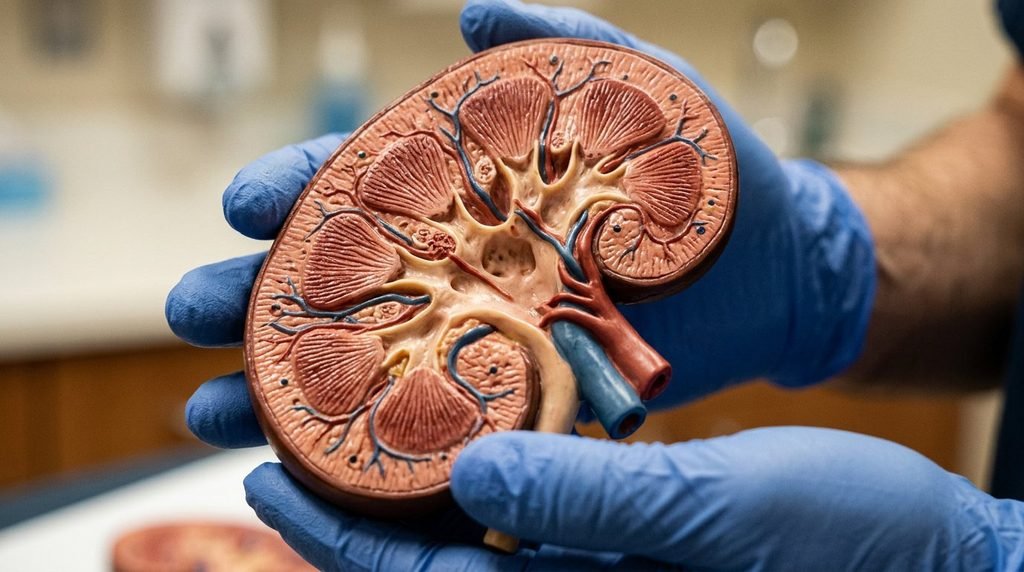
This is cousin to the creatinine bump people get when they start an ACE inhibitor or an ARB, the blood pressure pills that end in -pril or -artan. Those drugs relax the outgoing vessel of the filter. SGLT2 drugs mainly tighten the incoming vessel. Different plumbing. Same idea. A modest early rise in creatinine can be the price of long-term protection.
Here is the part most explainers get wrong. An eGFR drop after Jardiance is not proof the drug is working. Plenty of people get heart and kidney benefit with almost no early change. Do not chase a lower eGFR as a treatment goal. And do not assume a missing eGFR drop after Jardiance or Farxiga means the pill failed.
How big is the expected dip? The 4-30-12 rule
The expected dip is usually small, early, and then flat. In heart failure trials of Farxiga, the average extra drop versus placebo was about 3 mL/min/1.73 m² at two weeks. In Jardiance outcome trials, the week-4 change generally stayed within about 9 mL/min/1.73 m² and reversed when the drug was stopped. A fall over 30% is uncommon and deserves a workup, not a shrug.
I use a simple rule with patients. I call it the 4-30-12 rule for an eGFR drop after Jardiance or Farxiga.
- 4 weeks: Recheck creatinine, eGFR, and urine albumin. Expect the eGFR drop after Jardiance by then.
- 30%: A drop larger than 30% from your pre-drug eGFR is a same-week review, not a “wait and see.”
- 12 weeks: The curve should have flattened. A number that is still sliding at each draw is not an expected eGFR drop after Jardiance.
Those cutoffs are not magic. They come from the same 30% creatinine rise clinicians have tolerated for years with ACE inhibitors, plus trial data on canagliflozin (Invokana) and dapagliflozin. In CREDENCE, a drop over 10% was common. A drop over 30% was not. It happened in 4.2% of people on canagliflozin and 1.8% on placebo. After a drop of 30% or less, long-term kidney slopes on the drug still looked better than placebo.
In DAPA-HF, 38% of people on Farxiga had a greater than 10% early fall, versus 21% on placebo. A greater than 30% fall happened in 3.4% on Farxiga and 1.3% on placebo. People on Farxiga who dipped more than 10% actually had better heart outcomes than people who did not. A similar-sized drop on placebo went the other way. That is the tell. Same number, different meaning.

KDIGO, the main international kidney guideline group, said this in 2024 in plain language. The reversible eGFR decrease after starting an SGLT2 inhibitor is generally not a reason to stop. They also recommend these drugs for many adults with chronic kidney disease once eGFR is 20 or higher.
Keep this pocket version of an eGFR drop after Jardiance on your phone:
- An eGFR drop after Jardiance of about 3 to 5 points is common.
- An eGFR drop after Jardiance over 30% is not the usual pattern.
- An eGFR drop after Jardiance should flatten by week 12.
- An eGFR drop after Jardiance plus vomiting, fainting, or almost no urine is a same-day call.
- An eGFR drop after Jardiance with a falling urine albumin is often the protective pattern.
Green, yellow, red: how to read your lab
Green, yellow, and red is a faster way to read an eGFR drop after Jardiance than staring at a single flagged number. Green is a small early dip that then holds still. Yellow is a larger dip, a stacked drug change, or a number that has not flattened yet. Red is a drop over 30%, a falling trend after week 4, or any dip plus illness, fainting, or almost no urine.
Use your pre-drug eGFR as the baseline for any eGFR drop after Jardiance. Not last year’s “best” number. Not the ER value from a dehydrating stomach bug.
| Zone | What the numbers look like | What it usually means | What to do |
|---|---|---|---|
| Green | Drop of about 3 to 5 points, or under ~15%, in the first 2 to 4 weeks, then flat | Expected pressure change | Stay on the drug. Recheck by week 12. Watch urine albumin. |
| Yellow | Drop of about 15 to 30%, or a dip plus a new water pill, or no second lab yet | Still often the drug, but confirm | Repeat labs. Check blood pressure, volume, potassium. Do not stop on your own. |
| Red | Drop over 30%, a falling trend after week 4, or dip plus vomiting, dizziness, or very low urine | Not the textbook dip until proven otherwise | Same-week clinician contact. Look for another cause. |
Worked examples, because percentages feel abstract:
- Start 72, now 66. That is 8%. Green, if you feel well.
- Start 48, now 41. That is 15%. Yellow-green. Recheck. Very common on Farxiga.
- Start 36, now 24. That is 33%. Red. Same-week review.
- Start 98, now 46. That is 53%. Red. That is not the expected eGFR drop after Jardiance or Farxiga, no matter what a forum thread says.
Last March a 64-year-old patient I will call Denise came in with a portal screenshot. She was on Farxiga 10 mg, not Jardiance, but she had read a post about an eGFR drop after Jardiance and assumed the same crash was happening to her. Three weeks in, eGFR 52 to 44. She had already stopped the pill. In the same window her urine albumin fell from 612 mg/g to 240 mg/g. We restarted it. At week 10 her eGFR was 47 and albumin was 198. That is the pattern I want people to recognize. The filter number dipped. The leak got quieter. She almost threw away the drug that was doing the quiet work.
When an eGFR drop is not the expected dip
An eGFR drop is not the expected dip when it is large, late, or paired with illness. The textbook change shows up in the first month and then levels off. A crash after a stomach virus, a new ibuprofen habit, a contrast CT, or a doubled diuretic is a different problem. Treat that as possible acute kidney injury until a clinician says otherwise.
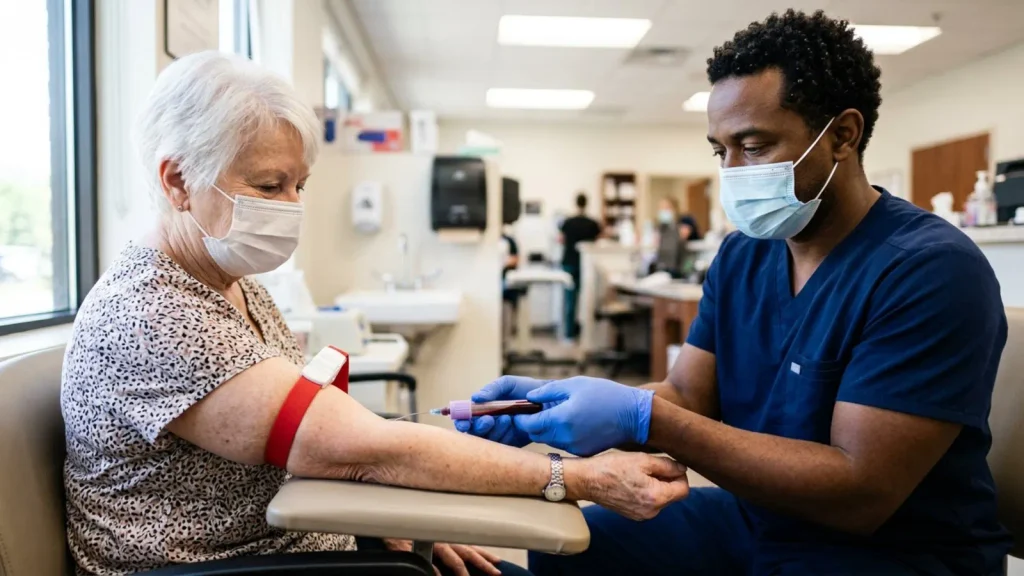
Acute kidney injury, or AKI, means a sudden real hit to kidney function. People often feel unwell. Urine output can fall. Potassium can rise. Bicarbonate can fall. The portal flag looks the same as an expected eGFR drop after Jardiance. The person does not.
Common look-alikes I see in clinic:
- Volume depletion. Too little fluid on board. Fever, vomiting, diarrhea, a heat wave, a new loop diuretic, or poor oral intake.
- NSAID stacking. Ibuprofen, naproxen, or high-dose aspirin on top of an ACE or ARB and an SGLT2 drug. That trio can choke kidney blood flow.
- Blocked urine flow. Prostate enlargement, a stone, a neurogenic bladder. The blood test falls because urine cannot leave.
- Lab artifact. A cooked-meat meal, creatine gummies, a bodybuilding week, or a different lab’s creatinine method.
- Progressive kidney disease. The underlying disease was already sliding. The new drug gets blamed for a slope that started last year.
Reddit is full of “98 to 46 after Farxiga” posts. I read those threads. Some of those people had a second problem. Some had a lab drawn during an illness. Some needed the drug held and a full workup. Do not use a forum outlier as your expected range.
If you have type 2 diabetes and you also take insulin or a sulfonylurea, a second issue can hide in the same month. These drugs pull sugar out in urine, so your other diabetes meds may need a trim to avoid lows. A low-sugar day with poor fluid intake can look like a kidney scare.
Should I stop Jardiance or Farxiga if my eGFR drops?
You should not stop Jardiance or Farxiga for a small, early, isolated eGFR drop. KDIGO says that reversible decrease is generally not a reason to discontinue. Stopping for a 3 to 5 point change throws away kidney and heart protection that took large trials to prove. Stop or hold the drug if you are acutely ill, cannot keep fluids down, or your clinician finds another cause of kidney injury.
This is where I get blunt. Most advice online is incomplete. Pharmacy blogs still tell people Jardiance is “not recommended below 30.” That was old glycemic labeling. It is not how we use the drug for kidney or heart protection in 2026.
Current U.S. practice, matching FDA labels and major guidelines:
- Jardiance (empagliflozin) for CKD or heart failure: can be started at eGFR 20 or higher. No dose change for kidney function. Continue even if eGFR later falls below 20, unless you start dialysis or cannot tolerate it.
- Farxiga (dapagliflozin) for CKD or heart failure: FDA label allows start at eGFR 25 or higher. If eGFR later falls below 25, you may continue 10 mg daily. Do not start it for the first time below 25. It is not used on dialysis.
- For blood sugar alone: Farxiga is a weak glucose drug once eGFR is under 45. Jardiance is a weak glucose drug once eGFR is under 30. Organ protection does not shut off at those lines.
ADA’s 2025 Standards of Care recommend an SGLT2 inhibitor with proven kidney benefit for people with type 2 diabetes and CKD once eGFR is 20 or higher. That is a grade A recommendation. It is not a niche nephrology trick.
Hold the drug, after talking with your clinician, if any of these are true:
- You cannot eat or drink, or you have vomiting or diarrhea.
- You are going for major surgery or a long fast. Most U.S. hospitals hold SGLT2 drugs 3 to 4 days before planned surgery because of ketoacidosis risk.
- eGFR fell more than 30% and a second cause is on the table.
- You have signs of true AKI: almost no urine, swelling with sudden weight gain, confusion, or a potassium that is suddenly high.
Do not hold it because a patient portal painted an eGFR drop after Jardiance red.
What the big trials actually showed
The big trials showed a short eGFR drop after Jardiance or Farxiga, then a slower long-term decline, plus fewer kidney-failure events. That is the whole plot. DAPA-CKD cut the risk of a 50% eGFR fall, kidney failure, or kidney or heart death by 39%. EMPA-KIDNEY cut kidney-disease progression or cardiovascular death by 28%. After the early dip, EMPA-KIDNEY cut the chronic yearly eGFR loss in half.
Those are not blog numbers. They are outcome trials.
DAPA-NEJM 2020). 4,304 adults with CKD, with or without type 2 diabetes. Mean eGFR 43. Primary result: 9.2% versus 14.5% hit the composite of a sustained 50% eGFR drop, end-stage kidney disease, or kidney or cardiovascular death. Hazard ratio 0.61. You treat 19 people for a median 2.4 years to prevent one of those events.
EMPA-KIDNEY (Jardiance 10 mg, NEJM 2023). 6,609 adults, many without diabetes, eGFR as low as 20. Primary result: 28% relative risk reduction for kidney-disease progression or cardiovascular death. Hazard ratio 0.72. Chronic eGFR slope, after month 2, went from −2.75 to −1.37 mL/min/1.73 m² per year. That is a 50% slower fade.
EMPA-REG OUTCOME (Jardiance, earlier heart trial). Kidney composite events fell about 39%. That is the paper many “Jardiance kidney” posts still quote. Useful, but EMPA-KIDNEY is the cleaner CKD trial.
2025 individual-patient meta-analysis of empagliflozin trials (The Lancet Diabetes & Endocrinology). After the early dip, chronic eGFR decline was 64% slower. Reported AKI events fell 27%. Kidney-failure risk fell 34%. Benefits looked similar whether the predicted early dip was small or large. About 1 in 4 people on empagliflozin had an observed dip over 14%, versus about 1 in 8 on placebo.
Read that again. The same drug class that causes an early eGFR dip also lowers the chance of a later acute kidney injury event. That is not how a kidney toxin behaves.
CDC estimates about 35.5 million U.S. adults have CKD, and most do not know it. Every day about 360 people start dialysis. These pills are one of the few tools that change that slope. Treating a 4-point dip like a poison report is how people lose them.
Why the FDA label still mentions kidney injury
The FDA label still mentions kidney injury because early post-marketing reports described AKI in people on SGLT2 drugs, especially older adults, people with eGFR under 60, and people on loop diuretics. Those reports were real. They were also collected before the large kidney-outcome trials finished. Trial data since then show fewer AKI events on the drugs than on placebo. The warning language lagged the evidence.
This is the gap that sends people to urgent care after an eGFR drop after Jardiance.
The current Jardiance label is honest about an eGFR drop after Jardiance. It says starting the drug raises creatinine and lowers eGFR within weeks, then the change stabilizes. In a long-term heart trial, the week-4 shift generally did not exceed 0.1 mg/dL of creatinine or 9 mL/min/1.73 m² of eGFR. It reversed after the drug was stopped. That reversal is the hemodynamic signature. Scarred kidneys do not bounce back in two weeks because you paused a pill.
So why keep the AKI language? Because volume depletion is real. Because people do get sick. Because a drug that makes you pee can tip a frail, diuretic-heavy patient into true injury if nobody adjusts the water pill. The label is a caution about context, not a claim that the expected dip equals damage.
If a clinician quotes only the warning section and ignores EMPA-KIDNEY and DAPA-CKD, they are reading half the insert.
Jardiance vs Farxiga: do the dips differ?
An eGFR drop after Jardiance and an eGFR drop after Farxiga do not differ in a way that should change your plan. Both cause a small early eGFR fall. Both then flatten the long-term slope. The practical differences are the FDA start lines and the trial populations, not the size of week-2 creatinine. Pick the drug your insurance covers and that matches your indication. Do not switch brands to “avoid the dip.”
Quick comparison you can take to a visit if you are sorting an eGFR drop after Jardiance versus Farxiga:
| Jardiance (empagliflozin) | Farxiga (dapagliflozin) | |
|---|---|---|
| Usual protective dose | 10 mg daily | 10 mg daily |
| CKD trial | EMPA-KIDNEY | DAPA-CKD |
| Lowest start eGFR in the CKD trial | 20 | 25 |
| FDA start line for CKD / HF | 20 | 25 (continue if it later falls) |
| Average early extra dip | A few mL/min; week-4 change usually within ~9 | About 3 mL/min extra vs placebo at 2 weeks in DAPA-HF |
| Glucose lowering at low eGFR | Weak below ~30 | Weak below ~45 |
| Dialysis | Not used to start; stop at kidney replacement | Contraindicated on dialysis |
Invokana (canagliflozin) belongs to the same class and taught us the 30% rule in CREDENCE. Steglatro (ertugliflozin) has weaker dedicated kidney-outcome data. If your goal is kidney protection, Jardiance or Farxiga is the usual U.S. pair.
People with stage 4 kidney disease (eGFR 15 to 29) still get considered for these drugs if they meet start criteria and a clinician is watching labs. That is a change from 2018, when many of us would not have written the prescription.
What your doctor should recheck
Your doctor should recheck a short list, not a mystery panel. Repeat creatinine and eGFR. Check urine albumin-to-creatinine ratio. Look at blood pressure, weight, potassium, and bicarbonate. Ask about vomiting, diarrhea, NSAIDs, contrast dye, and new diuretics. That set separates an expected eGFR drop after Jardiance from a real hit.
I want the urine number in the same folder as the eGFR. Albumin in urine is the leak. A falling leak with a small eGFR dip is reassuring. A rising leak with a falling eGFR is not.
A useful visit script, if you hate medical small talk:
- “My eGFR went from ___ to ___ in ___ weeks after starting ___.”
- “I feel ___ (well / dizzy / nauseated / fine except for more urine).”
- “I did / did not have vomiting, diarrhea, a new pain pill, or a CT scan.”
- “Can we check urine albumin and repeat the blood in the same lab?”
- “If this is the expected dip, what number would make you hold the drug?”
Ask for the 30% line in writing. If your start eGFR was 50, 30% down is 35. If it was 28, 30% down is about 20. People with low starting numbers have less room, so the same percentage is a smaller absolute change. That is why “a 10-point drop” is a poor rule. Ten points off 90 is noise. Ten points off 28 is a lot.
If your clinician wants to stop the drug for a 4-point eGFR drop after Jardiance and no other red flags, it is fair to ask them to look at KDIGO 2024 Practice Point 3.7.3 and the CREDENCE 30% analysis. That is not being difficult. That is matching the prescription to the evidence.
Sick days, water pills, and the stack that makes dips bigger
Sick days, water pills, and stacked blood pressure drugs make an eGFR drop after Jardiance or Farxiga bigger. These pills already make you lose some salt and water. Add a loop diuretic, a hot week, and a stomach bug, and a modest pressure change can become true volume depletion. Hold the SGLT2 drug during significant illness with poor intake. Restart it when you are eating, drinking, and stable.
U.S. diabetes and kidney groups have said this for years. The 2022 ADA/KDIGO consensus and later ADA Standards both push a sick-day plan. KDIGO’s 2026 diabetes-and-CKD draft keeps the same idea: withhold during prolonged fasting, major surgery, or critical illness. Restart once oral intake is decent.
A practical home plan:
- Keep taking it if you have a mild cold, you are eating and drinking, and you are making urine as usual.
- Hold it if you cannot keep food or fluids down, you have profuse diarrhea, or you are in a hospital for an acute illness.
- Ask about cutting the loop diuretic (furosemide, torsemide, bumetanide) when the SGLT2 drug is started, especially if your eGFR is under 45 or you already get lightheaded standing up.
- Do not add ibuprofen for the aches. Use acetaminophen unless your clinician said otherwise.
- Watch your weight. A 3 to 4 pound drop in two days plus dizziness is a volume problem, not a “good diet week.”
The other stack is ACE inhibitor or ARB plus SGLT2 plus a mineralocorticoid receptor antagonist such as finerenone or spironolactone. That trio is often good kidney care. It can also move potassium and creatinine more than any one drug alone. That is a reason for a 2 to 4 week lab check. It is not a reason to never combine them.
If you take insulin, do not stop insulin on a sick day just because you held Jardiance. That is how people land in ketoacidosis. These drugs can be linked to euglycemic DKA, a form of ketoacidosis that can happen even when the glucose number does not look very high. Nausea, belly pain, and fast breathing need an ER, not another portal message.
FAQ
Yes. An eGFR drop after Jardiance is common in the first 2 to 4 weeks. Average changes are a few milliliters per minute. The number then usually levels off. The FDA label describes an eGFR drop after Jardiance as an early creatinine rise and eGFR fall that later stabilizes and can reverse if the drug is stopped.
A drop over 30% from your pre-drug eGFR is the usual “look closer” line for an eGFR drop after Jardiance. For a start of 60, that is below 42. For a start of 40, that is below 28. A drop over 30% is uncommon in trials. It should trigger a review of volume, other drugs, obstruction, and illness, not an automatic lifelong stop.
Do not stop Farxiga on your own for a small early dip. KDIGO says that reversible decrease is generally not a reason to discontinue. Call your clinician if the drop is over 30%, you feel faint, you cannot keep fluids down, or the number is still falling after the first month.
No. A bigger dip is not a trophy. Some analyses found that people who dipped still got the long-term benefit. That is not the same as “more dip equals more protection.” You can do well with almost no early change. Do not ask your clinician to raise the dose to force a lower eGFR.
Jardiance is approved in the U.S. to lower the risk of a sustained eGFR decline, kidney failure, cardiovascular death, and hospitalization in adults with CKD at risk of progression. EMPA-KIDNEY showed a 28% relative reduction in kidney-disease progression or cardiovascular death. True AKI can still happen if you get very dry or very sick. That is why sick-day rules exist.
A fall that large is outside the expected hemodynamic range. In DAPA-HF, a greater than 30% early drop happened in only 3.4% of people on dapagliflozin. A 50% crash needs a workup: repeat labs, urine studies, medication review, and a look for illness or blockage. Do not accept “that’s just Farxiga” as the whole answer.
An eGFR drop after Jardiance appears within days to 4 weeks. It often eases a little over the next 1 to 2 months, then the long-term slope takes over. If you stop the drug, eGFR often rises back toward the old baseline within a few weeks. That rebound is why an eGFR drop after Jardiance is called hemodynamic.
Not automatically. An eGFR drop after Jardiance to below 20 is not, by itself, a stop rule. KDIGO says it is reasonable to continue an SGLT2 inhibitor even if eGFR later falls below 20, unless you cannot tolerate it or you start dialysis or a transplant. The start line and the stop line are different numbers. Ask your nephrologist before anyone cancels the refill.
Often, yes. Lower filter pressure usually means less albumin leaking into urine. A falling urine albumin-to-creatinine ratio next to a small eGFR drop after Jardiance is one of the more reassuring pairings I see. Recheck both. Do not judge the drug on eGFR alone.
The mechanism is the same. EMPA-KIDNEY and DAPA-CKD both enrolled large groups without type 2 diabetes and still showed kidney protection. The 2025 empagliflozin meta-analysis found kidney benefits whether or not diabetes was present. The dip can still happen. The long-term slope still usually flattens.
References
- Centers for Disease Control and Prevention. Chronic Kidney Disease Basics. Updated May 15, 2024. https://www.cdc.gov/kidney-disease/about/index.html
- Kidney Disease: Improving Global Outcomes (KDIGO) CKD Work Group. KDIGO 2024 Clinical Practice Guideline for the Evaluation and Management of Chronic Kidney Disease. Kidney International. 2024;105(4S):S117-S314. https://kdigo.org/guidelines/ckd-evaluation-and-management/
- American Diabetes Association Professional Practice Committee. 11. Chronic Kidney Disease and Risk Management: Standards of Care in Diabetes, 2025. Diabetes Care. 2025;48(Supplement_1):S239-S251. https://doi.org/10.2337/dc25-S011
- Heerspink HJL, Stefánsson BV, Correa-Rotter R, et al. Dapagliflozin in Patients with Chronic Kidney Disease. New England Journal of Medicine. 2020;383:1436-1446. https://www.nejm.org/doi/full/10.1056/NEJMoa2024816
- The EMPA-KIDNEY Collaborative Group; Herrington WG, Staplin N, Wanner C, et al. Empagliflozin in Patients with Chronic Kidney Disease. New England Journal of Medicine. 2023;388:117-127. https://www.nejm.org/doi/full/10.1056/NEJMoa2204233
- EMPA-KIDNEY Collaborative Group. Effects of empagliflozin on progression of chronic kidney disease: a prespecified secondary analysis from the EMPA-KIDNEY trial. The Lancet Diabetes & Endocrinology. 2024. https://www.thelancet.com/journals/landia/article/PIIS2213-8587(23)00321-2/fulltext
- Herrington WG, et al. Effects of empagliflozin on conventional and exploratory acute and chronic kidney outcomes: an individual participant-level meta-analysis. The Lancet Diabetes & Endocrinology. 2025. https://www.thelancet.com/journals/landia/article/PIIS2213-8587(25)00222-0/fulltext
- Adamson C, Docherty KF, Heerspink HJL, et al. Initial Decline (Dip) in Estimated Glomerular Filtration Rate After Initiation of Dapagliflozin in Patients With Heart Failure and Reduced Ejection Fraction: Insights From DAPA-HF. Circulation. 2022;146:438-454. https://www.ahajournals.org/doi/10.1161/CIRCULATIONAHA.121.058910
- Oshima M, Jardine MJ, Agarwal R, et al. Insights from CREDENCE trial indicate an acute drop in estimated glomerular filtration rate during treatment with canagliflozin with implications for clinical practice. Kidney International. 2021;99(4):999-1009. https://www.kidney-international.org/article/S0085-2538(20)31413-7/fulltext
- U.S. Food and Drug Administration. JARDIANCE (empagliflozin) tablets, for oral use. Prescribing information. 2025. https://www.accessdata.fda.gov/drugsatfda_docs/label/2025/204629s063lbl.pdf
- U.S. Food and Drug Administration. FARXIGA (dapagliflozin) tablets, for oral use. Prescribing information. https://www.accessdata.fda.gov/drugsatfda_docs/label/2023/202293s026lbl.pdf
- de Boer IH, Khunti K, Sadusky T, et al. Diabetes Management in Chronic Kidney Disease: A Consensus Report by the American Diabetes Association (ADA) and Kidney Disease: Improving Global Outcomes (KDIGO). Diabetes Care. 2022;45(12):3075-3090. https://diabetesjournals.org/care/article/45/12/3075/147614
- Wanner C, Inzucchi SE, Lachin JM, et al. Empagliflozin and Progression of Kidney Disease in Type 2 Diabetes. New England Journal of Medicine. 2016;375:323-334. https://www.nejm.org/doi/full/10.1056/NEJMoa1515920
- National Kidney Foundation KDOQI. KDOQI US Commentary on the KDIGO 2024 Clinical Practice Guideline for the Evaluation and Management of CKD. American Journal of Kidney Diseases. 2025. https://www.ajkd.org/article/S0272-6386(24)00977-6/fulltext
About the author. Dr. Adam N. Khan, M.D., is a licensed physician and the medical reviewer for MedLifeGuide. He trained at King Edward Medical University and completed residency in internal medicine. He writes for patients who are trying to read their own labs without walking into a decision they will regret. Full author page · <span rel=”author”>Adam N. Khan, M.D.</span>
Educational content only. Jardiance is a registered trademark of Boehringer Ingelheim and Eli Lilly. Farxiga is a registered trademark of AstraZeneca. This page has no affiliate relationship with the manufacturers.