
Medically Reviewed and Compiled by Dr. Adam N. Khan, MD
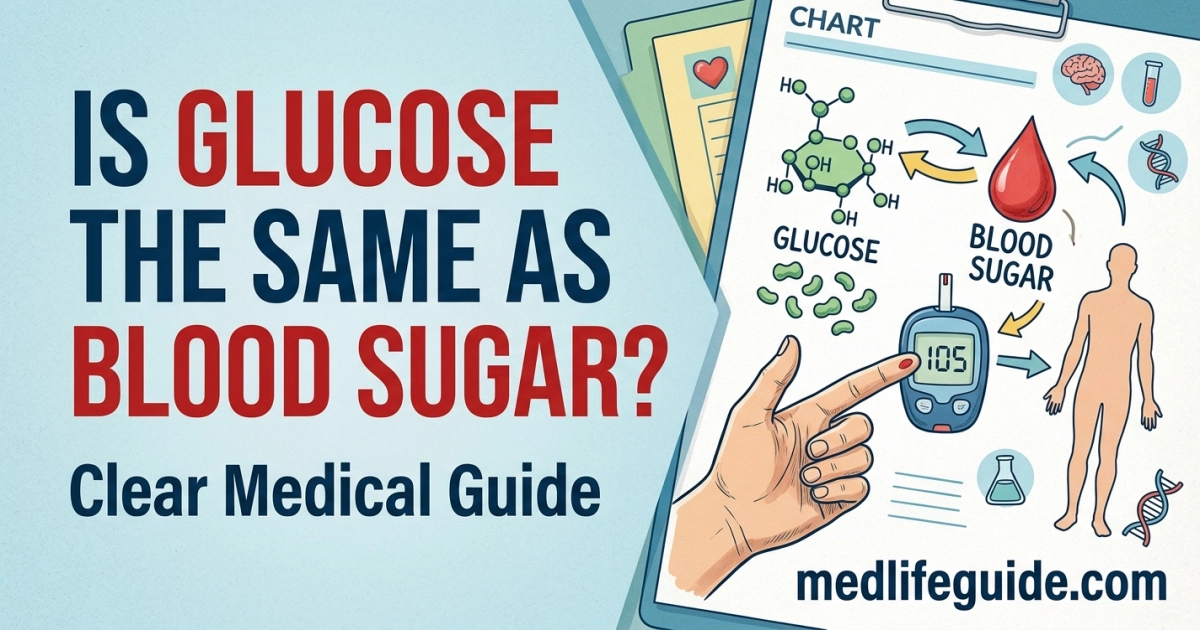
- Direct Answer: Yes, “blood sugar” and “glucose” refer to the exact same molecule ($C_6H_{12}O_6$) when discussing human health and diagnostic lab work.
- Functional Difference: Glucose is the pure chemical compound, while blood sugar is the everyday term describing glucose circulating through your bloodstream.
- Clinical Role: Glucose serves as your body’s primary energy source, and precise regulation by insulin is essential to prevent microvascular and macrovascular complications.
EMERGENCY WARNING: If you or someone in your care experiences confusion, severe dizziness, extreme weakness, fruity-smelling breath, rapid shallow breathing, persistent vomiting, or loss of consciousness, call 911 or visit the nearest emergency room immediately. These are potential warning signs of severe hypoglycemia or Diabetic Ketoacidosis (DKA), both of which are life-threatening medical emergencies.
1. Medical Overview and Pathophysiology
When patients ask if glucose is the same as blood sugar, the simplest clinical answer is yes. From a chemical perspective, glucose is a simple sugar—a monosaccharide with the molecular formula $C_6H_{12}O_6$. In a medical context, when healthcare providers discuss “blood sugar,” they are referring to the concentration of glucose dissolved in the blood plasma [1].
How Your Body Uses Glucose
Every cell in your body requires energy to function. Glucose is the primary fuel source for your central nervous system, red blood cells, and skeletal muscles [2].
- Ingestion and Digestion: When you eat carbohydrates (like bread, rice, fruit, or vegetables), your digestive system breaks them down into individual monosaccharides, primarily glucose.
- Absorption: Glucose passes through the lining of the small intestine into the bloodstream.
- Pancreatic Response: As blood glucose levels rise, specialized beta cells in the pancreas release the hormone insulin [3].
- Cellular Uptake: Insulin acts like a key, unlocking cellular receptors so glucose can enter cells to be converted into adenosine triphosphate (ATP), the primary energy currency of the body.
- Storage: Excess glucose is stored in the liver and muscle tissue as glycogen. When glycogen stores are full, excess energy is converted into fatty acids and stored in adipose tissue.
[Carbohydrates Ingested]
       ↓
[Digestion in Small Intestine]
       ↓
[Glucose enters Bloodstream] → (Triggers Pancreas to release Insulin)
       ↓
[Insulin Opens Cell Receptors]
       ↓
  ┌────┴─────────────────────────────┐
  ↓                                  ↓
[Used immediately for Energy]   [Stored as Glycogen in Liver/Muscles]
The Mechanism of Dysregulation
When the body cannot regulate glucose effectively, blood sugar levels move outside normal reference ranges:
- Insulin Resistance: Cells become less responsive to insulin. The pancreas initially produces extra insulin to compensate, but over time, beta-cell fatigue occurs, leading to elevated blood glucose levels (Prediabetes and Type 2 Diabetes) [3].
- Autoimmune Beta-Cell Destruction: The immune system mistakenly attacks pancreatic beta cells, preventing insulin production entirely (Type 1 Diabetes) [4].
- Hypoglycemia: Blood glucose drops below normal thresholds ($< 70\text{ mg/dL}$), depriving brain cells of necessary energy.
2. Symptom Breakdown and Diagnostic Comparison Table
Disruptions in glucose balance produce distinct symptoms depending on whether levels are too high or too low.
| Clinical Parameter | Hypoglycemia (Low Blood Sugar) | Normal Glucose Range | Hyperglycemia (High Blood Sugar) |
| Blood Glucose Levels | $< 70\text{ mg/dL}$ ($< 3.9\text{ mmol/L}$) | Fasting: $70\text{–}99\text{ mg/dL}$ Post-Meal: $< 140\text{ mg/dL}$ | Fasting: $\ge 126\text{ mg/dL}$ Post-Meal: $\ge 200\text{ mg/dL}$ |
| Onset Speed | Rapid (minutes to hours) | N/A (Homeostatic state) | Gradual (days to weeks) |
| Primary Symptoms | Tremors, sweating, fast heart rate, irritability, anxiety, hunger [5] | Energetic, alert, symptom-free | Frequent urination, extreme thirst, fatigue, blurred vision [1] |
| Neurological Symptoms | Dizziness, headache, confusion, slurred speech, seizures | Normal cognitive function | Brain fog, lethargy, headache |
| Urinary / Fluid Balance | Normal urine output | Normal hydration | Excessive urination (polyuria), unquenchable thirst (polydipsia) |
| Primary Physiological Cause | Excess insulin, skipped meals, intense exertion | Balanced insulin-glucagon axis | Insulin resistance, absolute insulin deficiency, stress |
3. Unique Clinical Takeaways
Beyond standard diagnostic lists, three distinct clinical factors significantly impact blood sugar monitoring and interpretation:
1. The “Dawn Phenomenon” vs. The “Somogyi Effect”
If you wake up with elevated fasting glucose, two distinct mechanisms may be responsible:
- Dawn Phenomenon: A natural surge in early-morning hormones (growth hormone, cortisol, glucagon) causes the liver to release stored glucose between 3:00 AM and 8:00 AM.
- Somogyi Effect: Rebound hyperglycemia triggered by overnight hypoglycemia. If blood sugar drops dangerously low around 2:00 AM or 3:00 AM, the body releases stress hormones to rescue blood sugar, causing a sharp spike by morning [3].
- Clinical Takeaway: Testing blood glucose at 3:00 AM for three consecutive nights helps differentiate between the two, altering whether evening medication should be increased or decreased.
2. Atypical Hypoglycemic Unawareness in Chronic Highs
Patients who maintain chronically elevated blood glucose ($> 200\text{ mg/dL}$) may experience “relative hypoglycemia” symptoms—such as shaking, sweating, and heart palpitations—when their blood glucose drops into a normal range ($90\text{–}100\text{ mg/dL}$). Conversely, individuals with frequent low blood sugar can lose autonomic warning signals altogether, leading to dangerous hypoglycemic unawareness [5].
3. Hematocrit Interferences in Capillary Glucose Testing
Point-of-care finger-stick glucose meters measure glucose in whole blood, which can be altered by hematocrit (red blood cell count) levels. Low hematocrit (severe anemia) can cause falsely high finger-stick readings, while high hematocrit (dehydration or polycythemia) can result in falsely low readings [2].
4. Stage-by-Stage Illness Progression Timeline
When glucose regulation fails and remains unmanaged, metabolic disease typically progresses through recognizable stages:
Stage 1: Insulin Resistance (Subclinical)
- Timeframe: Months to Years.
- Mechanism: Pancreatic beta cells overproduce insulin to keep blood sugar normal despite cellular resistance.
- Symptoms: Minimal to none. Occasional post-meal fatigue or skin tags (acanthosis nigricans).
Stage 2: Prediabetes
- Timeframe: 1 to 5 Years without intervention.
- Mechanism: Pancreatic output can no longer keep up with rising cellular resistance. Fasting glucose reaches $100\text{–}125\text{ mg/dL}$.
- Symptoms: Mild fatigue, slow wound healing, slight increase in thirst.
Stage 3: Overt Type 2 Diabetes
- Timeframe: Diagnosis stage.
- Mechanism: Significant beta-cell dysfunction. Fasting glucose exceeds $126\text{ mg/dL}$, or HbA1c reaches $\ge 6.5\%$ [1].
- Symptoms: Frequent urination, persistent thirst, unexplained weight loss, blurred vision, recurrent infections.
Stage 4: Microvascular and Macrovascular Complications
- Timeframe: 5 to 15+ Years of unmanaged hyperglycemia.
- Mechanism: Persistent high glucose damages small blood vessels (microvascular) and large arteries (macrovascular) through oxidative stress and glycation [4].
- Symptoms: Diabetic neuropathy (tingling/numbness in feet), nephropathy (kidney function decline), retinopathy (vision damage), and elevated cardiovascular risk.
5. High-Risk Vulnerabilities and Special Populations
Blood glucose abnormalities present uniquely across different patient groups:
- Older Adults (Pediatric / Elderly): Seniors often present with atypical signs of high blood sugar. Rather than classic thirst or frequent urination, they may display acute confusion, delirium, balance issues, or urinary incontinence [1]. Elderly patients are also at heightened risk for Hyperosmolar Hyperglycemic State (HHS), a severe condition characterized by extreme dehydration and blood glucose exceeding $600\text{ mg/dL}$.
- Pediatric Patients: Children with new-onset Type 1 Diabetes frequently present with nocturnal enuresis (bedwetting in a previously toilet-trained child), irritability, and rapid, heavy breathing. Children are especially vulnerable to rapid progression into Diabetic Ketoacidosis (DKA) [4].
- Immunocompromised Individuals: High blood glucose impairs neutrophil function and weakens immune defense. Individuals taking immunosuppressive medications or systemic corticosteroids often experience sharp, temporary glucose spikes that require short-term insulin adjustment.
6. Evidence-Based Diagnostic, Testing, and Medical Management Guidelines
Diagnosing and monitoring glucose dysregulation requires specific standardized clinical testing protocols [1]:
Key Diagnostic Tests
   Fasting Plasma Glucose (FPG)         Hemoglobin A1c (HbA1c)
   ┌──────────────────────────┐         ┌──────────────────────┐
   │ Normal:    <100 mg/dL    │         │ Normal:    <5.7%     │
   │ Prediabetes: 100-125 mg/dL│         │ Prediabetes: 5.7%-6.4%│
   │ Diabetes:   ≥126 mg/dL   │         │ Diabetes:  ≥6.5%     │
   └──────────────────────────┘         └──────────────────────┘
- Fasting Plasma Glucose (FPG): Measures blood glucose after an 8-hour fast. Normal: $< 100\text{ mg/dL}$; Prediabetes: $100\text{–}125\text{ mg/dL}$; Diabetes: $\ge 126\text{ mg/dL}$.
- Hemoglobin A1c (HbA1c): Reflects average blood sugar levels over the past 2 to 3 months by measuring the percentage of glycated hemoglobin [2]. Normal: $< 5.7\%$; Prediabetes: $5.7\%\text{–}6.4\%$; Diabetes: $\ge 6.5\%$.
- Oral Glucose Tolerance Test (OGTT): Measures glucose levels 2 hours after consuming a standardized $75\text{-gram}$ glucose drink. Normal: $< 140\text{ mg/dL}$; Diabetes: $\ge 200\text{ mg/dL}$.
Medical Management Framework
Management depends on the type and severity of glucose dysregulation:
- Lifestyle Interventions: Dietary modification focusing on low-glycemic index foods, daily physical movement, and weight management serve as first-line therapy for prediabetes and early Type 2 Diabetes [3].
- Oral Medications: Biguanides (e.g., Metformin) lower hepatic glucose production and improve insulin sensitivity. Other classes include SGLT2 inhibitors and DPP-4 inhibitors [1].
- Insulin Therapy: Required for all Type 1 Diabetes patients and advanced Type 2 Diabetes when oral agents no longer maintain target HbA1c levels.
7. Home Care, Protection Protocols, and Recovery
Managing blood glucose effectively requires routine daily monitoring and structured self-care habits.
Blood Glucose Monitoring
- Continuous Glucose Monitors (CGM): Sensor filaments inserted under the skin measure interstitial fluid glucose in real time, providing trend arrows and threshold alerts.
- Self-Monitoring of Blood Glucose (SMBG): Traditional capillary finger-stick monitoring. Always wash hands with warm water and soap rather than alcohol wipes, as leftover alcohol or sugars on fingers can alter test accuracy.
Emergency Rule of 15 for Mild Hypoglycemia
If blood sugar drops between $55\text{–}69\text{ mg/dL}$, follow these steps [5]:
- Consume 15 grams of fast-acting carbohydrates (e.g., 4 ounces of fruit juice, 3–4 glucose tablets, or 1 tablespoon of honey).
- Wait 15 minutes and recheck blood glucose.
- Repeat if blood glucose remains under $70\text{ mg/dL}$.
- Once normalized, eat a small meal containing protein and complex carbohydrates to stabilize levels.
Frequently Asked Questions (FAQs)
No. In medical science, blood sugar refers specifically to glucose circulating in your bloodstream; they are physically and chemically identical.
A normal fasting blood sugar level for an adult without diabetes after an 8-hour fast is between $70\text{ and }99\text{ mg/dL}$.
Healthcare providers use “glucose” because it is the precise scientific term for the specific carbohydrate molecule measured in clinical laboratory equipment.
Yes. Physical or emotional stress causes your body to release hormones like cortisol and adrenaline, which signal the liver to release extra glucose into the blood.
Carbohydrates are broken down during digestion directly into glucose, causing a temporary rise in blood sugar levels that triggers insulin release.
Medical Reviewer Profile
Dr. Adam N. Khan, MD
Board-Certified Internal Medicine Specialist
Dr. Adam N. Khan is a practicing physician specializing in metabolic health, endocrinology support, and internal medicine. He maintains zero commercial conflicts of interest and operates strictly as an independent medical reviewer dedicated to accessible patient education.