
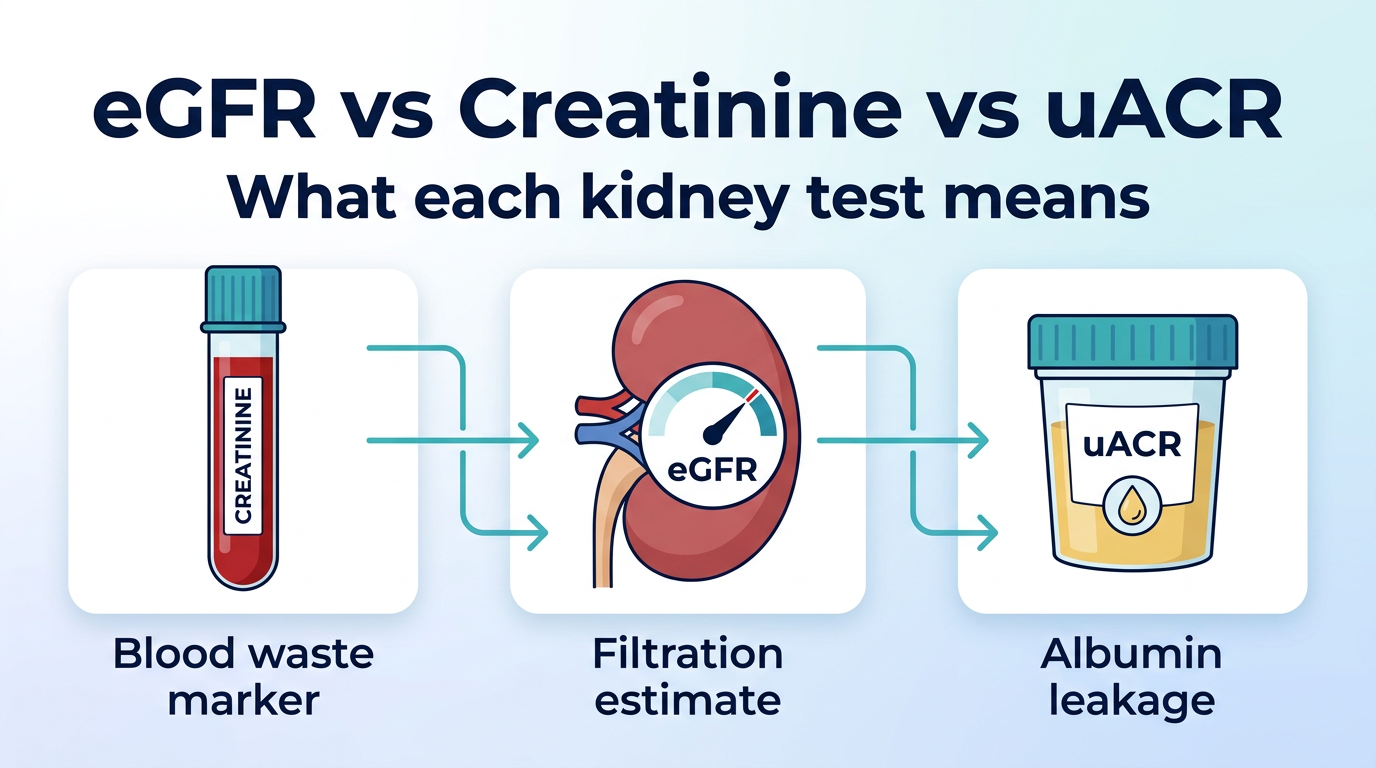
Creatinine, eGFR and uACR provide different but connected information about kidney health. Serum creatinine is a waste product measured in blood. It is used in an equation to estimate glomerular filtration rate, or eGFR. The uACR is a urine test that checks whether albumin is leaking through the kidney filters. In simple terms, eGFR estimates filtration while uACR looks for kidney damage. Both are generally needed because one can be abnormal while the other appears normal.
Quick answer: A normal creatinine does not always rule out kidney disease, and a normal eGFR does not rule out albumin leakage. For a clearer picture, clinicians interpret creatinine-based eGFR and uACR together, review their trends and confirm unexpected abnormalities.
eGFR vs creatinine vs uACR at a glance
| Test | Sample | What it measures | How to read it generally | Main limitation |
|---|---|---|---|---|
| Serum creatinine | Blood | Concentration of a waste product affected by filtration and muscle-related factors | A higher value often but not always suggests lower filtration | Varies with muscle mass, diet, supplements, medicines and acute illness |
| eGFR | Calculated from blood creatinine, age and sex; sometimes cystatin C | Estimated rate at which the kidneys filter blood | Higher is generally better; persistent values below 60 may indicate CKD | It is an estimate and is less reliable when creatinine is changing quickly or is atypical for the person |
| uACR | Urine | Ratio of urine albumin to urine creatinine | Lower is generally better; persistent results of 30 mg/g or more may indicate kidney damage | Can rise temporarily with exercise, infection, bleeding, marked blood-pressure or glucose changes and other factors |
None of these tests reveals the exact cause of an abnormal result. Diagnosis may also require urinalysis, blood pressure, imaging, medication review, medical history or more specialized testing.
What is serum creatinine?
Creatinine is a waste product formed largely through normal muscle metabolism. The kidneys remove it from the blood. A laboratory measures its concentration in a blood sample, usually in mg/dL or µmol/L.
When filtration falls, serum creatinine often rises. But the relationship is not simple enough to interpret one creatinine number in isolation. Two people with the same kidney filtration can have different creatinine levels because creatinine production differs.
Factors that can affect serum creatinine include:
- Muscle mass and body size
- Age and sex
- Frailty, malnutrition or limb amputation
- Bodybuilding or recent strenuous exercise
- Recent cooked meat intake
- Creatine supplements
- Muscle injury
- Some medicines that change creatinine handling
- Rapidly changing kidney function
- Laboratory method and normal range
This is why clinicians usually prefer a validated eGFR equation over serum creatinine alone.
What is a normal creatinine level?
There is no single universal normal value. Reference ranges vary by laboratory, sex, age, muscle mass and measurement method. A creatinine value within the printed laboratory range can still be misleading in someone with very low muscle mass, while a muscular person may have a higher value without the same reduction in filtration.
The result is best interpreted with eGFR, previous creatinine measurements and the clinical context.
Related reading: How to Lower Creatinine Levels and Protect Your Kidneys.
What is eGFR?
Estimated glomerular filtration rate (eGFR) is a calculated estimate of how effectively the kidney filters are clearing substances from the blood. In adults, laboratories commonly calculate eGFR using serum creatinine, age and sex. Current recommended equations avoid using race.
The result is usually reported in mL/min/1.73 m². The body-surface-area adjustment helps standardize results between people, although individualized decisions such as certain medication doses may require additional consideration.
eGFR categories
| GFR category | eGFR, mL/min/1.73 m² | Description |
|---|---|---|
| G1 | 90 or higher | Normal or high* |
| G2 | 60–89 | Mildly decreased* |
| G3a | 45–59 | Mildly to moderately decreased |
| G3b | 30–44 | Moderately to severely decreased |
| G4 | 15–29 | Severely decreased |
| G5 | Below 15 | Kidney-failure range |
*G1 or G2 alone does not establish chronic kidney disease without another marker of kidney damage, such as persistent albuminuria, urine abnormalities, imaging findings or a known structural disorder.
A persistent eGFR below 60 for at least three months can meet a criterion for CKD. A single low result may instead reflect acute illness, dehydration, medication effects, urinary obstruction, acute kidney injury or expected test variation. It should be evaluated and repeated according to the clinical situation.
Read more: Why Did My eGFR Drop Suddenly? and Chronic Kidney Disease Stages.
What is uACR?
Urine albumin-to-creatinine ratio (uACR) compares albumin with creatinine in a spot urine sample.
- Albumin is a blood protein that healthy kidney filters largely keep in the bloodstream.
- Urine creatinine helps account for how diluted or concentrated the urine sample is.
This is different from serum creatinine. In eGFR, blood creatinine acts as a filtration marker. In uACR, urine creatinine is the denominator used to standardize urine albumin concentration.
uACR categories
| Albuminuria category | uACR, mg/g | uACR, mg/mmol | Description |
|---|---|---|---|
| A1 | Below 30 | Below 3 | Normal to mildly increased |
| A2 | 30–299 | 3–29 | Moderately increased |
| A3 | 300 or higher | 30 or higher | Severely increased |
Persistent uACR of 30 mg/g or more can be a marker of kidney damage even when eGFR is 60 or higher. An unexpected abnormal result usually needs confirmation, preferably with a first-morning midstream sample when practical.
Temporary influences can include intense exercise, fever, urinary infection, urinary or menstrual bleeding, dehydration, a heart-failure flare and sudden marked increases in blood pressure or glucose.
For detailed interpretation, see uACR Test Results Explained.
Why eGFR and uACR are both needed
The kidney filters can become abnormally leaky before overall filtration falls. Conversely, filtration can decline without much albumin appearing in the urine. Testing only one marker may therefore miss clinically important information.
The KDIGO 2024 CKD guideline recommends assessing people at risk for or living with CKD using both urine albumin measurement and GFR assessment.
Think of the tests this way:
- Creatinine: the raw blood marker used in the calculation.
- eGFR: an estimate of how much blood is being filtered.
- uACR: an estimate of how much albumin is leaking into urine.
Together, eGFR and uACR help clinicians classify CKD, estimate kidney and cardiovascular risk, select treatments and determine monitoring frequency.
What if the results do not match?
Discordant results are common and do not automatically mean the laboratory made an error.
Normal eGFR but high uACR
This pattern may represent kidney damage with preserved filtration. It is often seen early in diabetes-related or blood-pressure-related kidney disease, but it can have other causes.
For example:
- eGFR: 92 mL/min/1.73 m²
- uACR: 85 mg/g
The eGFR is in G1, while the uACR is in A2. If albuminuria persists for at least three months, the person may meet a CKD criterion despite having an eGFR above 90.
The next step is usually to confirm albuminuria and assess its cause—not to dismiss the urine result because creatinine is “normal.”
Low eGFR but normal uACR
This pattern can occur in CKD without albuminuria, acute kidney injury, age-related changes, vascular or tubulointerstitial kidney disorders, urinary obstruction or when creatinine-based eGFR is inaccurate for the individual.
For example:
- eGFR: 48 mL/min/1.73 m²
- uACR: 12 mg/g
The filtration estimate is G3a, while albuminuria is A1. If the low eGFR persists for at least three months, it can still meet a CKD criterion even without high uACR.
A clinician may review previous results, medicines, blood pressure, urinalysis and imaging, and may consider cystatin C when greater precision is needed.
Low eGFR and high uACR
This combination generally signals higher risk than either abnormality alone.
For example:
- eGFR: 38 mL/min/1.73 m²
- uACR: 420 mg/g
This corresponds to G3b and A3. It warrants timely evaluation, risk assessment and an individualized treatment and monitoring plan. The values alone still do not identify the cause.
Normal eGFR and normal uACR
This is generally reassuring, but it cannot rule out every kidney disorder. Blood in the urine, inherited disease, recurrent stones, structural abnormalities or other findings may still require assessment.
Four common result combinations
| eGFR | uACR | What the combination may suggest | Usual next discussion |
|---|---|---|---|
| Normal/high | Below 30 mg/g | Lowest category based on these two markers | Repeat according to risk and clinical advice |
| Normal/high | 30 mg/g or higher | Possible kidney damage despite preserved filtration | Confirm uACR and assess cause |
| Below 60 | Below 30 mg/g | Reduced filtration without significant albuminuria | Confirm chronicity; review accuracy and cause |
| Below 60 | 30 mg/g or higher | Reduced filtration plus albumin leakage | Timely CKD risk and treatment assessment |
The CKD risk grid uses the exact G and A categories—not merely “normal” or “abnormal.” Risk generally rises as eGFR falls and uACR rises.
Is eGFR more important than creatinine?
For estimating kidney filtration, eGFR is generally more informative than creatinine alone because the equation accounts for age and sex. A creatinine of 1.2 mg/dL can imply different filtration in people of different ages and sexes.
However, eGFR is still derived from creatinine and inherits some of its limitations. Clinicians often examine both:
- The actual creatinine change can help identify a rapidly evolving problem.
- The eGFR makes the filtration estimate easier to classify and trend.
- The clinical picture determines whether the estimate is dependable.
In acute illness, rapidly changing creatinine means the assumptions behind a steady-state eGFR calculation are not met. Clinicians do not use the reported eGFR in isolation to diagnose or stage an acute kidney injury.
Is uACR more important than eGFR?
Neither test replaces the other.
- eGFR helps assess filtration and CKD G category.
- uACR helps assess albumin leakage and A category.
- Their combination provides stronger risk information than either alone.
A uACR can reveal early kidney damage when eGFR is preserved. An eGFR can reveal reduced filtration when uACR is normal. The “most important” result depends on the question being asked and the person’s condition.
What is cystatin C, and when might it help?
Cystatin C is another blood filtration marker. It is less directly affected by muscle mass than creatinine, although it has its own non-kidney influences.
KDIGO recommends considering an eGFR equation that combines creatinine and cystatin C when creatinine-based eGFR may be less accurate and the result will affect an important clinical decision. Examples may include:
- Very low or very high muscle mass
- Frailty or malnutrition
- Limb amputation
- A value close to a medication-dosing or treatment threshold
- Uncertainty about whether CKD is present
- A major mismatch between the laboratory estimate and clinical picture
The combined result is often reported as eGFRcr-cys. Cystatin C is not a replacement for uACR; it refines filtration estimation, while uACR evaluates albumin leakage.
eGFR is not the same as creatinine clearance
These terms are sometimes confused:
- eGFR estimates glomerular filtration using a validated equation and is usually standardized to 1.73 m² body surface area.
- Estimated creatinine clearance (eCrCl) is often calculated with the Cockcroft–Gault equation and may appear in medication-dosing guidance.
- Measured creatinine clearance uses blood creatinine and a timed urine collection, often over 24 hours, but collection errors can reduce accuracy.
- Measured GFR uses an external filtration marker and is more precise but less convenient.
Do not interchange these values when making your own medication decisions. The prescriber and pharmacist should use the method required for the specific drug and clinical situation.
How to prepare for kidney blood and urine tests
Follow the instructions from the laboratory and ordering clinician.
Before a creatinine/eGFR blood test
Ask whether you should:
- Avoid strenuous exercise beforehand
- Avoid cooked meat for a specified period
- Report creatine or protein supplements
- Follow normal hydration rather than overdrinking
- Take medicines as usual
Never stop a prescription unless the prescriber tells you to do so.
Before a uACR urine test
A first-morning midstream sample may be preferred, particularly for confirmation. Tell the clinician if you have:
- Fever or infection
- UTI symptoms
- Menstrual or urinary bleeding
- Recent vigorous exercise
- A heart-failure flare
- A sudden major change in blood pressure or glucose
These factors may affect interpretation or the timing of repeat testing.
When should abnormal results be repeated?
The timing depends on severity and context.
- A large, rapid eGFR decline or symptoms of acute illness may require repeat testing within hours or days.
- An incidentally high uACR should generally be confirmed, often with a first-morning sample.
- To establish CKD, abnormal kidney structure or function generally must persist for at least three months.
Clinicians do not wait three months to investigate a potentially urgent decline. Chronicity is a diagnostic criterion, not a reason to delay care.
Who should discuss kidney testing with a clinician?
Testing is especially relevant for people with risk factors such as:
- Diabetes
- High blood pressure
- Cardiovascular disease or heart failure
- Previous acute kidney injury
- Family history of kidney disease or kidney failure
- Older age
- Obesity or tobacco exposure
- Recurrent stones or urinary obstruction
- Autoimmune or inherited conditions
- Long-term exposure to medicines that may affect the kidneys
Testing schedules should be individualized. People with established CKD generally need periodic eGFR and albuminuria assessment, with frequency based on risk and whether the result will change care.
Questions to ask about your kidney results
- What are my serum creatinine, eGFR and uACR values?
- How do they compare with my previous results?
- What are my GFR and albuminuria categories?
- Does one result need confirmation?
- Have the abnormalities persisted for at least three months?
- Could illness, dehydration, exercise, diet, muscle mass or medicine affect the result?
- Would cystatin C improve the accuracy of my eGFR?
- Do I need urinalysis, imaging or another test to identify the cause?
- How often should eGFR and uACR be repeated?
- Does this change my medicine doses or treatment plan?
- Which symptoms should lead me to seek urgent care?
Frequently asked questions
Yes. A creatinine value can fall within the laboratory’s reference range while the calculated eGFR is lower than expected for a person’s age and sex. The eGFR equation provides context that creatinine alone does not.
Yes. Albumin leakage can occur before filtration declines. Persistent uACR of 30 mg/g or higher may indicate kidney damage even when eGFR is above 60.
Yes. Not every cause of reduced filtration produces substantial albuminuria. The low eGFR still needs confirmation and evaluation.
Not by itself. Urine creatinine varies with urine concentration and creatinine production. In uACR, it is used to standardize albumin. Focus on the reported albumin-to-creatinine ratio and ask the clinician about any separately flagged result.
No. A dipstick is usually semi-quantitative and may miss lower levels of albumin. A laboratory uACR provides a numerical ratio and is preferred for detecting and monitoring albuminuria. A positive dipstick may need confirmation with uACR or another quantitative test.
There is no universal single earliest test. uACR may detect albumin leakage before eGFR declines in common glomerular diseases, while some conditions reduce eGFR without increasing uACR. Both tests and sometimes urinalysis, imaging or genetic evaluation may be necessary.
The bottom line
Creatinine is the blood marker commonly used to calculate eGFR. eGFR estimates kidney filtration, while uACR checks for albumin leakage and kidney damage. A normal result in one test does not guarantee that the other will be normal. The clearest assessment comes from interpreting eGFR and uACR together, confirming unexpected findings and reviewing their trend with a qualified healthcare professional.
Editorial note
This article is for general education and does not diagnose kidney disease or provide individualized medical treatment. Laboratory ranges and interpretation vary by age, pregnancy status, muscle mass, acute illness, medicines and testing method. Seek prompt care for very low urine output, severe breathlessness, confusion, rapidly increasing swelling, persistent vomiting, or other acute symptoms.
Medical references
- Kidney Disease: Improving Global Outcomes (KDIGO). Executive Summary of the 2024 Clinical Practice Guideline for the Evaluation and Management of Chronic Kidney Disease.
- National Kidney Foundation. Know Your Kidney Numbers: eGFR and uACR.
- National Kidney Foundation. Chronic Kidney Disease.
- National Institute of Diabetes and Digestive and Kidney Diseases. Estimate Glomerular Filtration Rate.
- National Institute of Diabetes and Digestive and Kidney Diseases. Assess Urine Albumin.