
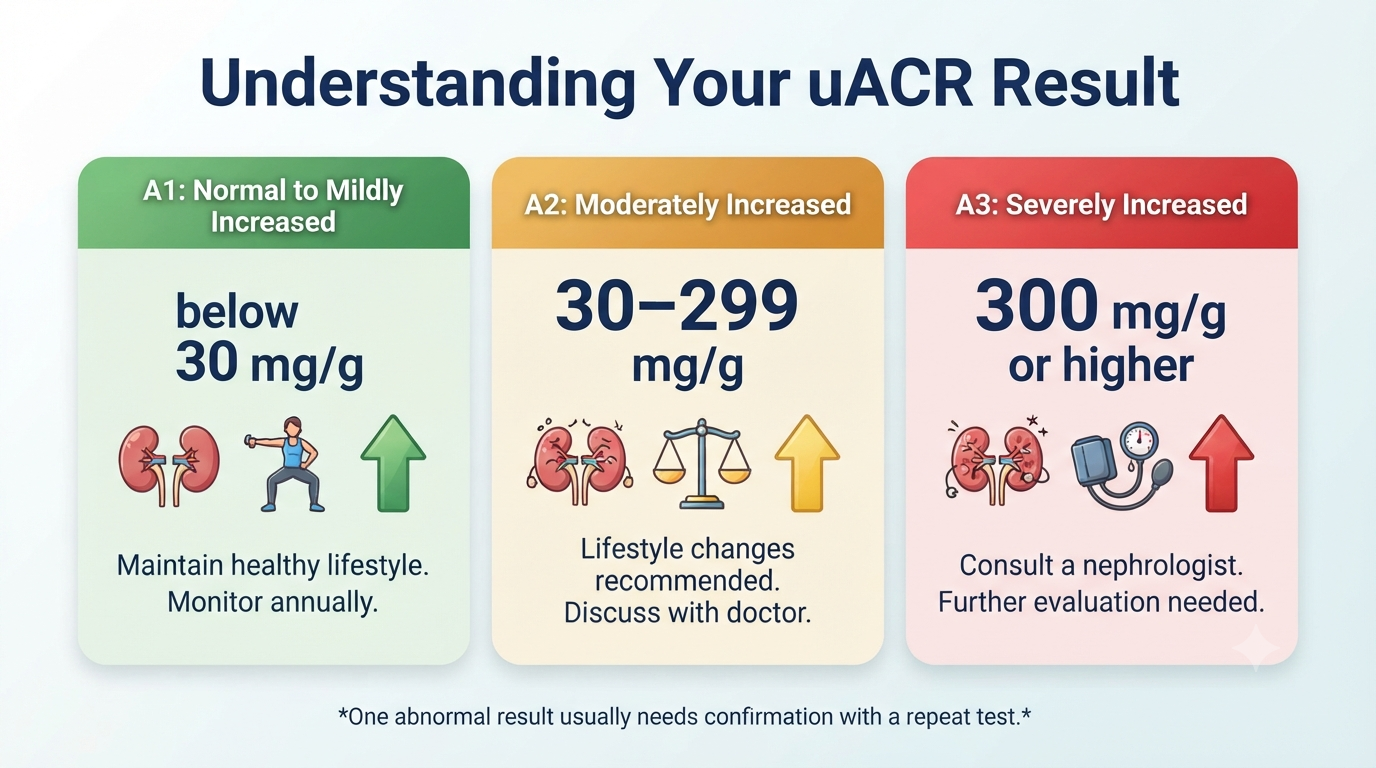
A urine albumin-to-creatinine ratio (uACR) checks whether albumin, a blood protein, is leaking into your urine. In adults, a result below 30 mg/g is classified as A1, 30–299 mg/g as A2, and 300 mg/g or higher as A3. A high result can signal kidney damage, but one abnormal test does not by itself diagnose chronic kidney disease. It usually needs to be confirmed with repeat testing and interpreted alongside your eGFR, health history, and current condition.
Quick takeaway: Lower is generally better, but do not interpret uACR in isolation. Infection, intense exercise, menstrual or urinary bleeding, dehydration, and sudden changes in blood pressure or blood sugar may temporarily affect the result.
uACR results chart: A1, A2 and A3
| Albuminuria category | uACR in mg/g | uACR in mg/mmol | Clinical description | General meaning |
|---|---|---|---|---|
| A1 | Below 30 | Below 3 | Normal to mildly increased | Lowest albuminuria-related risk category |
| A2 | 30–299 | 3–29 | Moderately increased | May indicate kidney damage if persistent |
| A3 | 300 or higher | 30 or higher | Severely increased | Higher kidney and cardiovascular risk; prompt follow-up is important |
These categories come from kidney-disease guidelines. Your laboratory may use slightly different display conventions, and children, pregnancy, acute illness, or specific kidney conditions may require different interpretation.
Examples:
- A uACR of 10 mg/g falls in A1.
- A uACR of 45 mg/g falls in A2.
- A uACR of 250 mg/g also falls in A2.
- A uACR of 300 mg/g or 800 mg/g falls in A3.
The number is a continuous risk marker: a result of 290 is not suddenly harmless compared with 300. Clinicians consider the exact number, its trend, your eGFR, blood pressure, diabetes status, and other findings.
What is a uACR test?
The uACR test measures two substances in one urine sample:
- Albumin: A protein that normally stays in the bloodstream. Damaged kidney filters may allow it to enter the urine.
- Creatinine: A waste product released through the urine. Comparing albumin with creatinine helps account for how diluted or concentrated the urine sample is.
The calculation is:
Urine albumin ÷ urine creatinine = uACR
A spot urine sample is usually enough. A first-morning, midstream sample is preferred for confirmation because it may reduce some of the variation seen during the day. A routine 24-hour collection is not normally needed for initial screening.
The uACR and estimated glomerular filtration rate (eGFR) answer different questions:
- uACR looks for kidney damage by detecting albumin leakage.
- eGFR estimates filtration function using a blood test, usually based on creatinine.
A person can have albuminuria even when eGFR is above 60. That is why kidney screening often includes both tests rather than creatinine or eGFR alone.
Related reading: Chronic Kidney Disease Stages and How to Lower Creatinine Levels and Protect Your Kidneys.
What does an A1 uACR result mean?
A1 is below 30 mg/g, or below 3 mg/mmol. It is described as normal to mildly increased albuminuria.
An A1 result is reassuring, but it does not rule out every kidney problem. Someone can have reduced eGFR, blood in the urine, an abnormal kidney scan, or another marker of kidney damage while the uACR remains below 30. Risk should therefore be assessed using the complete clinical picture.
People with diabetes, high blood pressure, cardiovascular disease, or established CKD may still need periodic screening even after an A1 result. Ask your clinician how often testing is appropriate for you.
What does an A2 uACR result mean?
A2 is 30–299 mg/g, or 3–29 mg/mmol. It is called moderately increased albuminuria.
If the elevation persists, A2 can be evidence of kidney damage—even when eGFR is in a range that appears normal. Persistent albuminuria is also associated with greater kidney and cardiovascular risk.
A first A2 result is not usually the end of the evaluation. Your clinician may:
- Check whether a temporary factor could have affected the sample.
- Repeat uACR, preferably using a first-morning midstream sample.
- Review eGFR, blood pressure, blood sugar, urinalysis, and medicines.
- Look at previous results to determine whether the finding has lasted at least three months.
- Investigate an underlying cause if the result remains elevated.
Older reports may call this range “microalbuminuria.” Many current guidelines prefer “moderately increased albuminuria” because albumin is not physically smaller in this range; the term refers only to the amount detected.
What does an A3 uACR result mean?
A3 is 300 mg/g or higher, or 30 mg/mmol or higher. It is called severely increased albuminuria.
A confirmed A3 result is associated with a higher risk of CKD progression and cardiovascular problems than A1 or A2. It deserves timely clinical follow-up, but it does not reveal the cause on its own.
Possible causes include diabetes-related kidney disease, high blood pressure, inflammation of the kidney filters, and other kidney disorders. Temporary or acute conditions can also raise albumin, so repeat testing and clinical evaluation remain important.
Your clinician may order blood pressure checks, repeat uACR, eGFR, urinalysis, blood tests, imaging, or specialist evaluation depending on the number, symptoms, and medical history.
Seek prompt medical advice if a high uACR occurs with visible blood in the urine, rapidly increasing swelling, very low urine output, shortness of breath, severe weakness, confusion, or pregnancy-related high blood pressure. These features require assessment rather than online interpretation.
Does a high uACR always mean chronic kidney disease?
No. A high uACR can be temporary, and one abnormal result should not automatically be labeled chronic kidney disease.
The 2024 KDIGO CKD guideline recommends repeating an incidentally elevated ACR to confirm it. Chronicity generally means that a kidney abnormality has persisted for at least three months. The timing of repeat tests depends on the result and clinical situation; a clinician may test sooner when the value is very high, symptoms are present, or acute kidney injury is possible.
A confirmed uACR of 30 mg/g or higher that persists for at least three months can satisfy a marker-of-kidney-damage criterion for CKD, even if eGFR is 60 or higher. A clinician still needs to determine the likely cause and assess the full CKD risk category.
What can temporarily raise uACR?
The following can interfere with a urine albumin result or cause a temporary rise:
- Intense exercise during the preceding 24 hours
- Fever or another infection
- Urinary tract infection
- Urinary or menstrual bleeding
- Dehydration
- A heart-failure flare
- A sudden, marked increase in blood pressure
- A sudden, marked increase in blood sugar
Tell the ordering clinician or laboratory if any of these apply. Do not delay an urgent evaluation simply to obtain a “perfect” sample.
Can a UTI increase uACR?
Yes. A urinary tract infection may temporarily increase urine albumin or interfere with the result. If a UTI is suspected, your clinician may treat or evaluate the infection and repeat the uACR after it has resolved.
Can exercise increase uACR?
Strenuous exercise can temporarily raise urine albumin. The National Kidney Foundation advises avoiding intense exercise for about 24 hours before a planned uACR sample unless your healthcare team gives different instructions.
Can dehydration affect the result?
Dehydration may contribute to temporary albuminuria. The ratio corrects for urine concentration better than albumin concentration alone, but it does not remove every source of biological variation. Follow the hydration instructions provided by your laboratory; do not force excessive water intake.
How to prepare for a uACR test
Follow your laboratory’s instructions. In general:
- Ask whether a first-morning sample is preferred.
- Avoid intense exercise for 24 hours beforehand.
- Tell the clinician about fever, infection, UTI symptoms, bleeding, or a major blood-pressure or blood-sugar spike.
- Stay normally hydrated; do not deliberately overdrink water.
- Ask whether food or medicines require special instructions. Do not stop prescribed medicine unless the prescriber tells you to.
- For a clean-catch sample, clean the area, begin urinating into the toilet, and then collect the midstream urine without touching the inside of the container.
What should happen after an abnormal result?
The correct next step depends on the number, symptoms, eGFR, and health history. A reasonable discussion with your clinician may cover:
- Confirmation: When should uACR be repeated?
- Sampling: Should the repeat test use a first-morning midstream sample?
- Chronicity: Is there an older abnormal result showing persistence for at least three months?
- Filtration: What is the current eGFR, and is it changing?
- Causes: Could diabetes, blood pressure, infection, medication, or another kidney condition explain the result?
- Treatment: Would blood-pressure, diabetes, or kidney-protective treatment be appropriate?
- Monitoring: How often should uACR and eGFR be checked?
- Referral: Does the degree of albuminuria, eGFR, or another finding warrant a nephrologist?
Treatment is individualized. Depending on the cause and patient, clinicians may focus on blood-pressure and glucose management, medicine review, smoking cessation, dietary sodium, cardiovascular protection, or kidney-protective medication. A high uACR is not a reason to begin a supplement, extreme diet, or “kidney cleanse.”
For prevention basics, see How to Prevent Kidney Disease and Managing Diabetes and Protecting Your Kidneys.
uACR versus protein in urine: are they the same?
They are related but not identical.
Albuminuria means albumin is present in the urine. Proteinuria is a broader term covering albumin and other proteins. In many common kidney diseases, albumin is the main urine protein and uACR is the preferred screening test.
A standard dipstick may miss smaller but clinically important amounts of albumin. A positive dipstick result should generally be quantified with a laboratory ratio such as uACR. In some conditions, a clinician may order a urine protein-to-creatinine ratio or other testing instead.
Frequently asked questions
A result of 30 mg/g is at the threshold for the A2, or moderately increased, category. It should be interpreted with your eGFR and repeated when appropriate to confirm whether the elevation persists.
A uACR of 300 mg/g is at the threshold for A3, or severely increased albuminuria. It is associated with higher kidney and cardiovascular risk and needs timely medical follow-up. The number alone does not determine the cause or prove an immediate emergency.
Yes. Albumin leakage can appear before serum creatinine rises or eGFR falls. This is one reason clinicians use both uACR and eGFR to assess kidney health.
uACR has biological variation and can change with acute illness, exercise, hydration status, blood pressure, blood sugar, and treatment. A repeated result and the longer-term trend are usually more informative than one isolated measurement.
Lifestyle measures that support blood pressure, blood sugar, and cardiovascular health may help as part of an evidence-based care plan, but no food, tea, or supplement reliably treats every cause of albuminuria. The priority is to confirm the result, identify the cause, and follow individualized medical treatment.
The bottom line
A uACR below 30 mg/g is A1, 30–299 mg/g is A2, and 300 mg/g or higher is A3. Higher, persistent albuminuria generally means greater kidney and cardiovascular risk. However, one high result may be temporary and does not by itself diagnose chronic kidney disease. Confirm the finding, review it with eGFR, and ask your healthcare professional what the trend means for you.
Editorial note
This article is for general education and does not provide a diagnosis or replace care from a qualified healthcare professional. Test interpretation depends on age, pregnancy status, symptoms, medical history, medicines, laboratory methods, and other results.
Medical references
- Kidney Disease: Improving Global Outcomes (KDIGO). Executive Summary of the 2024 Clinical Practice Guideline for the Evaluation and Management of Chronic Kidney Disease.
- National Institute of Diabetes and Digestive and Kidney Diseases. Assess Urine Albumin.
- National Kidney Foundation. Urine Albumin-Creatinine Ratio (uACR).
- National Institute of Diabetes and Digestive and Kidney Diseases. Chronic Kidney Disease Tests and Diagnosis.
1 thought on “uACR Test Results Explained: What Your Number Means”
Comments are closed.