
Medically reviewed by Dr. Adam N. Khan, M.D.
Internal Medicine
Reviewer profile and credentials
Review date: 9 November 2026
Last updated: 9 November 2026
Fact-checked by: MedLifeGuide editorial team
Funding disclosure: This article received no external funding and contains no affiliate links.
Key takeaways
- The 2026–2027 flu vaccine is a partial match for the dominant H1N1 strain carrying the G155E mutation. It is not useless, and the evidence does not support waiting.
- Teens and young adults under 25 have the largest antibody gap against G155E. Older adults appear to have broader cross-reactive immunity.
- The season started early. If you have not been vaccinated and flu is rising in your area, get vaccinated now rather than waiting for a perfect match that is not coming this season.
- The vaccine’s H3N2 and B components are well matched. Only the H1N1 component is partially mismatched.
- mFLUSIVA, the newly approved mRNA flu vaccine for adults 50 and older, is an additional option with stronger trial performance than standard vaccines, though real-world data are still pending.
- People with egg allergy of any severity can receive any age-appropriate flu vaccine, including egg-based vaccines, without additional precautions beyond those recommended for any vaccine recipient.
- If you develop flu symptoms and are at high risk, contact a clinician within 48 hours to discuss testing and antiviral treatment.
The short answer: partial match, real protection
If you are deciding whether the 2026–2027 flu vaccine is still worth getting now that a mutated H1N1 strain is circulating, the honest answer is this: the match is imperfect, but the vaccine is not useless, and the evidence does not support waiting.
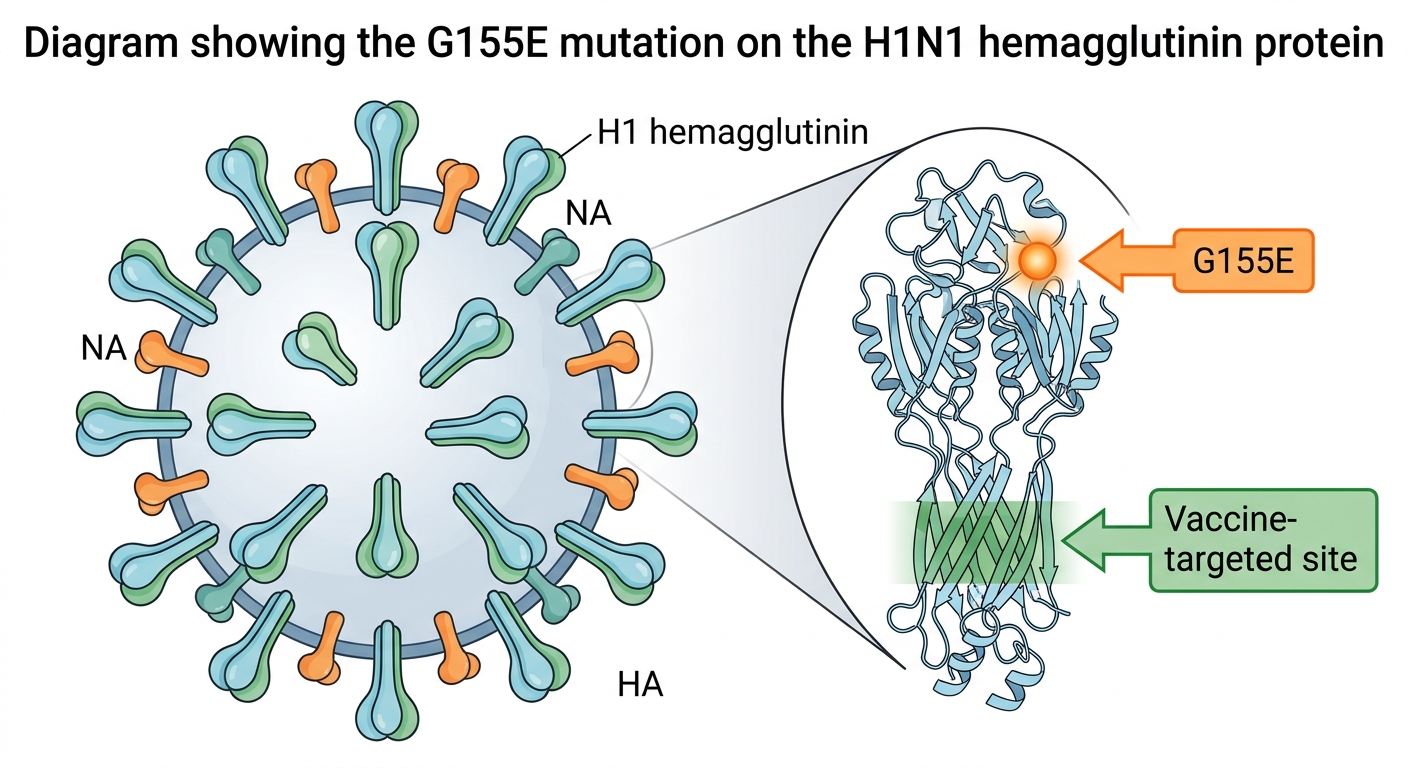
The mutation, called G155E, sits in a part of the virus’s surface protein that antibodies recognize. Laboratory studies show that some people’s antibodies bind less well to viruses carrying this change, particularly younger people.¹ At the same time, public health surveillance shows that the vaccine still raises antibodies against the mutated strain in most people, and an imperfect match has historically still reduced the risk of severe illness, hospitalization, and death.²
The practical takeaway is not “the vaccine fails.” It is “the vaccine is a partial shield, not a full shield, and the partial shield is still better than no shield.”
What changed in the virus: G155E and subclade D.3.1.1
Influenza A(H1N1)pdm09 has circulated since the 2009 pandemic. It changes more slowly than H3N2, but it does change. During the 2025–2026 season, a subgroup called subclade D.3.1.1 became dominant, and within that subgroup, a mutation at position 155 of the hemagglutinin protein (G155E) appeared. By late October 2026, 97.7% of subtyped influenza A viruses in US public health laboratories were H1N1, and the majority belonged to this D.3.1.1 subclade.³
The key point is that G155E was not the strain used to design the 2026–2027 vaccine. The vaccine’s H1N1 component is A/Missouri/11/2025 (H1N1)pdm09-like virus, chosen in February 2026 based on global surveillance.⁴ The mutation emerged and spread after that decision, which is a normal feature of flu vaccine production, not a failure of the system.
Why this mutation is different from ordinary seasonal drift
Ordinary antigenic drift involves small changes that accumulate over time. G155E is a single substitution in antigenic region Sa, a site that some antibodies use for binding.⁵ The Bloom lab’s neutralization data, based on 355 human sera collected between April and August 2026, show that adolescents and young adults have clearly lower antibody titers against viruses with mutations at position 155 compared with older adults.⁵ The likely reason is immunological experience: older adults have been exposed to H1N1 viruses with different amino acids at that site, so their antibody repertoire is broader. Younger people, whose first exposures were to more recent H1N1 strains, have a narrower response.
Who is most affected (and who is not)
The age pattern is the most actionable finding in the current data.
- Teens and young adults (under 25) are the group with the most consistently reduced antibody binding to G155E-carrying strains.⁵
- Adults over 25, and especially older adults, show less pronounced reductions, probably because of a wider history of H1N1 exposure.⁵
- There is no evidence that G155E makes the virus more likely to cause severe disease in otherwise healthy people, according to Johns Hopkins infectious disease specialist Dr. Amesh Adalja.⁶ The concern is about infection risk and transmission, not a new virulence factor.
This does not mean young people are safe from severe flu. It means the relative protection from vaccination may be lower for them this season, which makes vaccination and early antiviral treatment more important, not less.
What is actually in the 2026–2027 vaccine
The 2026–2027 US flu vaccines are trivalent (three components). All three components were updated compared with the 2025–2026 season.⁴
| Vaccine type | H1N1 component | H3N2 component | B component |
|---|---|---|---|
| Egg-based | A/Missouri/11/2025 (H1N1)pdm09-like | A/Darwin/1454/2025 (H3N2)-like | B/Tokyo/EIS13-175/2025 (B/Victoria) |
| Cell- or recombinant-based | A/Missouri/11/2025 (H1N1)pdm09-like | A/Darwin/1415/2025 (H3N2)-like | B/Pennsylvania/14/2025 (B/Victoria) |
Source: WHO recommended composition, 27 February 2026.⁴
Two of the three components (H3N2 and B) are considered well matched to circulating strains. The H1N1 component is the one with reduced reactivity against the D.3.1.1 subclade because of G155E and related changes.⁷
Comparison with the 2025–2026 season
| Feature | 2025–2026 season | 2026–2027 season |
|---|---|---|
| Formulation | Trivalent | Trivalent |
| H1N1 component | A/Victoria/4897/2022-like | A/Missouri/11/2025-like |
| Dominant H1N1 subclade | D.3.1.1 emerging | D.3.1.1 dominant with G155E |
| H1N1 match | Good | Partial (G155E mismatch) |
| H3N2 match | Moderate | Well matched |
| B match | Moderate | Well matched |
| mRNA vaccine available | No | Yes, for adults 50+ |
How well does the vaccine work against the mutated strain?
Antibody data: what the Bloom lab found
The most detailed human data come from a preprint by Jesse Bloom’s group at the Fred Hutchinson Cancer Center. The study measured 52,268 neutralization titers using 355 human sera collected between April and August 2026.⁵ The headline findings:
- Post-vaccination antibody increases were weakest against G155E-containing strains compared with other recent H1N1 strains.⁵
- The reduction was not absolute. Vaccination still raised antibodies against G155E in most people; the increase was simply smaller than the increase against the vaccine strain.⁵
- Age mattered. The reduction was most profound in younger individuals, especially young adults.⁵
What UKHSA and WHO surveillance suggest
The UK Health Security Agency reported in its Week 41 surveillance report (8 October 2026) that “some viruses within the D.3.1.1 subclade” showed “low reactivity” with post-infection ferret antisera raised against the A/Missouri vaccine strain and with human sera post-vaccination.⁷ The agency also stated clearly: “It is not yet clear how vaccine effectiveness against clinical disease may be affected by these observations. Vaccines typically still provide protection against severe clinical disease when drifted strains are seen with only a modest reduction in effectiveness.”⁷
What we still do not know
- Final VE estimates against G155E-confirmed illness for 2026–2027 are not yet available. The CDC’s preliminary 2025–26 data showed 22–34% effectiveness against outpatient visits in adults, 30% against adult hospitalization, and 38–41% against outpatient visits in children.⁸ Those numbers are a baseline, not a prediction for 2026–27.
- The clinical impact of the antibody reduction is uncertain. Laboratory neutralization is not the same as real-world protection. A smaller antibody boost may still be enough to prevent severe disease, especially in people with prior immunity.
Timing: the early season complicates the September–October rule
ACIP recommends that most people get vaccinated in September or October, and that vaccination continue throughout the season as long as influenza viruses are circulating.⁹ That guidance has not changed for 2026–2027.
But the 2026–2027 season started unusually early. By mid-October, weekly lab-confirmed flu hospitalizations were the highest for that point in the season since 2010–11, and early cases were driven by the H1N1 variant with the G155E mutation.⁶ This creates a genuine tension: if you wait for a “better match” that does not exist, you may be unvaccinated while the virus is already spreading.
When protection peaks
Protection rises for about 14 days after vaccination and then gradually declines. ACIP specifically advises against vaccinating most adults, especially those 65 and older, in July or August unless later vaccination might not be possible, because early vaccination can lead to waning immunity by the time the season peaks.⁹ A shot given in early November provides peak protection from mid-November through the winter holidays, which is when flu activity often accelerates.
A practical decision framework for October–December
| Your situation | What the evidence supports |
|---|---|
| You have not been vaccinated and flu is rising in your area | Get vaccinated now. The benefit of earlier protection outweighs the theoretical advantage of waiting for a perfect match that is not coming this season.⁶ |
| You are under 25 and healthy | Get vaccinated, but do not rely on it alone. The antibody data suggest your protection against infection may be lower this season.⁵ Use hand hygiene, avoid crowded indoor spaces during peaks, and seek early testing if you develop symptoms. |
| You are 65+ or have a chronic condition | Get vaccinated now. Your risk of severe outcomes is higher, and even a partially matched vaccine reduces hospitalization risk. ACIP preferentially recommends high-dose, recombinant, or adjuvanted formulations for adults 65 and older.⁹ See the comparison table below. |
| You already had flu this season | You still need the vaccine if you have not had it. The vaccine covers three strains, and infection with one does not guarantee protection against the others. |
| You are 50+ and considering the mRNA flu vaccine | mFLUSIVA received FDA approval on 5 August 2026 for adults 50 and older: traditional approval for ages 50–64 and accelerated approval for ages 65+.¹⁰ In the FLUENT trial it demonstrated 26.6% relative vaccine efficacy over standard vaccine.¹⁰ Real-world effectiveness data are still pending. |
Who should prioritize vaccination now
The CDC recommends annual flu vaccination for everyone aged 6 months and older without a contraindication.⁹ Within that broad recommendation, the following groups have the strongest reason to act now:
- Adults 65 and older, who account for the majority of flu hospitalizations and deaths. In 2025–2026, VE against hospitalization in this group was approximately 31%.⁸
- People with chronic heart, lung, kidney, liver, or metabolic disease, including diabetes. A 2026 evidence review confirmed that influenza vaccines continue to reduce severe disease across high-risk groups.¹¹
- Pregnant people, because flu can cause severe illness during pregnancy and vaccination protects both the parent and the infant.⁹
- Children under 5, especially those under 2. In 2025–2026, pediatric VE was 38–41% against outpatient visits and 41% against hospitalization.⁸
- Teens and young adults under 25, not because they are at high risk of severe disease, but because the antibody data suggest they may be more susceptible to infection with G155E this season.⁵
- Immunocompromised people, including those receiving chemotherapy, transplant recipients, and people with advanced HIV. These individuals may have reduced vaccine responses and should discuss timing and additional precautions with their clinician.⁹
Pediatric-specific guidance
Children aged 6 months through 8 years who are receiving flu vaccine for the first time, or who have received only one dose previously, need two doses separated by at least 4 weeks.⁹ Children in this age group who have received two or more doses previously need only one dose this season. The nasal spray vaccine is an option for healthy children aged 2 through 49 who are not pregnant and do not have certain underlying conditions.⁹
Pregnancy-specific guidance
Pregnant people can receive the flu vaccine during any trimester. The vaccine is not associated with an increased risk of miscarriage or birth defects.⁹ Vaccination during pregnancy also provides passive antibody protection to infants during their first months of life, when they are too young to be vaccinated themselves.
For adults 65 and older: comparing the preferred options
CDC and ACIP preferentially recommend three vaccine types for adults 65 and older over standard-dose unadjuvanted vaccines.⁸ The table below summarizes the key differences.
| Vaccine type | Brand example | Key feature | Evidence note |
|---|---|---|---|
| High-dose inactivated (HD-IIV) | Fluzone High-Dose | Contains four times the antigen dose per virus compared with standard-dose vaccines | Studies suggest potentially greater effectiveness in this age group⁸ |
| Adjuvanted inactivated (aIIV) | Fluad | Contains an adjuvant (MF59) designed to boost immune response | A large U.S. study found comparable effectiveness between adjuvanted and high-dose vaccines in adults 65+¹² |
| Recombinant (RIV) | Flublok | Egg-free, produced using recombinant technology | Preferentially recommended alongside HD-IIV and aIIV⁸ |
| mRNA (mFLUSIVA) | mFLUSIVA | First mRNA flu vaccine; approved August 2026 for adults 50+ | 26.6% relative efficacy over standard vaccine in the FLUENT trial; real-world data pending¹⁰ |
If none of these options is available at the time of vaccination, a standard-dose unadjuvanted inactivated vaccine should be given rather than delaying vaccination.⁸
Egg allergy: what the guidance says
A common question is whether egg allergy is a reason to avoid the flu vaccine. The answer has changed in recent years.
ACIP recommends that people with egg allergy of any severity can receive any influenza vaccine, egg-based or non-egg-based, that is otherwise appropriate for their age and health status.¹³ Egg allergy alone does not require additional safety measures beyond those recommended for any vaccine recipient, such as having epinephrine available.¹³
People with a history of severe allergic reaction to egg (defined as any symptom other than hives) should be vaccinated in a medical setting with healthcare professionals available to recognize and manage severe allergic reactions, but they can still receive any age-appropriate flu vaccine.¹³
For people who prefer an egg-free option, the recombinant vaccine (Flublok) and cell-culture-based vaccines are egg-free alternatives.¹³
Guillain-Barré syndrome: a rare risk in context
Guillain-Barré syndrome (GBS) is a rare neurological disorder that can cause muscle weakness and sometimes paralysis. It is more commonly triggered by infections, including influenza itself, than by vaccination.¹⁴
The data on the association between seasonal flu vaccination and GBS are varied and inconsistent across flu seasons. When an increased risk has been observed, it has consistently been in the range of 1–2 additional GBS cases per million flu vaccine doses administered.¹⁴ To put that in perspective, an estimated 3,000 to 6,000 people develop GBS each year in the United States from all causes.¹⁴
The CDC notes that it is more likely that a person will get GBS after getting the flu than after vaccination.¹⁴ This is not a reason to avoid vaccination; it is context for informed decision-making, especially for people with a history of GBS.
Vaccine safety monitoring: what happens after approval
Flu vaccines, including the newly approved mRNA vaccine, are monitored through multiple federal safety systems after they are licensed.
- VAERS (Vaccine Adverse Event Reporting System): A passive reporting system co-managed by CDC and FDA that serves as an early warning system for potential safety problems.¹⁵
- VSD (Vaccine Safety Datalink): A collaborative project that uses electronic health data from multiple healthcare organizations to actively monitor vaccine safety and conduct studies.¹⁵
- CISA (Clinical Immunization Safety Assessment Project): Provides clinical expertise for complex vaccine safety questions.¹⁵
CDC reports that monitoring by VAERS and VSD has not detected safety concerns for deaths following flu vaccination in the United States.¹⁵ These systems are not perfect, but they provide ongoing transparency and accountability.
If you develop flu symptoms: testing and treatment
If you develop fever, cough, sore throat, body aches, or fatigue during flu season, and you are at high risk of severe illness, contact a healthcare professional promptly. Antiviral treatment works best when started within 48 hours of symptom onset, though it can still be considered later in severe illness or high-risk patients.⁹
| Antiviral | How it is given | Typical use |
|---|---|---|
| Oseltamivir (Tamiflu) | Oral, twice daily for 5 days | Most common; approved for adults and children 2 weeks and older |
| Zanamivir (Relenza) | Inhaled, twice daily for 5 days | Not recommended for people with underlying respiratory disease |
| Baloxavir (Xofluza) | Oral, single dose | Approved for adults and children 5 and older; not recommended for pregnant people or severe illness |
Source: CDC influenza antiviral guidance.⁹
Rapid influenza diagnostic tests (RIDTs) can detect flu within 15–20 minutes but have lower sensitivity than molecular assays. A negative rapid test does not rule out flu if clinical suspicion is high, especially during peak season.⁹
When to seek emergency care
Seek emergency medical care if you or someone you are caring for experiences difficulty breathing, persistent chest pain, confusion, inability to wake or stay awake, bluish lips or face, or seizures. In children, emergency signs include fast breathing, not drinking enough fluids, severe irritability, or fever with a rash.⁹
Where to get vaccinated and what it costs
Flu vaccines are available at pharmacies, urgent care clinics, primary care offices, and local health departments. Most health insurance plans cover flu vaccination with no copay when received from an in-network provider. The Vaccines for Children (VFC) program provides free vaccines to eligible children under 19. Adults without insurance can check with their local health department for free or low-cost options.⁹
Side effects, safety, and the mRNA option
The most common side effects of flu vaccination are soreness at the injection site, fatigue, headache, and low-grade fever lasting one to two days. These are signs the immune system is responding, not signs of infection.
The mRNA flu vaccine, mFLUSIVA (mRNA-1010), was approved by the FDA on 5 August 2026 for adults 50 and older.¹⁰ In the FLUENT trial it demonstrated 26.6% relative vaccine efficacy over standard vaccine and cleared the FDA’s superiority threshold, supporting full approval for adults 50–64 and accelerated approval for adults 65 and older.¹⁰ The approval for adults 65+ is based on immune responses, and continued approval may depend on confirmatory trial data.¹⁰ Real-world effectiveness data are expected later in the season.
What the vaccine does not do
- It does not prevent all flu infections. No flu vaccine does. The goal is to reduce severe illness, hospitalization, and death.²
- It does not protect against every strain. This season’s vaccine targets three strains; others may circulate at low levels.
- It does not replace other precautions. Hand hygiene, ventilation, and staying home when sick still matter, especially for people at high risk.
- It does not cause the flu. Injectable flu vaccines contain inactivated virus or recombinant proteins; they cannot replicate and cause infection.
- It does not eliminate the need for antiviral treatment if you get sick. If you are high risk and develop symptoms, early treatment still matters even if you were vaccinated.⁹
Frequently asked questions
Yes, but the protection is partial. Laboratory studies show reduced antibody binding to the G155E-mutated strain, especially in people under 25.⁵ However, vaccination still raises antibodies in most people, and the H3N2 and B components are well matched.⁴ The vaccine is expected to reduce severe illness even if it is less effective at preventing mild infection.
No. A better-matched H1N1 vaccine is not expected this season. The season started early, and waiting leaves you unprotected while the virus is circulating.⁶ Get vaccinated now if you have not already.
Older adults have been exposed to more varied H1N1 strains over their lifetimes, which gives them a broader antibody repertoire that can recognize viruses with changes at position 155. Younger people’s first exposures were to more recent strains, so their antibodies are more narrowly targeted.
Yes. ACIP recommends that people with egg allergy of any severity can receive any influenza vaccine, egg-based or non-egg-based, that is appropriate for their age and health status.¹³ Egg allergy alone does not require additional precautions beyond those recommended for any vaccine recipient.
Yes. The CDC states that flu and COVID-19 vaccines can be administered during the same visit.
Yes, for healthy people aged 2 through 49 who are not pregnant and do not have certain underlying medical conditions. The nasal spray is not recommended for people with weakened immune systems or certain chronic conditions.
No. mFLUSIVA is a separate vaccine approved for adults 50 and older. It is not a replacement for the standard flu vaccine for people outside that age group, and it is not a COVID-19 vaccine.
Bottom line and next step
The 2026–2027 flu vaccine is an imperfect match for the dominant H1N1 strain, but the imperfection is a matter of degree, not a binary failure. Laboratory data show reduced antibody binding to G155E, especially in younger people,⁵ but vaccination still raises antibodies in most people, and the vaccine’s other two components are well matched.⁴ The early season means that waiting for a better match is not a realistic strategy.⁶
Your next step: if you have not been vaccinated this season and flu is circulating in your area, schedule a vaccination now. If you are 65 or older, or if you have a chronic condition, ask your clinician whether a high-dose, adjuvanted, or mRNA formulation is appropriate for you. If you develop flu symptoms, contact a healthcare professional early to discuss testing and antiviral treatment, which are most effective when started within 48 hours.⁹
MEDICAL DISCLAIMER
This article is for general educational purposes and does not constitute medical advice, diagnosis, or treatment. It does not create a physician–patient relationship. Vaccination decisions should be made in consultation with a qualified healthcare professional who knows your medical history, allergies, and risk factors. If you are experiencing a medical emergency, call emergency services immediately. The information reflects sources available as of 9 November 2026; guidance may change as new data emerge.
AUTHOR REVIEW
Reviewed for clinical accuracy by Dr. Adam N. Khan, M.D., licensed internal medicine physician.
Review focus: (1) Correct characterization of G155E and subclade D.3.1.1; (2) appropriate hedging around vaccine effectiveness against the mutated strain; (3) accurate representation of ACIP timing guidance and the early-season exception; (4) accurate representation of antiviral indications and timing; (5) accurate representation of the mRNA vaccine’s approval status and trial data; (6) egg allergy and GBS guidance accuracy; (7) clear separation of laboratory findings from clinical outcomes; (8) pediatric and pregnancy-specific guidance accuracy.
Review status: Approved for publication with the note that final 2026–27 VE estimates against G155E were not available at the time of review and should be updated when CDC publishes interim data.
SOURCES
- Kikawa C, Butler A, Huddleston J, et al. “Near real-time data on the human neutralizing antibody landscape to influenza virus in summer of 2026 shows antigenic advance of H3N2 subclade K region D mutants and H1N1 D.3.1.1 Sa mutants.” Open Library of Bioscience, 7 November 2026. https://ngdc.cncb.ac.cn/openlb/publication/OLB-BRV-10.64898/2026.09.15.751855v3
- World Health Organization. “Recommended composition of influenza virus vaccines for use in the 2026–2027 northern hemisphere influenza season.” 27 February 2026. https://www.who.int/publications/m/item/recommended-composition-of-influenza-virus-vaccines-for-use-in-the-2026-2027-northern-hemisphere-influenza-season
- CDC FluView. “Weekly US Influenza Surveillance Report: Key Updates for Week 43, ending October 31, 2026.” 6 November 2026. https://www.cdc.gov/fluview/surveillance/2026-week-43.html
- World Health Organization. “Recommended composition of influenza virus vaccines for use in the 2026–2027 northern hemisphere influenza season.” 27 February 2026. https://www.who.int/publications/m/item/recommended-composition-of-influenza-virus-vaccines-for-use-in-the-2026-2027-northern-hemisphere-influenza-season
- Bloom Lab. “Near real-time data on the human neutralizing antibody landscape to influenza virus in summer of 2026 and the G155E mutation.” 16 September 2026. https://jbloomlab.org/posts/2026-09-16_kikawa
- CIDRAP. “Experts say don’t wait. Now is the time to get your flu shot.” 29 October 2026. https://www.cidrap.umn.edu/influenza-vaccines/experts-say-dont-wait-now-time-get-your-flu-shot
- UK Health Security Agency. “National flu and COVID-19 surveillance report: 8 October 2026 (week 41).” https://www.gov.uk/government/statistics/national-flu-and-covid-19-surveillance-reports-2026-to-2027-season/national-flu-and-covid-19-surveillance-report-8-october-2026-week-41
- CDC. “Flu and People 65 Years and Older.” Updated 4 September 2026. https://www.cdc.gov/flu/highrisk/65over.htm
- CDC. “ACIP Recommendations Summary.” Updated 10 June 2026. https://www.cdc.gov/flu/hcp/vax-summary/acip-recommendations.html
- Drugs.com. “MFLUSIVA FDA Approval History.” Updated 10 August 2026. https://www.drugs.com/history/mflusiva.html
- Pharmacy Times. “Influenza Vaccines Continue to Reduce Severe Disease and Death Across High-Risk Groups, Evidence Review Finds.” 25 September 2026. https://www.pharmacytimes.com/view/influenza-vaccines-continue-to-reduce-severe-disease-and-death-across-high-risk-groups-evidence-review-finds
- CSL. “Published Large U.S. Study Finds Comparable Effectiveness Between Adjuvanted and High-Dose Influenza Vaccines in Adults 65 Years and Older.” 13 May 2026. https://newsroom.csl.com
- CDC. “Interim Clinical Considerations for the Use of Seasonal Influenza Vaccines in the United States.” Updated 2 September 2026. https://www.cdc.gov/flu/hcp/vax-summary/seasonal-influenza-vaccines.html
- CDC. “Guillain-Barré Syndrome (GBS) and Vaccines.” Updated 20 December 2024. https://www.cdc.gov/vaccine-safety/about/guillain-barre.html
- CDC. “Deaths in South Korea Following Flu Vaccination.” 8 June 2026. https://www.cdc.gov/vaccinesafety/concerns/2020/2020-10-23-deaths-south-korea.html