
Medically Reviewed and Compiled by Dr. Adam N. Khan, MD.
Quick Answer:
- High Severe Disease Protection: Updated COVID-19 vaccines lower your risk of critical illness or intensive care unit (ICU) admission by nearly 70 percent in the first two months.
- Waning Over Time: Immunity against mild or moderate infection fades within four to six months, making periodic updated boosters essential for vulnerable groups.
- Long COVID Risk Reduction: Staying up to date on your vaccines reduces your chance of developing lingering symptoms, commonly called long COVID.
EMERGENCY WARNING: If you or a loved one experience severe shortness of breath, persistent chest pain or pressure, new confusion, or bluish lips or face, seek immediate emergency medical care or call 911. Do not delay emergency evaluation.
What Does Vaccine Effectiveness Mean?
When scientists talk about vaccine effectiveness, they are describing how well a vaccine protects people in everyday life. Clinical trials test vaccines in controlled environments, but real-world effectiveness shows how shots perform across diverse populations.
Vaccine protection is measured in percentages:
- 80% Effective: Means a vaccinated group has an 80 percent lower risk of getting sick compared to an unvaccinated group facing the same exposure.
- Severe vs. Mild Illness: Vaccines are primarily designed to prevent severe complications, hospital stays, and death rather than completely blocking mild nasal congestion. CDC
Your individual protection depends on your age, immune health, past infections, and how recently you received a shot.
Master COVID-19 Vaccine Effectiveness Chart
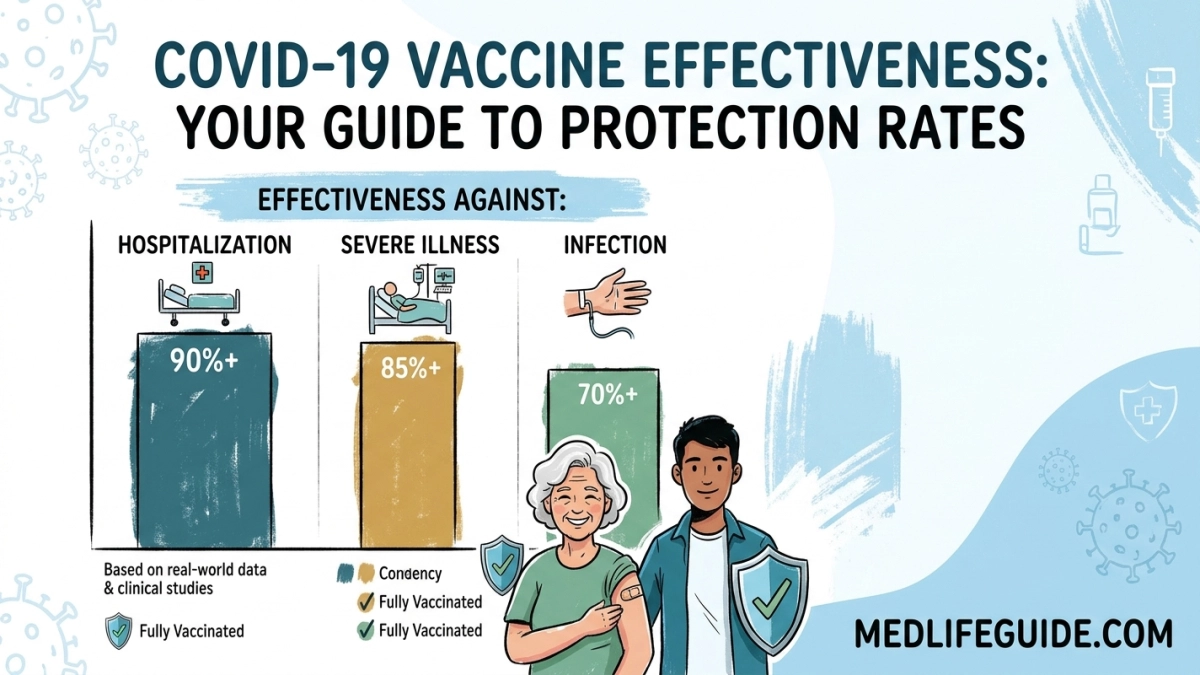
The following chart outlines average real-world protection rates across different timeframes based on surveillance data published by the Centers for Disease Control and Prevention (CDC) and peer-reviewed clinical studies.
| Time Since Last Shot | Protection Against Mild Symptoms | Protection Against Hospitalization | Protection Against ICU Admission / Death |
|---|---|---|---|
| 0 to 2 Months | 50% – 60% | 50% – 65% | 67% – 70% |
| 2 to 4 Months | 30% – 40% | 40% – 50% | 50% – 60% |
| 4 to 6 Months | 10% – 20% | 30% – 40% | 40% – 50% |
| 6+ Months | Minimal baseline | 20% – 30% | 35% – 40% |
Data compiled from CDC VISION Network surveillance and observational studies published by the National Institutes of Health (NIH).
Unique Clinical Takeaways
While standard vaccine guides cover basic dosage timing, clinical observation reveals critical nuances in how vaccines interact with your immune system:
- Hybrid Immunity Creates a Broader Shield: Individuals who have had both a COVID-19 infection and a recent vaccine dose develop what clinicians call “hybrid immunity.” This combination produces broader neutralizing antibody responses across multiple virus subvariants than infection or vaccination alone.
- Timing Around Medications Matters: For patients taking immunosuppressive treatments (such as biologics for autoimmune conditions or chemotherapy), timing the vaccine dose during periods of lower medication intensity can significantly enhance antibody production. Always coordinate booster schedules with your prescribing physician.
- Protection Against Vascular Complications: Beyond respiratory protection, staying updated on COVID-19 vaccines significantly reduces the risk of post-acute cardiovascular events, including blood clots and heart inflammation linked to severe viral infection.
How Protection Changes Over Time (Immune Waning)
Vaccine effectiveness naturally decreases over time. This process is known as immune waning.
Neutralizing Antibodies vs. T-Cell Memory
- Neutralizing Antibodies: These proteins circulate in your bloodstream and mucosal linings to block the virus from entering your cells. Antibody levels peak in the first few weeks after vaccination and fall significantly by month four.
- T-Cells and B-Cells: These long-term memory cells reside in your lymph nodes and bone marrow. Even when antibodies fade, memory cells recognize the virus quickly during an infection to prevent severe organ damage, keeping hospitalization rates low. CDC
High-Risk Populations
Certain groups experience faster waning and require closer monitoring:
- Adults aged 65 and older.
- Individuals with compromised immune systems.
- Patients with chronic heart, lung, or kidney conditions.
Protection Against Long COVID
Long COVID refers to symptoms that persist for months after the initial infection, including brain fog, fatigue, and shortness of breath.
Research supported by the National Institutes of Health shows that receiving updated COVID-19 vaccines lowers the risk of developing long-term post-viral complications. By reducing the severity and duration of the initial viral infection, the vaccine limits systemic inflammation and tissue damage.
Frequently Asked Questions (FAQs)
Natural immunity from an infection declines over time, and updated vaccines provide better targeted protection against newer circulating variants. Combining natural exposure with a booster creates stronger, longer-lasting hybrid immunity.
Adults 65 and older or individuals with weakened immune systems are typically advised to receive an additional dose 6 months after their previous shot. Always verify specific timing with your primary care provider.
Yes, studies show that staying up to date on COVID-19 vaccines reduces your overall risk of developing long COVID symptoms if you experience a breakthrough infection.
Yes, health authorities confirm it is safe to receive both the influenza vaccine and an updated COVID-19 vaccine during the same clinic visit, typically in different arms.
Common side effects include mild sore arm pain at the injection site, brief low-grade fatigue, muscle aches, or a mild fever lasting 24 to 48 hours.
References and Citations
- Centers for Disease Control and Prevention (CDC) – Vaccine Effectiveness Program Updates [/references/cdc-covid-vaccine-effectiveness]
- National Institutes of Health (NIH) – Research on COVID-19 Immunity and Booster Protection [/references/nih-covid-vaccine-research]
- World Health Organization (WHO) – Technical Guidance on COVID-19 Vaccine Efficacy [/references/who-covid-vaccine-guidance]
- Mayo Clinic – COVID-19 Vaccines: Protection Duration and Overview [/references/mayoclinic-covid-vaccines]
- Morbidity and Mortality Weekly Report (MMWR) – Real-World Protection Data [/references/mmwr-covid-effectiveness-data]
Reviewer Bio
Dr. Adam N. Khan, M.D. earned his medical degree from King Edward Medical University and completed his Internal Medicine residency at Mayo Hospital. He is an active PMDC-licensed physician dedicated to global health literacy, translating complex peer-reviewed research into accurate, safe, and actionable health guidance for MEDLIFEGUIDE readers.
Conflict of Interest Disclosure: Dr. Khan reports no financial disclosures or commercial conflicts of interest related to vaccine manufacturers or pharmaceutical entities.
Medical Disclaimer
This article is for educational and informational purposes only and does not constitute medical advice, diagnosis, or treatment. Always consult a qualified healthcare provider regarding a medical condition, booster schedules, or personal health choices. Never disregard professional medical advice or delay seeking it because of something you have read on this website.
JSON
{
  "@context": "https://schema.org",
  "@graph": [
    {
      "@type": "MedicalWebPage",
      "@id": "https://medlifeguide.com/covid-19-vaccine-effectiveness-chart#webpage",
      "url": "https://medlifeguide.com/covid-19-vaccine-effectiveness-chart",
      "name": "Understanding the COVID-19 Vaccine Effectiveness Chart",
      "description": "Explore our complete COVID-19 vaccine effectiveness chart. Learn how booster shots protect against severe illness, hospitalization, and long COVID.",
      "medicalAudience": "Patient",
      "aspect": "Overview, Prevention, Effectiveness"
    },
    {
      "@type": "Article",
      "@id": "https://medlifeguide.com/covid-19-vaccine-effectiveness-chart#article",
      "isPartOf": {
        "@id": "https://medlifeguide.com/covid-19-vaccine-effectiveness-chart#webpage"
      },
      "headline": "Understanding the COVID-19 Vaccine Effectiveness Chart",
      "description": "Comprehensive medical guide and real-world effectiveness chart for COVID-19 vaccines and boosters.",
      "author": {
        "@type": "Person",
        "name": "Dr. Adam N. Khan, M.D.",
        "jobTitle": "Internal Medicine Physician",
        "alumniOf": {
          "@type": "EducationalOrganization",
          "name": "King Edward Medical University"
        }
      },
      "publisher": {
        "@type": "Organization",
        "name": "MEDLIFEGUIDE",
        "url": "https://medlifeguide.com"
      }
    }
  ]
}