
Medically Reviewed and Compiled by Dr. Adam N. Khan, MD.
Quick Summary:
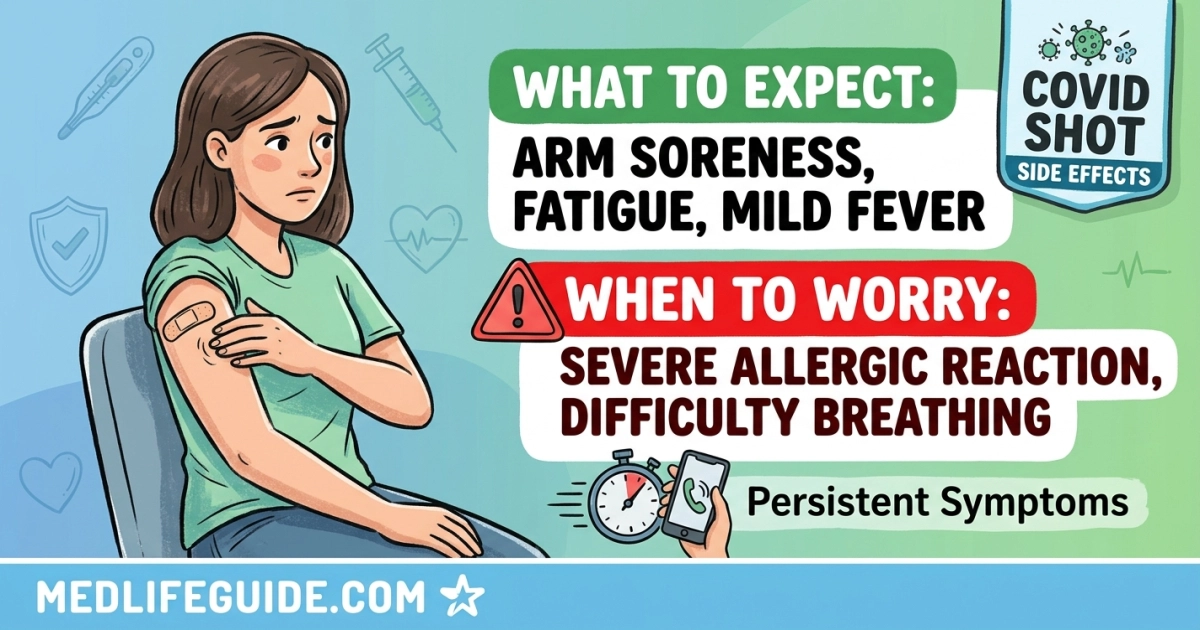
- Most COVID shot side effects — sore arm, fatigue, headache, mild fever — are normal signs your immune system is working and usually fade within 1 to 3 days.
- Serious events like myocarditis (heart muscle inflammation) and anaphylaxis (severe allergic reaction) are rare, but they are real and require prompt medical attention if warning signs appear.
- Knowing which symptoms to manage at home and which demand emergency care is the single most important thing you can do before and after vaccination.
EMERGENCY WARNING: Call 911 or go to the nearest emergency room right away if you experience chest pain, shortness of breath, a racing or pounding heart, severe dizziness, or swelling of your face, lips, tongue, or throat after vaccination.
Why Side Effects Happen at All
A COVID shot does not contain live virus, so it cannot give you COVID-19. Instead, it teaches your immune system to recognize the spike protein of the coronavirus. That training process is active — your immune cells multiply, release signaling chemicals, and prepare antibodies. The symptoms you feel are largely the visible output of that immune “revving up,” not direct damage from the vaccine. This is why a stronger reaction after a second or booster dose is not a sign of danger; it often means your immune system was already primed and responded faster. (For a closer look at what goes into each formulation, see What Was in the COVID Vaccine.)
Common Short-Term Side Effects: The Expected List
In clinical trials and real-world monitoring, most local and systemic reactions are mild to moderate and resolve in 1 to 3 days. The Mayo Clinic lists the most frequent expected symptoms as redness or soreness at the injection site, muscle aches, fatigue, headache, and fever or chills. The CDC adds that swelling and redness at the injection site, swollen lymph nodes in the same arm, and diarrhea can also occur. These are not failures of the vaccine; they are the ordinary cost of immune activation. (For the full breakdown by vaccine brand, see COVID Vaccine Side Effects 2025–2026.)
Local Reactions (Around the Injection Site)
Pain and tenderness in the upper arm are the most common local complaints. Some people notice a small firm bump, mild swelling, or a pinkish discoloration over the injection spot. Tenderness in the lymph nodes under the vaccinated arm is also reported and is not a sign of infection. These local reactions typically begin within hours and settle within a day or two.
Systemic Reactions (Throughout the Body)
Systemic symptoms feel more like a mild flu: fatigue, low-grade fever, chills, headache, muscle aches, and joint discomfort. Some people also experience nausea or a temporary loss of appetite. The key clinical point is timing. Systemic reactions usually start 1 to 3 days after the shot and resolve within 1 to 3 days. Symptoms that begin later, or that worsen after day 3, fall outside the expected pattern and deserve a clinician’s review. (If you’re unsure whether what you’re feeling is vaccine-related or an actual infection, this COVID vs. Flu Symptoms Comparison can help you tell them apart.)
How Side Effects Differ by Age, Sex, and Dose
Not everyone reacts the same way, and that variation is well documented.
Adults and biological sex. Adult women report mild to moderate side effects somewhat more often than men. Researchers believe hormonal differences, particularly estrogen’s effect on early antibody responses, play a role. (See also: New COVID Vaccine Side Effects in Women 2025.)
Older adults. People aged 65 and older often report fewer fevers and less severe body aches than younger adults, even though their immune systems still build protective antibodies. A milder reaction in an older adult is not evidence of a weaker immune response.
Infants and young children. Caregivers should look for fussiness, unusual sleepiness, poor feeding, and mild fever. Febrile seizures are uncommon but can occur with any fever spike in a young child and should be evaluated by a pediatrician.
Second and booster doses. The second dose of a primary series often produces a stronger reaction than the first. In the original clinical trials, this pattern was consistent and expected because the first dose primes the immune system and the second dose triggers a faster, larger response. (Wondering whether another dose is right for you? Read Should I Still Get the COVID-19 Booster in 2025?)
Rare but Serious Side Effects: What the Safety Systems Have Found
The CDC’s monitoring systems — VAERS, the Vaccine Safety Datalink, V-safe, and CISA — have identified a small number of serious adverse events that are confirmed or strongly suspected to be causally linked to COVID-19 vaccination. The existence of these signals does not mean they are common. It means they are real enough to monitor, study, and discuss openly. (For a broader safety overview, see Are COVID Vaccines Safe?)
Myocarditis and Pericarditis
Myocarditis is inflammation of the heart muscle; pericarditis is inflammation of the lining around the heart. These cases have been observed most frequently in adolescent and young adult males within 7 days of receiving the second dose of an mRNA vaccine. A 2025 systematic review and meta-analysis found a small but measurable increased risk of myocarditis in adolescents, particularly males after the second dose, with a higher incidence following mRNA-1273 compared with BNT162b2. Most cases are mild and resolve with rest and supportive care, but chest pain, shortness of breath, or a fluttering heart after vaccination should never be dismissed. The CDC notes that extending the interval between the first and second doses to 8 weeks may reduce this rare risk in certain eligible groups. (Related reading: Can COVID Cause Heart Problems? and Can COVID Cause a Heart Attack?)
Anaphylaxis
Anaphylaxis is a severe allergic reaction that can compromise breathing and blood pressure. It is exceptionally rare — on the order of 2 to 5 cases per million doses — and vaccination sites monitor patients for 15 to 30 minutes so that any reaction can be treated immediately with epinephrine. This is why the observation period after a shot is not optional.
Guillain-Barré Syndrome and Other Monitored Events
Guillain-Barré syndrome (GBS), a nerve disorder causing progressive weakness, was seen in higher-than-expected numbers with the Johnson & Johnson/Janssen vaccine, but the signal was specific to that adenoviral vector platform and was not consistently observed with mRNA vaccines. The CDC also monitors thrombosis with thrombocytopenia syndrome, cerebral venous sinus thrombosis, and febrile seizures as adverse events of special interest. These are tracked so that rare patterns are detected quickly, not because they are frequent.
Unique Clinical Takeaways
- The 72-hour rule is more useful than a symptom checklist. Most expected side effects resolve within about 72 hours, and at most within a week. A symptom that is still present or worsening after 3 full days is no longer following the normal recovery curve and should prompt a call to a clinician rather than continued home management. This single time marker helps patients and caregivers separate ordinary immune reactogenicity from something that needs evaluation.
- Pre-vaccination hydration is a practical lever against systemic symptom intensity. Headaches and muscle aches after vaccination are often worsened by mild dehydration, which is common when people feel feverish or skip meals. Drinking 16 to 24 ounces of water or an electrolyte-containing fluid shortly before the appointment is a low-risk, patient-controlled step that can reduce the discomfort of the expected systemic response without changing the immune benefit.
- Cardiac risk is dose-interval-sensitive, not just age-sensitive. The myocarditis signal is strongest after the second mRNA dose in young males, but the CDC explicitly notes that extending the interval between doses to 8 weeks may reduce that rare risk in eligible groups. This means the conversation about cardiac safety is not only “who should get which vaccine” but also “on what schedule.” Patients with questions about spacing should raise them with their provider before the second dose, not after.
Caring for Yourself at Home
Most side effects can be managed without a prescription. A cool, damp washcloth over the sore arm reduces local heat and swelling, and gently moving the arm keeps blood circulating. Rest, fluids, and light clothing layers help with fever and chills. Over-the-counter pain relievers such as acetaminophen or ibuprofen can ease soreness, headache, or fever, but patients should talk with a pharmacist or clinician to choose the safest option for their medical history, and routine pre-medication before the shot is not recommended. This is general comfort guidance, not a prescription; individual medication decisions belong with a licensed provider. (For safe dosing and precautions, see the Tylenol Side Effects Guide and Tylenol Benefits & Pain Relief Guide.)
When to Call a Doctor vs. When to Call 911
Call your doctor or clinic if redness or tenderness in the arm worsens after 24 hours, if symptoms do not begin to improve after 3 full days, or if new symptoms make daily tasks difficult.
Call 911 or go to the emergency room for chest pain, shortness of breath, a racing or pounding heart, severe dizziness, or swelling of the face, lips, tongue, or throat. In younger children, irritability, vomiting, poor feeding, rapid breathing, or unusual lethargy after vaccination should be evaluated urgently because myocarditis in young children can present with non-specific signs.
Long-Term Side Effects: What Five Years of Data Show
The phrase “long-term side effects” is often used loosely, but the clinical record is now substantial. The WHO reports that more than five years of accumulated safety data from clinical trials, post-marketing surveillance, and international regulatory reviews show a favorable safety profile, with serious adverse events remaining extremely rare relative to more than 13 billion doses administered globally. Mayo Clinic clinicians have stated that long-term side effects beyond the immediate post-vaccination window are essentially unheard of in the vaccine world.
That does not mean every symptom reported after vaccination has been fully explained. A 2026 comparative study of AstraZeneca, Pfizer-BioNTech, and Moderna recipients found that the most commonly self-reported long-term symptoms were chronic fatigue, cognitive impairment, and menstrual irregularity, and the authors called for larger studies to confirm these signals. The honest clinical position is this: serious long-term safety issues such as increased mortality, malignancy, or autoimmune disease have not been supported by the evidence, while some persistent symptoms are reported and are an active area of research. Patients who experience symptoms lasting weeks to months should discuss them with a clinician rather than assume they are either “all in their head” or automatically caused by the vaccine. (If fatigue or thinking difficulties persist, see Long COVID Brain Fog Treatment and How Long Does the COVID Vaccine Last in Your Body in 2025?)
Frequently Asked Questions
No. The vaccines used in the United States do not contain live virus, so they cannot cause COVID-19 illness .
No. A stronger second-dose reaction is expected because the first dose primes the immune system, and it is not a marker of danger .
It is rare. The highest risk is in males ages 12 to 39 within 7 days of the second mRNA dose, and most cases resolve with supportive care .
Reviewer Bio
Dr. Adam N. Khan, M.D., earned his medical degree from King Edward Medical University and completed his Internal Medicine residency at Mayo Hospital. He is an active PMDC-licensed physician dedicated to global health literacy, translating complex peer-reviewed research into accurate, safe, and actionable health guidance for MedLifeGuide readers.
Affiliation: MedLifeGuide Medical Review Board.
Conflict of interest: Dr. Khan reports no financial conflicts of interest related to COVID-19 vaccines or their manufacturers.
Medical Disclaimer
This article is for educational purposes only and does not replace personalized medical advice, diagnosis, or treatment. Always consult a qualified healthcare provider with questions about your health or before making decisions about vaccination or medication. If you think you are experiencing a medical emergency, call 911 or go to the nearest emergency department immediately.