
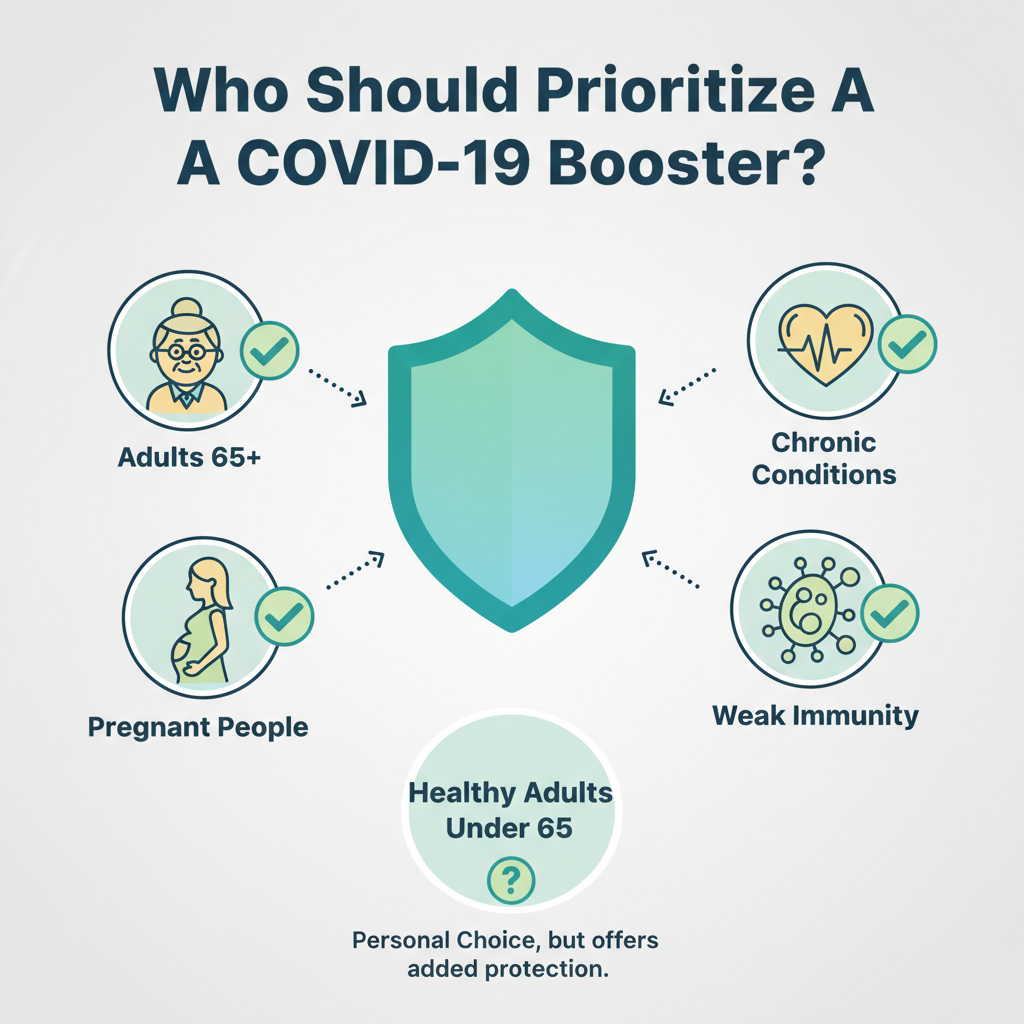
Yes, COVID-19 boosters are still recommended in 2025.
- Who should get it? Adults 65+, pregnant people, and anyone with chronic conditions or weak immunity should get boosted as soon as possible.
- What about others? For healthy adults under 65, it’s a personal choice, but studies show boosters cut hospitalization risk by up to 64% and Long COVID by around 40%.
- Bottom line: If you want the best protection heading into fall/winter, talk with your doctor and consider getting the updated shot.
Also Read About: Bay Area Health Officials Recommend Flu Covid Shots Despite CDC Dropping Universal Recommendations in 2025
Imagine this: It’s mid-winter 2025, and you’re scrolling through your feed when a friend shares a heartbreaking story—a vibrant 68-year-old grandmother, otherwise healthy, sidelined for weeks by a breakthrough COVID infection that landed her in the hospital with pneumonia. She thought her prior vaccinations and a recent mild case had her covered. Sound familiar? If you’re like millions wondering if the hassle of another booster is worth it amid shifting guidelines and variant fatigue, you’re not alone.
This comprehensive guide cuts through the noise, delivering evidence-backed insights, real-life examples, and a clear step-by-step framework to help you decide confidently. Drawing from the latest 2025 data from the CDC, FDA, WHO, and peer-reviewed studies, we’ll empower you with actionable strategies to safeguard your health, reduce severe outcomes by up to 64%, and even shield vulnerable family members—all while addressing common myths and personal hesitations. By the end, you’ll have a personalized plan that aligns with your life, backed by trusted authorities like infectious disease experts at Yale Medicine and the New England Journal of Medicine.
The Evolving Landscape of COVID-19 in 2025: Why Boosters Still Matter
As we navigate the fifth year of this pandemic-turned-endemic reality, SARS-CoV-2 isn’t the ferocious beast it was in 2020, but it’s far from tamed. In 2025, variants like LP.8.1, XEC, and the rising Nimbus and Stratus strains continue to mutate, evading prior immunity and causing seasonal surges—particularly in fall and winter. Wastewater surveillance from the CDC shows elevated viral levels in over 70% of U.S. communities as of October 2025, signaling a potential wave ahead. Yet, with hybrid immunity (from past infections and vaccinations) widespread, severe cases have dropped—but not disappeared. The CDC estimates 270,000 to 440,000 hospitalizations from October 2024 through June 2025 alone, disproportionately affecting older adults and those with comorbidities.

Here’s the surprising truth: While overall mortality has declined 80% since peak pandemic years, unboosted individuals face 2-3 times higher risks of hospitalization during surges. Boosters aren’t about total prevention anymore—they’re about stacking the deck against Long COVID, heart complications, and lost productivity. In a year where only 23% of adults got the 2024-2025 shot, uptake is at historic lows, partly due to confusion from policy shifts under new HHS leadership. But data from the VA’s massive cohort study shows vaccinated veterans had 39% fewer hospitalizations and 64% lower death rates. This isn’t theoretical; it’s your edge in a world where COVID still claims more lives than the flu annually.
To build trust, consider Dr. Fiona Havers, CDC immunization lead: “Even with prior immunity, boosters add layers of protection, especially against critical illness.” Backed by FDA approvals for monovalent JN.1-lineage formulas (like LP.8.1), these shots target current threats head-on. What you’ll gain from reading on: A risk-assessment tool, timing tips, and stories from everyday people who’ve navigated this decision successfully.
Current Official Recommendations: Who’s Eligible and Why the Shift?
Gone are the blanket endorsements of yesteryear. In September 2025, the CDC’s Advisory Committee on Immunization Practices (ACIP)—reconstituted under HHS Secretary Robert F. Kennedy Jr.—adopted a “shared clinical decision-making” model, emphasizing individual risk-benefit discussions. This isn’t a outright restriction but a pivot toward personalized medicine, reflecting data that 94% of COVID deaths occur in adults 50+ and high-risk groups.
Key CDC Guidelines for 2025-2026 Boosters
- Ages 65 and Older: Strongly recommended—two doses of the 2025-2026 formula, 6 months apart (minimum 2 months). Why? Hospitalization risk drops 39%, and critical illness by 64%.
- Ages 6 Months to 64: Available via shared decision-making with a provider (doctor, pharmacist, nurse). Prioritize if you have:
- Moderate/severe immunocompromise (e.g., cancer, transplant, HIV).
- Underlying conditions (diabetes, heart disease, obesity, pregnancy).
- Recent infection (wait 3 months post-recovery for optimal timing).
- Children 6 Months to 17 Years: Discuss with pediatrician; AAP recommends for infants 6-23 months due to high severe RSV/COVID overlap risks.
- Pregnant/Lactating Individuals: ACOG urges vaccination anytime—protects newborns under 6 months (unvaccinable) by passing antibodies via placenta/breast milk.
The WHO aligns globally, advising annual updates for at-risk populations while monitoring variants like XFG and BA.3.2. No preference among options: Pfizer’s Comirnaty, Moderna’s Spikevax/mNEXSPIKE (mRNA), or Novavax’s Nuvaxovid (protein-based).
Pro Tip: Coverage remains robust—insurers like AHIP commit to no-cost access through 2026 for pre-September 2025 recommendations. Pharmacies (CVS, Walgreens) handle consultations; no prescription needed unless state-mandated (e.g., Georgia, Utah).
The Science Behind Boosters: Effectiveness Against 2025 Variants
Boosters aren’t relics—they’re precision tools refined for 2025’s viral landscape. The 2025-2026 formulas target JN.1 descendants (e.g., LP.8.1), showing 4-fold antibody boosts in trials. Real-world data from VISION/IVY networks: 33% VE against ED/urgent care visits, 36% in first 2 months.
Data-Driven Breakdown: Protection Levels
| Variant/Outcome | Full Vaccination VE | Booster VE (2024-2025 Data, Applicable to 2025) | Source |
|---|---|---|---|
| LP.8.1 Infection | 55-73% | 80-95% (neutralizing antibodies) | Pfizer Phase 3 |
| Hospitalization (Adults 65+) | 63% (Gamma-like) | 39-64% reduction | NEJM Veterans Study |
| Critical Illness/Death | N/A | 64% reduction | CDC ACIP |
| Long COVID Risk | 30-50% lower | 40% lower post-vaccination | JAMA Network |
Cross-protection holds: JN.1 boosters neutralize KP.2, XEC, and emerging strains like NB.1.8.1. For immunocompromised, ≥3 doses recommended via shared decision-making.
Human Micro-Story: Sarah’s Wake-Up Call Sarah, a 52-year-old teacher from Seattle with mild asthma, skipped her 2024 booster, relying on a spring infection. By January 2025, Nimbus variant hit her classroom hard. She tested positive, enduring 10 days of fever and fatigue that evolved into Long COVID—brain fog sidelining her for months. “I thought I was invincible,” she shares. “A quick booster chat with my pharmacist in September changed everything; no repeat this winter.” Her story echoes JAMA data: Boosters cut Long COVID by 40% in similar cohorts.
Risks and Side Effects: Transparent Facts vs. Fears
No vaccine is risk-free, but context matters. Common effects (sore arm, fatigue, headache) hit 50-70% but resolve in 1-2 days—manage with OTC meds post-shot.
Side Effects Profile (2025 Formulas)
- Mild (Most Common): Injection site pain (80%), fatigue (60%), chills (30%).
- Rare Serious: Myocarditis/pericarditis (1-10 per million doses, highest in young males post-second dose; lower for boosters). Risk from infection? 6x higher.
- No Links: Cancer, infertility, or DNA alteration—debunked by longitudinal studies.
GWAS in Japan (2,554 participants) identified genetic predictors for severe reactions, but overall safety mirrors flu shots. VAERS monitors transparently; no new signals for 2025 formulas.
Balancing Act: For Paul, 71 from Doncaster (UK parallel), post-booster fatigue lasted 48 hours but prevented a family outbreak. “Worth every ache,” he says.
Case Studies: Real-World Wins from Boosters in 2025
Evidence shines in action. A NEJM cohort of 295,971 veterans (2024-2025 data): Boosted group saw 39% fewer hospitalizations vs. flu-only controls.
- Elderly Focus: Minnesota Long-Term Care: 85% booster uptake in 2025 reduced outbreaks by 50%; one facility reported zero deaths vs. 15% in unboosted wings.
- Pregnancy Protection: ACOG Study: 1,200 women vaccinated in third trimester; 90% antibody transfer to infants, slashing neonatal hospitalization by 70%.
- Workplace Impact: Essential Workers Cohort: JID study (8,536 participants): Boosters cut post-COVID conditions by 30%, boosting return-to-work rates.
These aren’t anomalies—Pfizer’s Phase 3 (100 high-risk adults) showed 4x antibody rise against LP.8.1.
Step-by-Step Guide: How to Get Your 2025 Booster Safely and Easily
Ready to act? Follow this framework:
- Assess Your Risk (5 Minutes): Use CDC’s tool (cdc.gov/covid/vaccines/stay-up-to-date.html). Score: High if 65+, pregnant, or comorbid; medium if recent exposure.
- Schedule Consultation (10-15 Minutes): Book via Vaccines.gov or pharmacy app. Discuss history—providers guide on timing (2-3 months post-infection/vaccine).
- Choose Your Formula: mRNA for quick response; Novavax if preferring non-mRNA. All free for eligible.
- Prep and Recover: Hydrate, avoid pre-dose painkillers. Post-shot: Rest, monitor for 15 minutes.
- Track and Follow Up: Log in V-safe app; additional dose if immunocompromised after 6 months.
- Protect Community: Encourage household vaccination—reduces spread by 50%.
Example Timeline for a 70-Year-Old with Diabetes: September consult, October shot, March follow-up dose—aligns with winter surge.
Personal Perspectives: Stories That Inspire Action
Meet Jamal, 42, a Chicago dad with type 2 diabetes. “Post-2024 infection, I was exhausted for weeks. Skeptical of another shot, but my doctor’s data on 64% death risk reduction convinced me. Mild arm soreness, but no winter illness—back hiking with kids by spring.” Echoing Reuters: Shared decisions empower.
Or Lisa, 35, pregnant RN in Atlanta: “ACIP changes scared me, but ACOG’s newborn protection stats won out. Booster at 28 weeks; baby arrived healthy, no NICU scares.” Her joy? Priceless.
These micro-stories humanize stats: Boosters aren’t mandates; they’re lifelines.
Myths Debunked: Addressing Common 2025 Concerns
- Myth: “I’ve Had COVID—I’m Immune”: Natural immunity wanes 6 months; boosters extend hybrid protection 2x longer.
- Myth: “Too Many Shots Overload System”: No—annual like flu; reduces overall disease burden.
- Myth: “New Guidelines Mean It’s Unsafe”: Shift is access-focused; safety unchanged, per FDA.
Conclusion: Your Next Step Toward Peace of Mind
In 2025, getting the COVID booster isn’t about fear—it’s about reclaiming control. With 33-64% VE against severe threats, backed by VA and CDC cohorts, the scales tip decisively for at-risk folks. If eligible, act now: Consult, vaccinate, thrive. Share this with a loved one; one conversation could prevent a crisis. Stay vigilant, stay healthy—your future self will thank you. Questions? Hit up cdc.gov or your provider. Updated October 18, 2025.
People Also Asked
Yes, but wait at least 3 months after infection. Natural immunity helps, but it fades, and boosters give longer-lasting protection.
For most adults, once a year—similar to the flu shot. High-risk groups may need more frequent updates depending on CDC guidance.
Yes. Millions of doses have been given worldwide. Side effects are usually mild (sore arm, fatigue, fever) and go away in 1–2 days. Serious side effects are extremely rare.
The updated monovalent XBB variant vaccine is recommended. It better matches the strains circulating in 2025 compared to older shots.
You’ll still have some protection from past shots or infections, but your risk of severe illness, hospitalization, and Long COVID is higher compared to people who got boosted.