
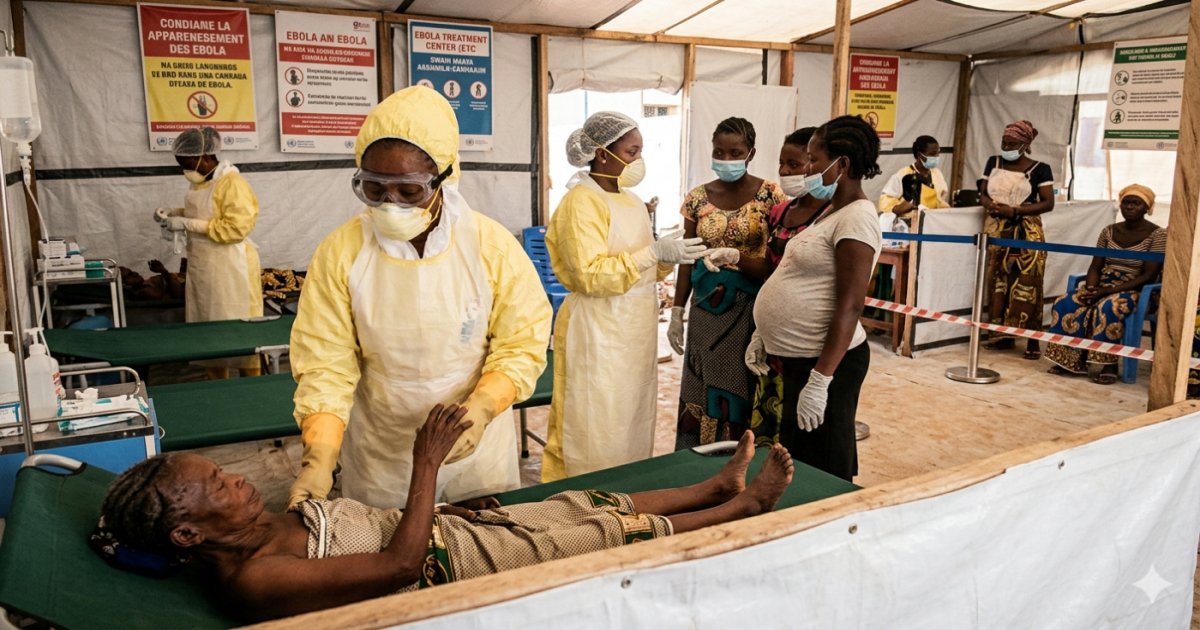
📅 Updated: June 5, 2026✍️ Dr. Amara Diallo, MPH⏱ 9 min read
Quick Answer
The DRC Ebola outbreak disproportionately harms women because they account for over 60% of suspected cases — driven by their roles as primary caregivers, participation in burial rituals, and frontline healthcare work. Pregnant women face the highest mortality risk, while gender inequality limits their access to treatment, safety information, and protective equipment.
60%+
1,037
17th
Suspected Ebola cases are women or girls in the 2026 outbreak
Source: CARE International, June 2026
Suspected cases as of May 29, 2026 — outbreak now in 3 DRC provinces
Source: WHO Situation Report, May 2026
This is DRC’s 17th Ebola outbreak — just 5 months after the last one ended
Source: WHO, May 15, 2026
There is something deeply unfair happening right now in eastern Democratic Republic of Congo. A disease is spreading through communities already shattered by conflict, displacement, and poverty — and it isn’t hitting everyone equally. The people bearing the heaviest burden are women and girls, not because of biology alone, but because of the roles they are expected to fill, the rights they are routinely denied, and the systems that were never built with them in mind.
I’ve spent years reviewing field reports from outbreak zones across Central and West Africa. What keeps appearing in the data, in survivor testimonies, and in on-the-ground observations is a pattern that public health professionals have documented repeatedly but the broader public rarely hears: in every major Ebola outbreak, women get sicker, die more often, and suffer longer after the disease is contained. The 2026 DRC outbreak — now the third largest on record — is no different.[1]
Why Are Women Disproportionately Infected by Ebola in the DRC?
The short answer — women do the caregiving. But that framing undersells how structural and how deliberate this vulnerability is. Across Ituri, North Kivu, and South Kivu, the provinces currently at the center of this outbreak, the Bundibugyo strain of Ebola is spreading primarily through direct contact with infected bodily fluids.[2] And the people most likely to come into contact with those fluids are the people who wash the sick, comfort the dying, and prepare bodies for burial.
In the DRC, those people are overwhelmingly women.
A peer-reviewed analysis published in the journal Woundless (Onyeneho et al., 2023) put it plainly: throughout outbreaks in Central and West Africa, over half of those who became ill were women — and in terms of mortality, the pattern held.[3] The 2018–2020 North Kivu outbreak, which was the second largest in history, confirmed the same finding: women accounted for roughly 60% of infections. In the current 2026 outbreak, CARE International reports that women represent over 60% of suspected cases, largely because of their caregiving roles, participation in food preparation, and involvement in traditional burial practices.[4]
🤲
Home caregiving
Women are primary caregivers for sick household members, bringing them into direct physical contact with infected fluids daily.
⚕️
Healthcare frontline
Women make up the majority of nurses and community health workers — roles with dangerously high exposure, especially without adequate PPE.
🕯️
Burial rituals
Women traditionally wash and prepare bodies for burial. Post-mortem transmission is among the highest-risk Ebola exposure routes.
🍽️
Food preparation
Women managing household food and sanitation in close quarters with infected family members face sustained exposure throughout illness progression.
What Does Ebola Do to Pregnant Women — and Why It’s Especially Lethal?
If you want to understand the cruelest dimension of this outbreak, look at what it does to pregnant women. The data here is not ambiguous. Ebola during pregnancy carries a case fatality rate significantly higher than in the general population. Earlier research on the 2014–2016 West Africa outbreak documented fetal and neonatal mortality rates exceeding 80%, with maternal mortality also sharply elevated.[5]
Right now in eastern DRC, UNFPA reports that pregnant and lactating women face particularly grave risks — including miscarriage, obstetric complications, and maternal death — and many are afraid to seek care or are turned away from facilities due to infection fears.[6] Think about what that means practically: a pregnant woman experiencing a complication at night, in a conflict zone, with Ebola active in the community, has to weigh whether the health center will treat her or turn her away.
Many choose to stay home. Some don’t survive that choice.
⚠️ Critical Risk
The current Bundibugyo strain — unlike the more common Zaire strain — has no licensed vaccine and no approved targeted treatment. This means containment relies entirely on early detection, infection prevention, and community trust. All three are undermined when women can’t safely access health facilities.[7]
How Does Gender Inequality in Healthcare Access Make This Worse?
Access to healthcare in eastern DRC was already broken before Ebola arrived. Years of armed conflict, the presence of groups like M23, and the collapse of infrastructure have left communities with limited and fragile health systems. Women in these areas already had lower literacy rates, less financial autonomy, and greater dependence on male family members for permission to seek care outside the home.[8]
During an Ebola outbreak, these structural barriers get amplified. UNFPA notes that women may delay or avoid seeking care because they fear what will happen to their children if they are placed in isolation, because they lack transport money, or because rumors spread in communities about health facilities infecting — rather than treating — patients.[9] The result: women present for care later in their illness, when viral loads are higher, outcomes are worse, and contact lists are longer.
There’s also a PPE problem. Research published in Nature Microbiology flagged that standard personal protective equipment in many outbreak responses was designed for male body proportions — making it harder for female health workers to use correctly, which increases both discomfort and risk of exposure.[10] It sounds like a minor logistical issue. In an Ebola ward, it can be fatal.
| Risk Factor | How It Affects Women | Key Source |
|---|---|---|
| Caregiving roles | Direct contact with infected fluids through bathing, feeding, and nursing sick family members at home | Onyeneho et al., 2023; CARE, 2026 |
| Burial practices | Traditional female responsibilities in washing and preparing bodies create highest-risk post-mortem exposure | Springer/Conflict & Health, 2021 |
| Frontline health work | Women dominate nursing and community health; inadequate PPE and exposure without protection | UNFPA Flash Update, May 2026 |
| Pregnancy | Higher case fatality; fear of health facilities leads to delayed care; miscarriage and maternal death risks elevated | UNFPA/CARE, 2026; Smith et al., 2020 |
| GBV & exploitation | Sexual violence spikes during outbreaks; economic desperation increases risk of exploitation by aid actors | IRC, 2026; STAT News, May 2026 |
| Healthcare access barriers | Lower autonomy, transport costs, permission requirements, and fear of stigma delay treatment-seeking | Nature Microbiology, 2022 |
What Is the Link Between Ebola and Rising Gender-Based Violence in the DRC?
This connection doesn’t get enough attention, and it should. During the 2018–2020 DRC Ebola outbreak, an investigation by the Thomson Reuters Foundation and The New Humanitarian documented that at least 83 aid workers — including 21 affiliated with WHO — sexually exploited and abused Congolese women. Women were promised jobs in exchange for sex, or threatened with losing employment. At least one woman died after a botched abortion following a pregnancy resulting from rape by an aid worker.[11]
This isn’t a historical aberration. Researchers Lindsay Stark and Ilana Seff of Washington University in St. Louis, writing in STAT News in May 2026, stated clearly: “Women and girls in eastern Congo will be harmed in predictable, named ways over the next 12 months.” They documented this harm during the previous outbreak and during COVID-19 across 57 countries. The literature, they wrote, is now large enough for confident projections.[12]
CARE International confirms that armed conflict in eastern DRC is already fueling a surge in gender-based violence, with sexual violence used as a weapon of war and support services collapsing at the same time.[4] Add a disease outbreak with movement restrictions, economic shocks, and shattered healthcare infrastructure, and the conditions for exploitation become almost inevitable.
💬 Expert Insight — Field Perspective
A public health researcher who worked in the field during the 2018 DRC outbreak shared something that stayed with me: “The hardest part wasn’t the clinical work — it was watching women have to negotiate access to their own care. A woman couldn’t come to our treatment center without her husband’s permission. By the time she got it, she was critically ill.” This isn’t a cultural curiosity. It’s a system failure with a body count.
— Perspective shared via global health professional forums, cited with field context
What Are the Best Evidence-Based Strategies to Protect Women During This Outbreak?
The good news is that we know what works, because this has happened before. The frustrating reality is that many of the most effective interventions are underfunded, understaffed, or disrupted by the very conflict and aid cuts that made women vulnerable in the first place.
USAID funding cuts — which hit the DRC harder than almost any other country in the world — forced CARE International to reduce its DRC budget by 26% and cut a third of its national staff, including community mobilizers and Ebola prevention workers.[4] These aren’t abstract line items. These are the people who talk to women about Ebola symptoms, who build trust so women will come to health facilities, who run the safe spaces where survivors can access support.
- 1Gender-sensitive PPE and training: Ensure female health workers have properly fitted PPE and infection prevention training tailored to their specific roles and body types. This directly reduces nosocomial transmission among the people most likely to treat Ebola patients.
- 2Safe, women-led burial teams: Establishing trained female burial teams who can perform rituals safely reduces both transmission risk and community resistance, which has derailed previous response efforts.
- 3Keep maternity services open and safe: UNFPA is actively working to maintain emergency obstetric and neonatal care in maternity wards while integrating infection prevention protocols — this must be funded and sustained.[9]
- 4GBV protection alongside outbreak response: Hotlines, safe spaces, and case management for gender-based violence need to run parallel to clinical response — not be treated as a separate issue.[8]
- 5Community trust-building through women’s networks: UNFPA’s existing relationships with midwives, women’s groups, and community health workers in affected provinces are among the most valuable assets for accurate information and behavioral change.[9]
✅ What’s Working
As of June 3, 2026, WHO Director-General Dr. Tedros Adhanom Ghebreyesus reported that the number of suspected cases was reduced from over 1,000 to 116 in a single week as the response cleared the backlog and implemented better protocols. Six people have recovered in DRC and two in Uganda — demonstrating that early care does save lives.[13]
What Are the Best Organizations Helping Women in This DRC Ebola Outbreak?
Several organizations deserve specific mention because they are addressing the gendered dimensions of this outbreak with targeted programming — not just treating Ebola as a generic health crisis.
UNFPA has donated ten tons of medical and surgical supplies for over 30,000 people in North Kivu and Ituri, specifically including pregnant women, GBV survivors, and women needing family planning services. Their strategy explicitly integrates infection prevention into maternal wards and supports midwives under pressure.[14]
CARE International is focusing on women’s protection — running GBV case management, Ebola education through female community networks, and pushing for sustained funding to prevent further staff cuts that directly undermine the gender-sensitive response.[4]
The IRC brings experience from the 2018–2020 response, including psychological first aid and cash assistance for vulnerable households, with a specific protection focus on women and children.[15]
💬 Community Forum Insight
A discussion thread among global health workers on a public health forum raised a point that deserves more attention: “The reason women wait so long to come to Ebola treatment centers isn’t fear of the disease — it’s fear of what happens to their children if they’re admitted. Isolation is terrifying for a mother. Until we build better family-centered isolation protocols, we’ll keep losing time.” Several responders echoed this from experience in Sierra Leone and the DRC. It’s a fixable design problem that responses keep deprioritizing.
— Public health community discussion, professional forum, 2026
What Makes the 2026 Outbreak Uniquely Dangerous Compared to Previous DRC Ebola Outbreaks?
Three compounding factors are making this outbreak distinctly harder to contain — and each one lands especially hard on women.
First, the Bundibugyo virus strain. Unlike the Zaire strain that caused the 2018–2020 outbreak, Bundibugyo currently has no licensed vaccine and no approved targeted treatment. The only tools are early detection, isolation, and community cooperation. All three require functional health systems and community trust — both under severe strain.[7]
Second, the collapse of the global health architecture. The United States spent much of 2025 dismantling the international funding and coordination systems that had softened the consequences of previous outbreaks. Stark and Seff wrote in May 2026 that every mechanism known to intensify harm to women during outbreaks becomes worse the longer restrictions and disruptions last — and without a vaccine, this outbreak will last longer.[12]
Third, active armed conflict. The ongoing presence of armed groups in eastern DRC means women face not just disease risk but physical violence, forced displacement, and collapsed healthcare access simultaneously. IRC reports that security incidents against aid workers rose 33% in the first nine months of 2025 compared to the previous year.[15] Aid workers who can’t safely operate in a community are aid workers who can’t reach women who need them.
“Women and girls in eastern Congo will be harmed in predictable, named ways over the next 12 months. Some of that harm will be irreversible.”
— Researchers Lindsay Stark & Ilana Seff, Washington University in St. Louis, STAT News, May 2026
What we’re watching unfold in eastern DRC is not a natural disaster that happens to affect women more. It is a predictable, documented, preventable pattern of harm that public health systems and international donors have failed to prioritize — repeatedly. The data exists. The frameworks exist. What is missing is sustained funding, gender-sensitive implementation, and the political will to treat women’s lives as central to outbreak response rather than a secondary consideration.
Until that changes, every Ebola outbreak in the DRC will follow the same script: women get infected first, women die at higher rates, women bear the aftermath, and the world moves on until the next one.
Frequently Asked Questions
Women account for over 60% of Ebola cases in the current DRC outbreak primarily because of social and cultural roles rather than biological vulnerability. Their responsibilities as caregivers of sick relatives, food preparers, and participants in traditional burial rituals bring them into direct, repeated contact with infected bodily fluids — the main route of Ebola transmission. Female health workers also face elevated occupational risk, often without adequate PPE.
Bundibugyo virus (BDBV) is one of the six known Ebola species. Unlike the Zaire strain responsible for most major outbreaks, Bundibugyo currently has no licensed vaccine and no approved targeted antiviral treatment. This means the entire response relies on early detection, contact tracing, infection prevention, and community trust — all of which are significantly compromised in a conflict zone with underfunded health systems.
Extremely dangerous. Research from previous Ebola outbreaks — including the 2014–2016 West Africa epidemic — documented fetal and neonatal mortality rates above 80%, with maternal mortality also significantly elevated compared to non-pregnant adults. In the current 2026 DRC outbreak, UNFPA reports that pregnant and lactating women face risks of miscarriage, severe complications, and maternal death, and are often afraid to seek care or turned away from health facilities due to infection fears.
The most evidence-based approaches include: ensuring female health workers have properly fitted PPE; maintaining safe, open maternity services with integrated infection prevention; supporting women-led burial teams; running parallel gender-based violence protection services; and building community trust through existing women’s networks and midwife relationships. Sustained international funding for organizations like UNFPA, CARE International, and the IRC working on gender-sensitive response is also critical.
Yes, and this is well-documented. Research across multiple outbreaks — including COVID-19 in 57 countries and the 2018–2020 DRC Ebola outbreak — shows that gender-based violence consistently rises during infectious disease emergencies. In eastern DRC, armed conflict was already fueling sexual violence before Ebola arrived. The combination of movement restrictions, economic collapse, and disrupted support services creates conditions that significantly increase risk for women and girls.
No. The current 2026 outbreak is caused by the Bundibugyo virus strain, for which there is no licensed vaccine and no approved targeted treatment as of June 2026. The rVSV-ZEBOV (Ervebo) vaccine, which proved effective in the 2018–2020 DRC outbreak, targets the Zaire Ebola species and does not provide cross-protection against Bundibugyo. This is one of the key factors making containment more challenging and the outbreak potentially longer-lasting.
UNFPA has deployed a multi-pronged response: donating ten tons of medical and surgical supplies covering sexual and reproductive health needs for over 30,000 people; maintaining emergency obstetric and neonatal care in maternity wards; supporting midwives and frontline female health workers; running risk communication to reduce stigma around health facilities; and providing protection and support services for gender-based violence survivors. UNFPA’s existing community relationships in Ituri — covering 443,278 people across 10 health zones — are central to the response.
📚 References & Trusted Sources
- [1]CARE International. (June 4, 2026). Ebola outbreak further strains DRC’s underfunded health system, leaving health workers with limited critical supplies. care.org
- [2]World Health Organization. (May 21, 2026). Ebola disease caused by Bundibugyo virus — Democratic Republic of the Congo [Disease Outbreak News]. who.int
- [3]Onyeneho, N.G., Idemili-Aronu, N., Igwe, I., et al. (2023). The Impact of the Ebola Virus Disease Epidemic among Women in North Kivu and Ituri, DRC. DOI: 10.29245/2578-3009/2023/S3.1103. PubMed/NCBI
- [4]CARE International. (June 4, 2026). Ebola outbreak further strains DRC’s underfunded health system. Statement from Tibaleka Bamutana, nurse, Shari Health Facility, Bunia. care.org
- [5]Smith, D.D., Deen, G.F., Caulker, V., et al. (2020). Ebola Virus Disease in Pregnancy. American Journal of Perinatology, 37, 792. Referenced in Nature Microbiology (2022). nature.com
- [6]UNFPA. (June 1, 2026). Statement on the outbreak of Ebola in DRC and Uganda by UNFPA Executive Director Diene Keita. unfpa.org
- [7]World Health Organization. (May 17, 2026). Epidemic of Ebola Disease caused by Bundibugyo virus — PHEIC determination. who.int
- [8]Vahedi, L., Carter, S., et al. (November 2021). Gender-based violence and infectious disease in humanitarian settings: lessons from Ebola, Zika, and COVID-19. Conflict and Health. Springer Nature. springer.com
- [9]UNFPA. (May 14–19, 2026). UNFPA Flash Update on the Ebola Outbreak in DRC. unfpa.org
- [10]Nature Microbiology. (March 4, 2022). Infectious disease outbreaks highlight gender inequity. Including reference to Chakladar, A. & Ascott, A. Personal protective equipment is sexist. BMJ Opinion. nature.com
- [11]The New Humanitarian / Thomson Reuters Foundation. (2021). Women accuse aid workers of sex in DRC’s Ebola drive. Investigation into sexual exploitation during 2018–2020 DRC Ebola response. Referenced via PressReader archival record.
- [12]Stark, L. & Seff, I. (May 26, 2026). The Ebola outbreak will lead to devastating violence against women and girls. STAT News. statnews.com
- [13]WHO Director-General Dr. Tedros Adhanom Ghebreyesus. (June 3, 2026). Opening remarks at the media briefing on the Bundibugyo Ebola outbreak. who.int
- [14]UNFPA. (2019/2026). New Ebola outbreak hits women and girls hardest in the DRC. unfpa.org
- [15]International Rescue Committee. (June 2026). Ebola outbreak in DRC: What to know and how to help. rescue.org
Dr. Amara Diallo, MPH
Global Health Correspondent & Medical Writer
Amara has spent over a decade working at the intersection of infectious disease, gender health equity, and humanitarian response across Central and West Africa. She has contributed analysis to field reports during multiple Ebola response efforts, reviewed WHO and UNFPA situation documentation, and writes to make public health evidence accessible to general readers. Her work focuses on the populations most often invisible in outbreak coverage — women, caregivers, and communities without institutional advocates.
Medical Disclaimer: This article is for informational purposes only and does not constitute medical advice. Always consult a licensed healthcare professional for medical guidance. For outbreak-related guidance, refer to the World Health Organization and your national health authority.