
Medically Reviewed and Compiled by Dr. Adam N. Khan, MD.
Key Takeways:
- Active Components: mRNA vaccines (Pfizer-BioNTech, Moderna) contain laboratory-made messenger RNA that provides instructions to build a harmless spike protein, while protein-based vaccines (Novavax) deliver purified spike protein directly.
- Protective Delivery Shell: Microscopic lipid nanoparticles (fatty bubbles made of lipids, cholesterol, and PEG) enclose and safeguard fragile mRNA, ensuring safe cell entry without altering human DNA.
- Stabilizers & Buffers: Common salts, sugars (sucrose), and pH balancers maintain vaccine stability, prevent degradation during freezing, and keep the pH balanced with human bodily fluids.
EMERGENCY WARNING: If you experience difficulty breathing, swelling of your face, lips, throat, or tongue, severe chest pain, persistent dizziness, or rapid heart rate shortly after receiving a vaccination, call 911 or seek immediate emergency medical attention immediately.
Understanding COVID-19 Vaccine Formulations
When COVID-19 vaccines were introduced worldwide, many individuals wondered exactly what substances were being injected into their bodies. Public health organizations such as the Centers for Disease Control and Prevention (CDC) and the World Health Organization (WHO) maintain strict disclosure standards regarding vaccine ingredients.
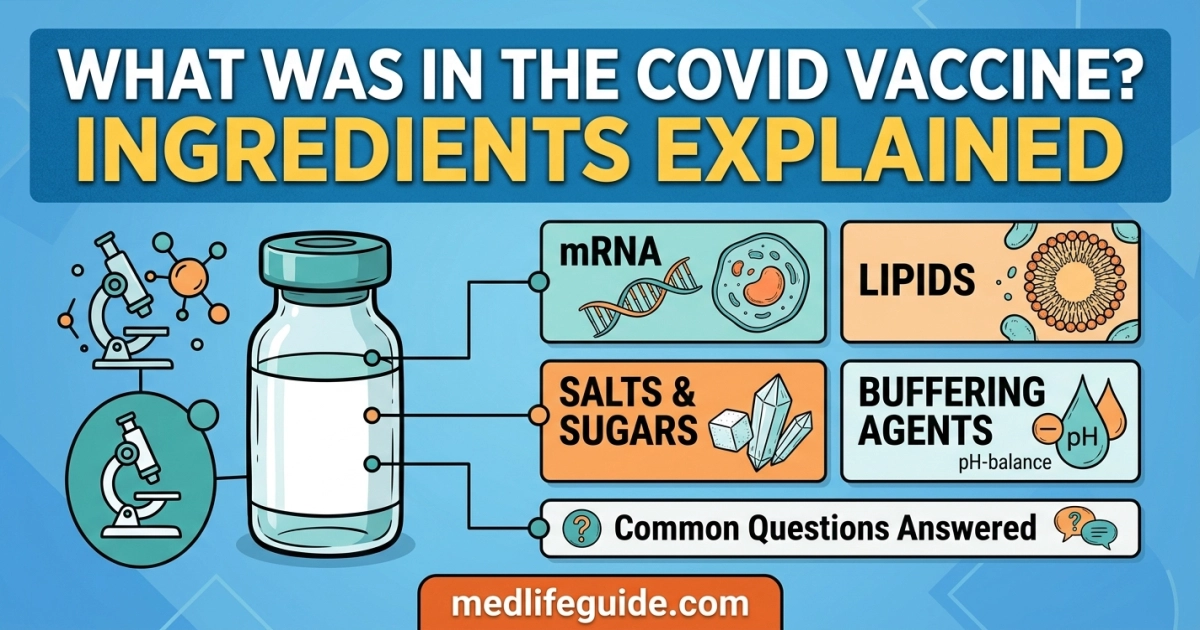
At a high level, COVID-19 vaccines consist of a primary active ingredient designed to prompt immune recognition, surrounded by protective lipids (fats), sugar, and balanced salt buffers. None of the authorized or approved COVID-19 vaccines contain live virus particles, antibiotics, microchips, mercury, aluminum, or human fetal tissues.
Active Ingredients: Delivering the Signal
The active ingredient in a vaccine is the specific molecule that teaches the immune system how to recognize the virus.
Messenger RNA (mRNA) Vaccines
Pfizer-BioNTech (Comirnaty) and Moderna (Spikevax) utilize synthetic messenger RNA (mRNA).
- Nucleoside-Modified mRNA: The vaccine contains a highly purified snippet of synthetic mRNA. This mRNA acts like a temporary instruction manual for human cells to manufacture a non-infectious piece of the SARS-CoV-2 spike protein.
- No Genomic Integration: mRNA remains exclusively within the cell’s cytoplasm and cannot enter the cell nucleus or modify human DNA. The cell naturally breaks down and clears the mRNA strand within days after translation.
Protein Subunit Vaccines
Novavax utilizes a traditional protein-based mechanism.
- Recombinant Spike Protein: Novavax directly delivers microscopic nanoparticles containing purified SARS-CoV-2 spike proteins.
- Matrix-M Adjuvant: Novavax includes an adjuvant derived from saponins (compounds found in the soapbark tree) to boost the body’s immune response to the protein.
Inactive Ingredients: Protection and Stability
Because naked mRNA and viral proteins are fragile molecules, vaccines rely on specific inactive ingredients (excipients) to ensure structural stability during manufacturing, deep-freeze storage, and injection.
Lipid Nanoparticles (LNPs)
mRNA is delicate and naturally breaks down if exposed directly to enzymes in blood or tissue. To protect it, manufacturers encapsulate mRNA in microscopic oil-like spheres called lipid nanoparticles.
- Ionizable Lipids: Such as SM-102 (Moderna) or ALC-0315 (Pfizer), which carry a positive charge to bind negatively charged mRNA.
- Phospholipids & Cholesterol: Structural fats that reinforce the particle wall, mimicking natural cell membranes.
- Polyethylene Glycol (PEG): A PEGylated lipid outer layer that stabilizes the nanoparticle and prevents aggregation.
Salts and pH Buffers
Vaccines contain salt solutions to keep the liquid’s acidity (pH) matched to human blood and tissue fluids.
- Common Salts: Sodium chloride (table salt), potassium chloride, monobasic potassium phosphate, and dibasic sodium phosphate dihydrate.
- Tromethamine (Tris): Used as an acid-base stabilizer in Moderna and pediatric formulations to improve room-temperature stability during handling.
Sugars
- Sucrose: Standard table sugar acts as a cryoprotectant. It prevents the lipid nanoparticles from freezing together or cracking while stored at sub-zero temperatures.
Unique Clinical Takeaways
- Differential Excipient Sensitivity (PEG vs. Polysorbate 80): Individuals with a confirmed or suspected severe allergy to Polyethylene Glycol (PEG)—found in Pfizer and Moderna—can often safely receive Novavax, which uses Polysorbate 80 instead, under physician supervision.
- Rapid Biological Clearance: Neither the synthetic mRNA nor the lipid envelope remains in the human body long-term. The mRNA breaks down via normal enzymatic cellular processes within 3 to 10 days, while the lipids are metabolized by the liver.
- Buffer Modernization Reduces Injection Reactions: The transition from legacy phosphate-buffered saline (PBS) to tromethamine (Tris) buffers in newer formulations extended shelf-life at refrigerated temperatures and reduced local injection-site sting.
Detailed Breakdown of Major Vaccine Brands
| Vaccine Brand | Active Platform | Key Lipids / Adjuvants | Stabilizing Buffers | Sugar / Cryoprotectant |
| Pfizer-BioNTech | Nucleoside-modified mRNA | ALC-0315, ALC-0159 (PEG lipid), DSPC, Cholesterol | Tromethamine, Tromethamine HCl, Potassium & Sodium Salts | Sucrose |
| Moderna | Nucleoside-modified mRNA | SM-102, PEG-2000-DMG, DSPC, Cholesterol | Tromethamine, Tromethamine HCl, Acetic Acid, Sodium Acetate | Sucrose |
| Novavax | Recombinant Spike Protein | Matrix-M Adjuvant (Saponins, Cholesterol, Phosphatidylcholine) | Sodium Phosphate, Sodium Chloride, Polysorbate 80 | Disodium Hydrogen Phosphate Dihydrate |
Common Misconceptions and Ingredients NOT Included
Medical authorities publish complete ingredient lists to dispel common myths. The following substances are never present in FDA-authorized COVID-19 vaccines:
- No Preservatives: No thimerosal or mercury derivative.
- No Heavy Metals: No aluminum, lead, or nickel.
- No Antibiotics: No penicillin or neomycin.
- No Microchips or Trackers: The solutions contain only simple chemical salts, fats, sugar, and genetic molecules.
- No Live Virus: Cannot cause active SARS-CoV-2 infection.
Frequently Asked Questions (FAQs)
No, the mRNA strand breaks down naturally inside your cells within a few days after vaccination, leaving only the protective antibodies your body produced.
No, the vaccine mRNA never enters the cell nucleus where your DNA is stored, making it biologically impossible to alter your genetic code.
In rare cases, severe allergic reactions are caused by inactive ingredients like Polyethylene Glycol (PEG) in mRNA vaccines or Polysorbate 80 in protein subunit vaccines.
mRNA molecules and lipid nanoparticles are delicate and easily degrade at room temperature, requiring sugar cryoprotectants and sub-zero freezing to maintain stability.
No, none of the authorized COVID-19 vaccines contain live coronavirus, so you cannot contract COVID-19 from getting vaccinated.