
Written by the MedLifeGuide editorial team. Medically reviewed by Adam N. Khan, M.D., internal medicine. Reviewed Nov 21 2026. General education only, not a personal prescription.
The question usually arrives on a Tuesday, right after a lab report. Potassium 5.4. A diet sheet with a long list of foods and very little explanation. And a person sitting at a kitchen table wondering whether the two cups of tea that hold their morning together are now off limits.
Can CKD Patients Drink Tea or Coffee?
Here is the answer most nephrology teams would give. For most adults with chronic kidney disease who are not on dialysis, who have a potassium level in range and whose blood pressure is controlled, one to two standard 8 ounce cups of plain coffee or plain tea a day is a reasonable place to start. It is not a free pass, and it is not a prescription either. What changes the answer is not the coffee bean. It is the size of the cup, the milk or creamer that goes in it, whether you are on a fluid limit, and what else you swallow in the same hour as that cup.
| The short answer, before anything else Yes, for most people with CKD stages 1 to 4. Plain coffee and plain tea are low potassium drinks per standard serving, and current guidance does not ask for potassium restriction in CKD unless there is a reason to restrict it. The cup is rarely the problem. The mug size, the milk, the creamer, the added phosphate, the fluid count on dialysis and the timing around tablets are the parts that need attention. Three groups need a conversation before the first cup. Anyone with a potassium level above target in the last few months, anyone on a fluid restriction, and anyone whose blood pressure climbs after caffeine. This is general education, not a personal prescription. Your own numbers, medicines and stage decide your limit. The article will show you exactly which numbers to bring to that conversation. |
Why the advice you read ten years ago sounds different
Older patient leaflets often treated caffeine as a kidney irritant. That advice was mostly precaution, not trial evidence. The evidence has moved, and it has moved in a more interesting direction than a simple reversal.
A large cross-sectional analysis of US adults published in 2025 found that higher coffee, tea and caffeine intake were each associated with lower odds of CKD, and that each additional 100 mg of caffeine per day was associated with an eGFR about 0.23 mL/min/1.73 m2 higher (Scientific Reports, 2025). A Dutch population cohort of 78,346 people without CKD at baseline reported that higher coffee intake was associated with slightly less annual eGFR decline, with the largest difference in people drinking more than six cups a day (Nutrition, Metabolism and Cardiovascular Diseases, 2024). A pooled analysis of four observational studies found a direction of benefit but a confidence interval that crossed one, which means the pooled result alone cannot be called conclusive.
Then the picture gets less tidy. In PREDIMED-Plus, a cohort of 5,851 older adults with overweight or obesity and metabolic syndrome, drinking more than two cups of caffeinated coffee a day was associated with a 0.88 mL/min/1.73 m2 greater one year decline in eGFR, and a 19 percent higher risk of rapid eGFR decline. Decaffeinated coffee showed no such association (Scientific Reports, 2021). A 2025 Japanese cohort added a further wrinkle: the association between coffee and kidney function differed by genotype, and in people who metabolise caffeine slowly, higher intake was associated with lower eGFR (European Journal of Nutrition, 2025).
Three conclusions follow, and all three belong in a patient article.
- These are observational studies. They describe associations, not causes, and the differences are small in absolute terms.
- The people most likely to show a downside were older adults with metabolic syndrome, obesity or slow caffeine metabolism. That is a large share of the CKD population.
- Nothing here justifies starting coffee for kidney protection, and nothing here justifies banning it for someone who tolerates it well.
The practical consequence is a shift in the question. The useful question is not “is coffee bad for kidneys” in general. It is “is this particular cup compatible with this particular person’s potassium, fluid allowance, blood pressure and medicine schedule”. That question has a specific answer, and it can be worked out in a few minutes.
The four things that actually decide your answer
Four variables carry almost all of the risk. They also happen to be the four things most patient handouts leave out.
1. Potassium: the number that matters is per serving, not per sip
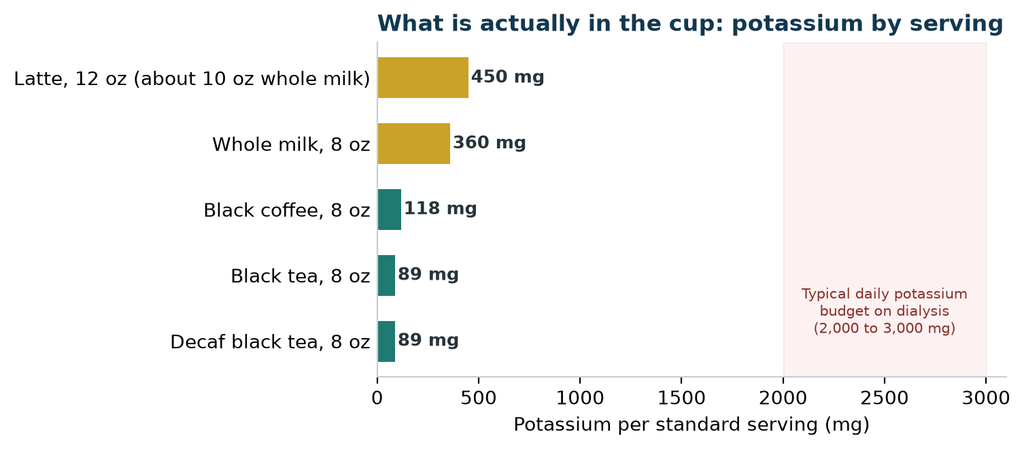
Per 100 grams, brewed coffee contains about 49 mg of potassium and brewed black tea about 37 mg. Scaled to a standard 8 fluid ounce serving, that is roughly 118 mg for coffee and 89 mg for black tea, with only about 7 mg and 2 mg of phosphorus respectively (USDA FoodData Central, 2019). Both drinks are low potassium choices at that size. The trouble starts with what gets poured around them.
| Drink, as actually poured | Potassium | Phosphorus | Caffeine | What it means |
| Black coffee, 8 oz | about 118 mg | about 7 mg | about 96 mg | Low potassium, low phosphorus. The default safe cup. |
| Black tea, 8 oz | about 89 mg | about 2 mg | about 48 mg | Slightly lower than coffee on both minerals and caffeine. |
| Decaf black tea, 8 oz | about 89 mg | about 2 mg | about 2 mg | Decaffeination does not remove potassium. |
| Whole milk, 8 oz | about 360 mg | about 242 mg | 0 mg | Milk is the hidden load in most coffee orders. |
| Latte, 12 oz (about 10 oz milk) | about 450 mg | about 300 mg | varies by shot count | One cafe latte can use a fifth of a dialysis potassium budget. |
| Cafe drip coffee, 16 oz | about 236 mg | about 14 mg | about 192 mg | Two standard servings in one cup. Count it twice. |
Table 1 sources: USDA FoodData Central records for brewed coffee, brewed black tea, decaffeinated brewed black tea and whole milk, all published April 2019.
Two nuances keep this from becoming a simple potassium counting exercise.
First, KDIGO’s 2024 CKD guideline explicitly does not endorse blanket potassium restriction. It notes that in earlier CKD, foods naturally rich in potassium appear protective, and that highly processed foods containing potassium additives are a bigger problem than fresh plant foods because additive potassium is absorbed at around 90 percent while much of the potassium in unprocessed plant food is not (KDIGO 2024 CKD Guideline, practice point 3.11.5). A black coffee has no additives. A whipped, flavored, shelf stable coffee drink may have several.
Second, a single number is a poor guide on its own. If your last potassium was 4.6 and stable across three checks, a daily cup is a very different proposition than if it was 5.6 last month. The National Kidney Foundation defines hyperkalemia as a serum potassium above 5.0, with levels above 6.0 in the danger zone, and notes that the speed of the rise can matter as much as the number (National Kidney Foundation). For reference, a typical dialysis diet targets 2,000 to 3,000 mg of potassium a day (University of Florida IFAS, 2016).
2. Fluid: the cup is also a unit of water
On hemodialysis, most patients are asked to keep fluids to around 32 ounces, or about 1 liter, per day between treatments (National Kidney Foundation). In that budget, a 16 ounce coffee is half the day gone before breakfast. This is the single most common reason a dialysis patient is told to cut back, and it has nothing to do with potassium at all.
Peritoneal dialysis is usually more flexible, and many people still pass urine, which is sometimes added to the allowance. Both depend on the prescription, the residual kidney function and the fluid removed per treatment. This is a conversation with the dialysis team, not a rule from an article.
A small practical note that patients discover for themselves: caffeine is a mild diuretic and a stimulant, and thirst often follows. In a forum thread on fluid limits, one person calculated their allowance as roughly four twelve ounce drinks a day and spent two of them on breakfast coffee (r/dialysis). Another said their morning cup was a quarter of the daily limit before they had eaten anything (r/dialysis). Those are not clinical findings. They are accurate descriptions of why the fluid conversation needs to happen before the habit is set.
3. What goes into the cup
This is where most of the potassium, phosphorus and calories in a coffee habit actually live. Plain black coffee has almost nothing in it. A blended drink with milk, syrup and whipped cream can be a small meal.
- Milk. Eight ounces of whole milk carries about 360 mg of potassium and 242 mg of phosphorus (USDA FoodData Central, 2019). A large latte is mostly milk. If you are counting either mineral, this is the first place to look.
- Creamers. Many commercial non dairy creamers and flavored coffee mixes contain phosphate additives and often potassium additives too. Added phosphate is absorbed far more completely than the phosphorus naturally present in food, which is why renal dietitians read creamer labels closely.
- Sugar and syrup. Not a kidney mineral problem in the short term, but relevant for readers with diabetes, which is the most common cause of kidney failure in the United States.
- Protein and supplement powders. Trend drinks that add collagen, protein or “electrolyte” blends can carry meaningful potassium and phosphorus. A steep rise in potassium after starting one of these is worth mentioning to your team.
- Instant and flavored coffee. Read the ingredient list for phosphate salts and potassium salts. Plain instant coffee itself is low in both.
4. Timing: the medicine cabinet comes first
People with CKD usually take several medicines, and three of them interact with a cup of coffee or tea in ways that matter.
| Medicine or supplement | What coffee or tea does | Practical spacing |
| Levothyroxine (Synthroid and similar) | Coffee taken with the tablet reduced levothyroxine absorption by about 36 percent in one crossover study. A gap of 60 minutes gave absorption similar to water alone (Benvenga et al., Thyroid, 2008). | Take with water, wait 30 to 60 minutes before coffee; 60 minutes is the more reliable choice. Some clinicians prefer longer with calcium or iron. |
| Oral iron | Polyphenols bind non heme iron in the gut. In a classic test meal study, coffee cut iron absorption by about 39 percent and tea by about 64 percent (Morck et al., 1983). Milk did not fix it (Hurrell et al., 1999). | Separate by at least one hour before, and about two hours after, an iron dose. Tea is the stronger blocker of the two. |
| Phosphate binders | Binders work on the phosphorus in the meal or drink they are taken with. A milky coffee counts as phosphorus. | Take the binder with the drink, exactly as you would with food, if your team has prescribed it that way. |
| Potassium binders | These medicines have their own timing rules and can affect other medicines. | Follow the label and your pharmacist’s instruction, not a general rule from an article. |
Table 2. Spacing rules are the ones used in the cited studies and in standard patient guidance. Confirm with your prescriber, because formulations differ.
The tea and iron interaction deserves a second sentence, because iron deficiency is common in CKD and oral iron is often prescribed. If you take your iron tablet with breakfast tea every morning, you may be absorbing a good deal less of it than your prescription assumes. Moving the tea one hour later is a cheap, safe experiment that your next blood test will reveal.
Where caffeine sits in all this
Caffeine is a stimulant before it is anything else. In a meta-analysis of randomized trials, regular caffeine intake raised blood pressure modestly, with a 4.16/2.41 mmHg rise when caffeine was given on its own and a much smaller 1.22/0.49 mmHg rise when the same amount arrived as coffee (Noordzij et al., Journal of Hypertension, 2005). A 2023 dose-response meta-analysis found caffeine supplementation increased systolic pressure by about 1.9 mmHg and diastolic by about 1.7 mmHg. Small averages, but averages hide the people who respond strongly.
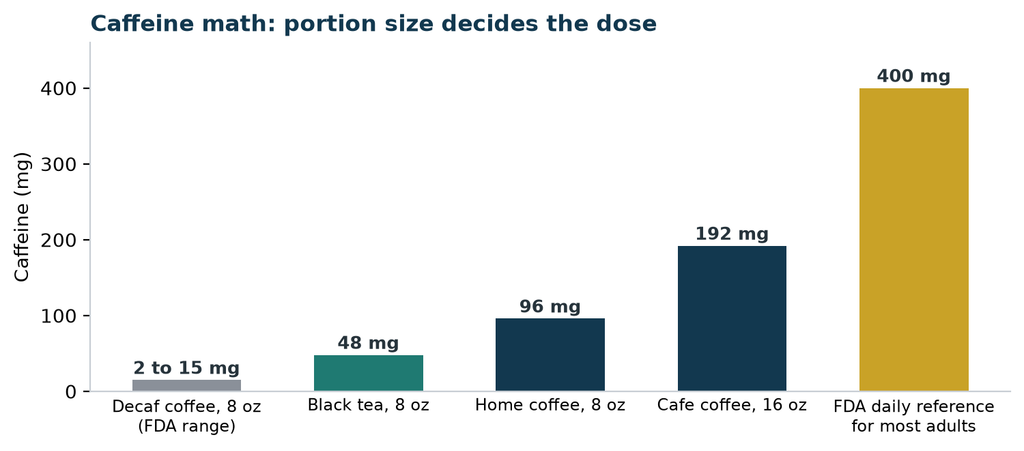
Two practical points. First, portion size dominates. A home mug and a cafe cup are different doses of the same drink. Second, tolerance is real but incomplete, and it varies with genetics and with blood pressure status. If your home readings run 10 points higher in the hour after your cup, that is worth a conversation, whatever the population averages say.
Where you sit on the CKD timeline
Stage is a starting point, not a verdict. The right column matters more than the middle one.
| Situation | Typical starting guidance | What decides your personal answer |
| CKD stage 1 to 2 | Plain coffee or tea in normal amounts, usually 1 to 3 cups a day, is generally fine. Blood pressure control is the main issue. | Your blood pressure log and whether caffeine pushes it up. |
| CKD stage 3a to 3b | Most people can keep 1 to 2 standard cups. Watch the additions, not the drink. | Latest potassium and phosphate, plus any binder prescription. |
| CKD stage 4 | Often still fine, but this is the stage where individual potassium limits start to appear. Keep cups standard sized and mostly black. | Potassium trend across the last three labs, fluid status, and dietitian advice. |
| CKD stage 5, not on dialysis | Individualised. Some teams reduce caffeine for blood pressure or sleep; some do not restrict it at all. | Potassium, fluid status, blood pressure and symptoms. |
| Hemodialysis | Fluid comes first. Most patients have about 32 ounces a day, and one large coffee can use half of it. Potassium matters if your level runs high. | Your dry weight, fluid gain between treatments, and potassium target. |
| Peritoneal dialysis | Usually more fluid flexibility. Potassium still depends on your labs. | Your prescription and residual kidney function. |
| Kidney transplant | Coffee is generally acceptable. The priorities move to blood pressure, bone health, blood sugar and drug timing. | Immunosuppressant timing, blood pressure, blood sugar. |
| Autosomal dominant PKD | Older advice to avoid caffeine has weakened. Two human cohort studies found no clinically important effect of coffee or caffeine on kidney volume or function. | Blood pressure, because caffeine can raise it in some people. |
| Kidney stone former | Coffee and tea are associated with lower stone risk, not higher, in large cohorts. Fluid volume still does most of the work. | Stone type, urine volume, and your 24 hour urine results. |
Table 3. Stage-by-stage starting points. The ADPKD row reflects the Suisse ADPKD cohort (2018) and the CRISP cohort analysis (2018), neither of which found a clinically important effect of coffee or caffeine on disease progression. The stone row reflects Ferraro et al. (2014) and Curhan et al. (1996).
Tea needs its own section
Tea is not one drink. Black tea, green tea, rooibos and a licorice throat tea all sit on the same shelf and behave nothing alike.
Black tea, green tea and oxalate
Black tea contains measurable oxalate, which is the compound that forms the most common kidney stones. A cup brewed from a standard teabag contains on average about 9.5 mg of soluble oxalate, with a range of roughly 3 to 16 mg depending on the tea and the brew time. Green and oolong teas are far lower, at roughly 0.3 to 1.7 mg per cup (Charrier et al., Asia Pacific Journal of Clinical Nutrition, 2002). Adding milk binds some of that oxalate before it is absorbed, which is one reason the traditional milky brew is not the villain it is sometimes made out to be, though the milk adds potassium and phosphorus back in.
Population data do not support the idea that moderate tea drinking causes stones. In a prospective study of beverage use and stone risk, tea intake was associated with a lower risk of stones, and coffee and caffeine have shown the same pattern in three large US cohorts, where the highest caffeine intake was associated with a 26 to 31 percent lower risk of incident stones (Curhan et al., American Journal of Epidemiology, 1996; Ferraro et al., American Journal of Clinical Nutrition, 2014). The mechanism is probably not the tea itself but the extra fluid, plus a small reduction in urine oxalate seen with caffeine intake. If you form stones, the useful action is still urine volume.
Herbal tea, the part most articles skip
Herbal teas are the least regulated drinks in the cupboard and the ones most likely to be marketed as kidney medicine. A few groups deserve attention.
| Herbal tea or product | Concern in CKD | Reasonable approach |
| Peppermint, chamomile, ginger, rooibos, fennel | Low potassium, caffeine free, no meaningful reports of harm in usual amounts. | Fine for most people. Good evening substitutes for a fourth coffee. |
| Licorice root, often in throat and “comfort” blends | Glycyrrhizin inhibits an enzyme that normally protects the kidney from cortisol, producing sodium retention, potassium loss and raised blood pressure. Published cases describe severe hypokalemia from daily licorice tea, including a potassium of 2.3 mmol/L with ECG changes. | Avoid daily use. Read the ingredient list, because licorice hides in blends that do not say so on the front of the box. |
| Dandelion, nettle, horsetail, alfalfa, “kidney flush” and detox blends | Marketed as kidney tonics, often high in potassium and mildly diuretic. Laxative detox blends add dehydration on top. | Avoid, especially in stage 4 to 5 or on dialysis, and especially alongside ACE inhibitors, ARBs or potassium sparing diuretics. |
| Star fruit juice or star fruit tea | Star fruit contains caramboxin, a neurotoxin cleared by healthy kidneys. In advanced CKD and dialysis, case reports describe hiccups, confusion, seizures and death. | Avoid entirely in CKD. This is not a moderation question. |
| Green tea extract capsules and concentrated herbal supplements | Dose and content vary widely and are not equivalent to drinking tea. | Treat as medicines. Ask before starting, and never substitute for prescribed treatment. |
Table 4. Herbal tea triage. Licorice case details from Cureus 2025 case reports; the star fruit warning is based on published case series and reviews of caramboxin neurotoxicity in kidney failure.
A note on the word natural. Glycyrrhizin is natural. Caramboxin is natural. Potassium chloride sold as a salt substitute is a salt. In reduced kidney function, the source of a compound tells you nothing about whether the kidney can clear it.
Decaf, instant, cold brew, espresso and cafe drinks
| Version of the drink | What changes | Watch for |
| Decaf coffee or tea | Caffeine drops to roughly 2 to 15 mg per 8 ounces. Potassium, phosphorus and oxalate stay about the same. | It is not caffeine free, and it is not potassium free. |
| Instant coffee | Similar potassium to brewed when made plain. Convenience formats often include creamer and sugar in the same sachet. | Phosphate and potassium additives in 3 in 1 sachets and flavored mixes. |
| Cold brew | Often sold as a concentrate and diluted at home. Strength and serving size vary enormously. | A 16 ounce bottle of concentrate used as if it were ready to drink. |
| Espresso | Small volume, so less potassium per shot, but more caffeine per fluid ounce. | The milk in a latte or cappuccino is the bigger issue than the shot. |
| Cafe drip coffee | Frequently 16 to 20 ounces in one cup, which is two to two and a half standard servings. | The cup size on the menu board, not the word coffee. |
| Energy drinks and cola | Not equivalent to coffee. Added phosphate, added sodium, and caffeine ranging from 54 to 328 mg per 16 ounces. | These are the drinks most renal dietitians ask patients to drop first. |
Table 5. Drink formats. Decaf caffeine range from the FDA consumer update on caffeine; energy drink caffeine range also from the FDA.
What patients say when nobody is watching
Reading patient forums is not research, but it is a fast way to see where advice fails in real kitchens. These are public posts, quoted briefly, and they are included because they show the four variables at work.
- On stage and setting. In a long r/kidneydisease thread titled “Is coffee bad for the kidneys?”, replies ranged from a nephrologist saying coffee is fine as long as blood pressure stays controlled, to a renal dietitian advising no milk or sugar, to a dialysis patient whose dietitian told them to add cream and sugar because they had lost too much weight. Same drink, four different answers, all defensible in context.
- On the two cup rule. One poster reported being told to drink two cups of water for every cup of coffee. That is a folk rule, not a guideline, and it can be wrong for anyone on a fluid limit.
- On kidneys and fluid. In r/dialysis threads on fluid limits, patients described measuring the day in twelve ounce drinks and spending two of them on breakfast coffee, and using ice chips and smaller cups to keep the rest of the day. The arithmetic, not willpower, is what they describe struggling with.
- On polycystic kidney disease. In r/ADPKD, patients compared notes on nephrologists who said avoid caffeine, nephrologists who said it is fine, and the PKD Charity’s position that up to two cups of coffee or four cups of tea a day is thought to be acceptable. The thread is a good illustration of how a weak in vitro finding can outlive the human data that followed it.
- On dialysis and after transplant. One patient noted that during dialysis only tea was offered, and that coffee appeared on the tray after transplant. Small observations like this show how much ward culture, rather than evidence, shapes what patients believe is allowed.
The pattern across all of these is consistent: the arguments are rarely about coffee. They are about blood pressure, fluid, potassium, weight and habit, and the same cup gets a different answer depending on which of those is currently the problem.
A seven day test you can run with your care team
If you are stable and curious about your own tolerance, a short structured trial beats guessing. It is not a substitute for medical advice, and it is not appropriate if you have had recent hyperkalemia, a fluid restriction you struggle to meet, or unstable blood pressure.
- Pick a fixed portion: one 8 ounce cup, black or with a measured splash, at the same time each day.
- Record it for seven days: the drink, the time, the portion, your blood pressure if you monitor at home, and any symptoms such as palpitations, jitteriness, poor sleep or unusual thirst.
- Book your next routine lab as usual. Ask whether potassium, creatinine and phosphate can be included if they are not already due.
- Bring the log to your dietitian or nurse. The decision to continue, reduce or stop should be made on your numbers and your symptoms, not on this article.
| Day | Drink and portion | Time | Home BP (if you monitor) | Sleep quality | Symptoms or notes |
| 1 | 8 oz black coffee | 7:30 am | 128/78 | Good | None |
| 2 | |||||
| 3 | |||||
| 4 | |||||
| 5 | |||||
| 6 | |||||
| 7 |
Table 6. Printable log. The first row is an example format only, not a suggested target.
When to stop and call your team
Stop the drink and contact your care team if you notice any of the following, and treat chest pain, palpitations with shortness of breath, or sudden muscle weakness as urgent.
- A potassium result above your target range, or a rising trend across two checks.
- Palpitations, a slow or irregular pulse, or unusual shortness of breath (National Kidney Foundation hyperkalemia guidance).
- New muscle weakness, numbness or tingling.
- Rapid weight gain, swelling in the legs or ankles, or a drop in urine output, which point to fluid overload.
- Blood pressure readings that are consistently higher in the hour after your cup.
- New confusion or hiccups in advanced CKD, especially if star fruit, a detox tea or a new herbal blend has entered the picture.
Frequently asked questions
Most can. One to two standard 8 ounce cups of plain coffee a day is the range most teams are comfortable with when potassium and blood pressure are in range. Daily use is not the concern. Portion size, milk, creamer and total caffeine are. The 400 mg a day reference used by the FDA for most healthy adults works out to roughly four 8 ounce cups of brewed coffee, but that is a general adult number and not a kidney specific target.
Per 8 ounce serving, black tea is slightly lower in potassium, phosphorus and caffeine than coffee, so it is a reasonable swap if you are counting any of the three. Neither drink is a treatment. Green tea has much less oxalate than black tea, which matters only if you are a stone former with high urine oxalate.
Only if your potassium or phosphorus is a problem, or your dietitian says so. Eight ounces of whole milk adds about 360 mg of potassium and 242 mg of phosphorus, which is a meaningful portion of a dialysis day. A splash is a few tablespoons, not a cup. Measure it once so you know what your usual splash actually is.
Decaf removes most of the caffeine, not the potassium. It is a sensible choice if caffeine raises your blood pressure, disturbs your sleep or gives you palpitations. If your issue is potassium or fluid, decaf changes almost nothing.
Peppermint, chamomile, ginger and rooibos are fine for most people. Avoid daily licorice, dandelion and nettle blends, anything sold as a kidney cleanse or detox, and any product containing star fruit. If a tea is marketed as a treatment for kidney disease, that is the strongest reason to check the ingredient list before drinking it.
Your next step
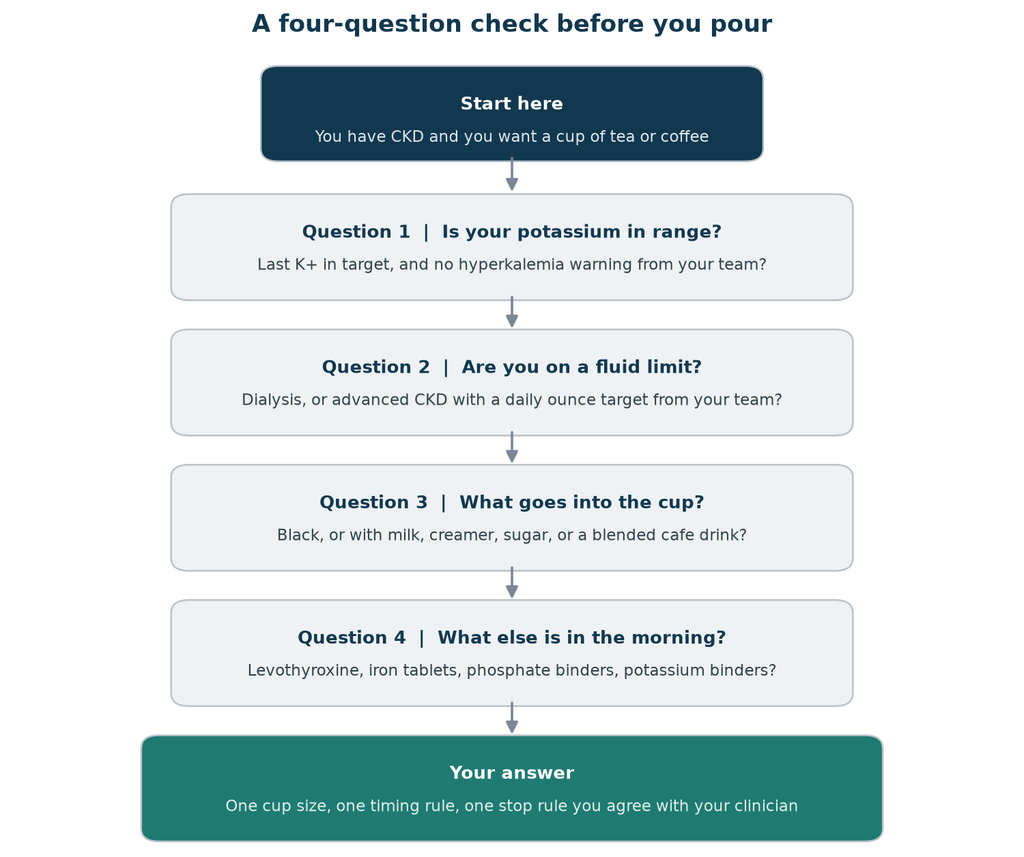
Take one action this week, and make it the smallest useful one. Find your last potassium result and note whether it was inside your target range. Then count how much liquid your usual cup actually holds, using a measuring cup once, because almost nobody’s mug is 8 ounces. Those two numbers turn this article into a decision you can have with your dietitian or nurse at your next visit, and they are the two numbers the four-question check in Figure 1 is built around.
If you are also managing stones, the fluid side of this conversation overlaps with stone prevention, and the probability of a stone passing on its own is a separate question worth understanding before you make plans. Readers who want the stage by stage picture of kidney function itself, or a practical renal diet framework, will find those guides linked below.
Medical disclaimer
This article is for general education only. It is not medical advice, and it does not create a doctor patient relationship. It cannot tell you what is safe for your body, because that depends on your kidney function, your laboratory results, your blood pressure, your fluid allowance, your other medical conditions, your medicines and your pregnancy status if relevant.
Do not start, stop or change any drink, supplement, herbal tea, medicine or dialysis fluid limit based on this article. Talk to your nephrologist, your primary care clinician, your renal dietitian or your dialysis team first. Targets for potassium, phosphorus, fluid and blood pressure differ between countries, between clinics and between individual patients.
Seek urgent medical care if you have chest pain, severe shortness of breath, a very fast or irregular heartbeat, sudden muscle weakness or paralysis, fainting, new confusion, or a potassium result above the range your team has given you. In the United States, call 911 or go to the nearest emergency department.
MedLifeGuide does not sell or endorse any product, creamer, coffee brand, supplement or herbal tea mentioned in this article. Brand names are not used to imply endorsement. Information can become out of date; the review date at the top of the page shows when the content was last checked by a licensed physician.
If you are reading this outside the United States, the numbers and thresholds here may not match your national guidance. Use it to inform a conversation with your own clinical team, not to replace it.
Sources
1. USDA FoodData Central. Beverages, coffee, brewed, prepared with tap water (FDC ID 171890). Published 1 April 2019. https://fdc.nal.usda.gov/food-details/171890/nutrients
2. USDA FoodData Central. Beverages, tea, black, brewed, prepared with tap water (FDC ID 173227). Published 1 April 2019. https://fdc.nal.usda.gov/food-details/173227/nutrients
3. USDA FoodData Central. Beverages, tea, black, brewed, prepared with tap water, decaffeinated (FDC ID 174871). Published 1 April 2019. https://fdc.nal.usda.gov/food-details/174871/nutrients
4. USDA FoodData Central. Milk, whole, 3.25% milkfat, with added vitamin D (FDC ID 746782). https://fdc.nal.usda.gov/food-details/746782/nutrients
5. US Food and Drug Administration. Spilling the Beans: How Much Caffeine is Too Much? Consumer Update. https://www.fda.gov/consumers/consumer-updates/spilling-beans-how-much-caffeine-too-much
6. Kidney Disease: Improving Global Outcomes (KDIGO). KDIGO 2024 Clinical Practice Guideline for the Evaluation and Management of Chronic Kidney Disease. Kidney International, April 2024. See practice points 3.3.1, 3.3.2, 3.11.5.1 and 3.11.5.2. https://kdigo.org/wp-content/uploads/2024/03/KDIGO-2024-CKD-Guideline.pdf
7. National Kidney Foundation. High Potassium (Hyperkalemia): Causes, Symptoms, and Treatment. https://www.kidney.org/kidney-topics/hyperkalemia-high-potassium
8. National Kidney Foundation. Fluid Overload in a Dialysis Patient. https://www.kidney.org/kidney-topics/fluid-overload-dialysis-patient
9. University of Florida IFAS Extension. Chronic Kidney Disease: Potassium and Your Diet (FSHN16-9). 2016. https://ask.ifas.ufl.edu/publication/FS287
10. Association between coffee and caffeine consumption and chronic kidney disease. Scientific Reports, 12 July 2025 (NHANES cross-sectional analysis). https://www.nature.com/articles/s41598-025-11543-4
11. Cai Q, van Westing AC, Cao Y, Bakker SJL, Navis GJ, Geleijnse JM, et al. Coffee consumption and risk of kidney function decline in a Dutch population-based cohort. Nutrition, Metabolism and Cardiovascular Diseases. 2024;34:455 to 465. Journal citation only; add the publisher URL at final check.
12. Diaz-Lopez A, Paz-Graniel I, Ruiz V, Toledo E, Becerra-Tomas N, Corella D, et al. Consumption of caffeinated beverages and kidney function decline in an elderly Mediterranean population with metabolic syndrome. Scientific Reports. 2021. https://doi.org/10.1038/s41598-021-88028-7
13. Unohara T, Fujii R, Watanabe T, et al. Coffee intake, genetic variants, and chronic kidney disease: a cross-sectional analysis of the Japan Multi-Institutional Collaborative Cohort (J-MICC) study. European Journal of Nutrition. 2025;64:301. https://link.springer.com/article/10.1007/s00394-025-03819-2
14. Girardat-Rotar L, Puhan MA, Braun J, Serra AL. Long-term effect of coffee consumption on autosomal dominant polycystic kidney disease progression: results from the Suisse ADPKD prospective longitudinal cohort study. Journal of Nephrology. 2018;31:87 to 94. https://pmc.ncbi.nlm.nih.gov/articles/PMC5778163/
15. Relationship between caffeine intake and autosomal dominant polycystic kidney disease progression: a retrospective analysis using the CRISP cohort. BMC Nephrology. 2018. https://pmc.ncbi.nlm.nih.gov/articles/PMC6307167/
16. Noordzij M, Uiterwaal CSPM, Arends LR, Kok FJ, Grobbee DE, Geleijnse JM. Blood pressure response to chronic intake of coffee and caffeine: a meta-analysis of randomized controlled trials. Journal of Hypertension. 2005. https://pubmed.ncbi.nlm.nih.gov/15834273/
17. Abbas-Hashemi SA, et al. The effects of caffeine supplementation on blood pressure in adults: a systematic review and dose-response meta-analysis. Clinical Nutrition ESPEN. 2023. https://www.clinicalnutritionespen.com/article/S2405-4577(23)02154-X/pdf
18. Morck TA, Lynch SR, Cook JD. Inhibition of food iron absorption by coffee. American Journal of Clinical Nutrition. 1983. Journal citation only; add the publisher URL at final check.
19. Hurrell RF, Reddy M, Cook JD. Inhibition of non-haem iron absorption in man by polyphenolic-containing beverages. British Journal of Nutrition. 1999;81(4):289 to 295. https://pubmed.ncbi.nlm.nih.gov/10999016/
20. Benvenga S, Bartolone L, Pappalardo MA, et al. Altered intestinal absorption of L-thyroxine caused by coffee. Thyroid. 2008;18(3):293 to 301. https://pubmed.ncbi.nlm.nih.gov/18341376/
21. UCLA Health. How Should I Take Thyroid Hormone (L-thyroxine)? Patient guidance on the 60 minute gap. https://www.uclahealth.org/medical-services/surgery/endocrine-surgery/conditions-treated/thyroid/how-should-i-take-thyroid-hormone
22. Charrier MJS, Savage GP, Vanhanen L. Oxalate content and calcium binding capacity of tea and herbal teas. Asia Pacific Journal of Clinical Nutrition. 2002. Journal citation only; add the publisher URL at final check.
23. Curhan GC, Willett WC, Rimm EB, Spiegelman D, Stampfer MJ. Prospective study of beverage use and the risk of kidney stones. American Journal of Epidemiology. 1996;143:240 to 247. Journal citation only; add the publisher URL at final check.
24. Ferraro PM, Taylor EN, Gambaro G, Curhan GC. Caffeine intake and the risk of kidney stones. American Journal of Clinical Nutrition. 2014. https://knowledgeconnection.mainehealth.org/mmc/70/
25. Saha P, Aydin-Ghormoz E, Beers K, et al. A case of hypokalemia caused by the consumption of licorice-containing herbal tea. Cureus. 2025;17(6):e86154. https://assets.cureus.com/uploads/case_report/pdf/287363/20250716-132412-awrmb9.pdf
26. Pseudo-hyperaldosteronism after the ingestion of licorice tea: a case report. Cureus. 2026. https://pmc.ncbi.nlm.nih.gov/articles/PMC13307586/
27. Licorice toxicity presenting as refractory hypokalemia and hypertension in an elderly patient. Cureus. 2024. https://pmc.ncbi.nlm.nih.gov/articles/PMC11533832/
28. Why eating star fruit is prohibited for patients with chronic kidney disease? Brazilian Journal of Nephrology (Jornal Brasileiro de Nefrologia), 2015. https://www.scielo.br/j/jbn/a/Xmy8DPXsfpSX6GRQ6kHn8mR/?lang=en
29. Star fruit induced neurotoxicity in a patient with end stage renal disease on maintenance hemodialysis: a case report. Cureus. 2026. https://assets.cureus.com/uploads/case_report/pdf/502296/20260804-636354-e4jzes.pdf