
| Clinical Editorial & Physician Review StampWritten by: MedLifeGuide Editorial Research Desk | Published: November 25, 2026 Medically Reviewed & Audited by: Dr. Adam N. Khan, M.D. (Licensed Internal Medicine Physician; M.D., King Edward Medical University; Internal Medicine Residency, Mayo Hospital; Active PMDC/PMC License; Member, Association of Medical Writers and Editors). Audit Scope: Cross-checked directly against the primary FDA Center for Biologics Evaluation and Research (CBER) pharmacovigilance memoranda, U.S. Senate Permanent Subcommittee on Investigations enclosures, and peer-reviewed cardiology pathology literature. |
When headlines collide over Sen. Johnson Releases HHS Records on COVID Vaccine Death Reviews, patients, parents, and clinicians are often left choosing between two incomplete narratives. One side frames the newly disclosed government files as proof of a sweeping agency cover-up; the other dismisses anything tied to the Vaccine Adverse Event Reporting System (VAERS) as unverified noise. If you actually open the nearly 100 pages of internal Department of Health and Human Services (HHS) documents made public by Senate Permanent Subcommittee on Investigations Chairman Ron Johnson on November 23, 2026, a much more specific clinical and regulatory picture emerges.
Here is the direct answer supported by the primary records: An internal Food and Drug Administration (FDA) memorandum dated February 10, 2026 examined 88 U.S. VAERS death reports among young adults aged 18 to 24 following COVID-19 vaccination through August 14, 2025. Using World Health Organization standardized causality rules, FDA career medical officers classified zero deaths as ‘certain’ or ‘probable’, three deaths as ‘possibly’ related to mRNA COVID-19 vaccination, 54 deaths as ‘unlikely’ related, and 31 deaths as ‘unassessable’ due to incomplete medical files. All three ‘possible’ cases involved young women aged 19, 20, and 21 who received a second mRNA vaccine dose in 2021, developed severe cardiac inflammation or heart muscle injury roughly two weeks later, and died despite hospital care. At the same time, internal agency emails attached to Chairman Johnson’s November 20, 2026 oversight letter confirm genuine operational breakdowns inside the FDA, including an accidental omission of 24-year-olds from the query, staffing shortages that prevented a corrected draft, internal disagreement over adding a fatal myocarditis boxed warning, and unfinished reviews of roughly 625 adult death reports.
| At a Glance: Five Verified Facts From the Released HHS & FDA Records 1. Scope of the Release: On November 20, 2026, Sen. Ron Johnson sent HHS Secretary Robert F. Kennedy, Jr. nearly 100 pages of internal FDA/CBER records (publicly posted November 23, 2026) and set a December 11, 2026 deadline for outstanding files. 2. Young Adult Findings (Ages 18 to 24): Out of 88 U.S. VAERS death reports reviewed by FDA’s Division of Pharmacovigilance, 3 cases (3.4%) were rated ‘possibly’ vaccine-related (two Pfizer-BioNTech, one Moderna; all Dose 2 in 2021). None were rated ‘certain’ or ‘probable.’ 3. Prior Pediatric Findings (Under Age 18): An earlier December 5, 2025 FDA memo covering 96 U.S. pediatric VAERS death reports classified 2 deaths as ‘probable’ and 5 as ‘possible’ (all 7 following Pfizer-BioNTech doses, with 5 involving myocarditis). 4. Why ‘Possible’ Does Not Mean Proven: Under WHO-UMC pharmacovigilance criteria, ‘possible’ means the timing fits a known biological risk (myocarditis), yet another equally plausible explanation (such as an concurrent viral infection) could also explain the fatal outcome. 5. Unfinished Safety Work: Internal emails show FDA deferred a proposed boxed warning on fatal myocarditis while awaiting a four-team review of more than 600 adult VAERS death reports (ages 18 to 40), and later declined to fix missing 24-year-old data due to reviewer shortages. |
Inside the Nearly 100 Pages of HHS Records Released in November 2026
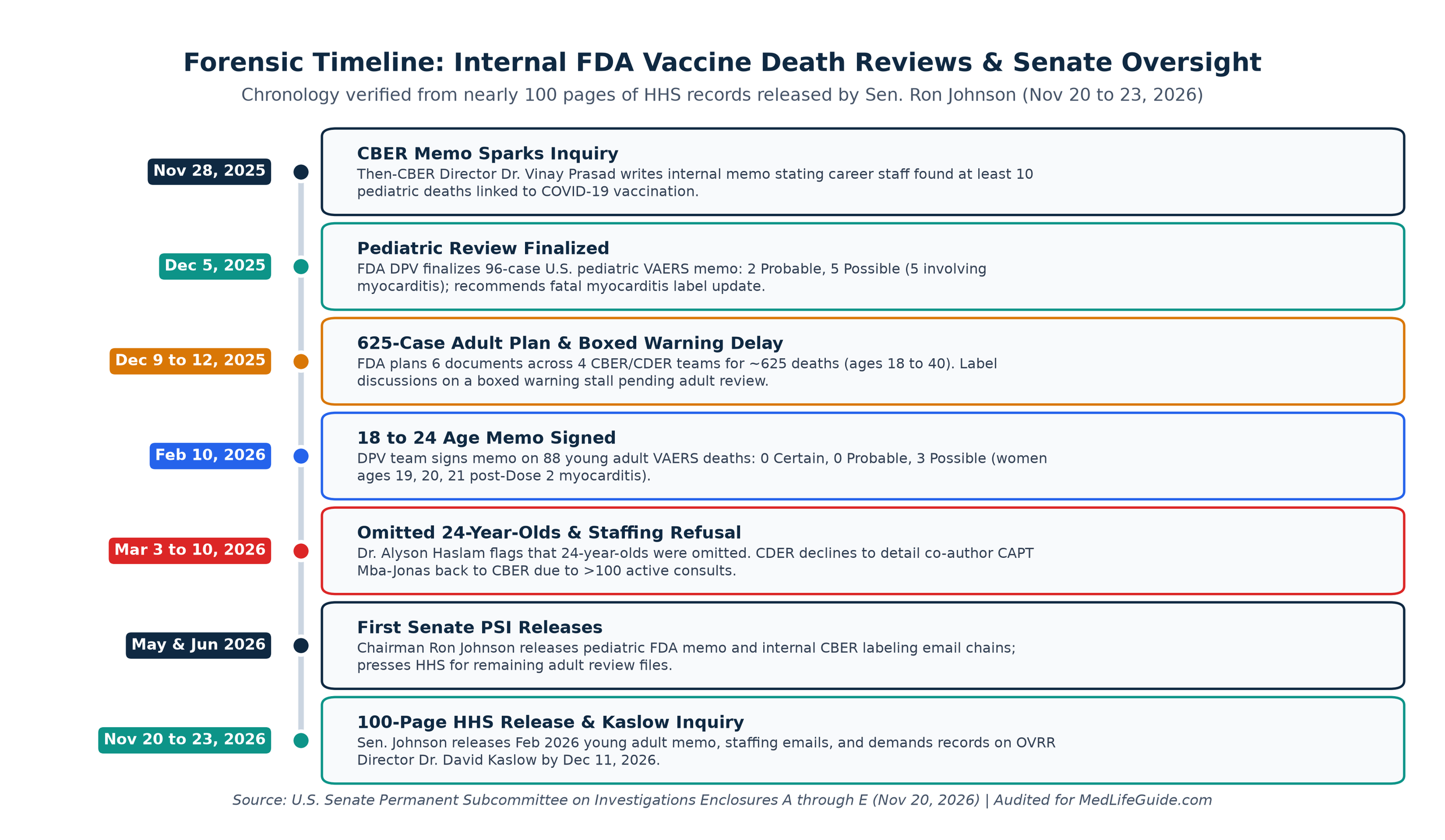
To understand why these documents exist at all, it helps to trace the oversight chain back one year. On November 28, 2025, Dr. Vinay Prasad, who then served as FDA Chief Medical and Scientific Officer and Director of the Center for Biologics Evaluation and Research (CBER), sent an internal staff memorandum stating that career reviewers in the Office of Biostatistics and Pharmacovigilance (OBPV) had concluded that at least 10 children died after and because of COVID-19 vaccination. That leaked statement triggered an immediate formal inquiry on December 15, 2025 from Senator Johnson’s Permanent Subcommittee on Investigations.
Between December 2025 and November 2026, HHS produced more than 6,000 pages of records to the subcommittee. In May 2026, Senator Johnson published the FDA’s underlying December 5, 2025 pediatric death review memorandum, which clarified how an initial preliminary count of 10 pediatric cases had been refined during quality-control adjudication to 7 cases (2 probable and 5 possible) out of 96 domestic reports. The November 23, 2026 disclosure represents the next chapter: what happened when CBER leadership ordered the same structured case-by-case causality review for young adults.
| Document / Enclosure | Official Source & Authors | Core Regulatory & Clinical Disclosure |
|---|---|---|
| Cover Letter (Nov 20, 2026) | Oversight demand from Sen. Ron Johnson to HHS Secretary Robert F. Kennedy, Jr. (copied to Ranking Member Sen. Richard Blumenthal and HHS Inspector General T. March Bell) | Summarizes five newly released HHS document sets, questions delays in label updates, cites leakage allegations involving OVRR Director Dr. David Kaslow, and sets a Dec 11, 2026 production deadline. |
| Enclosure A (Dec 8 to 10, 2025) | Internal CBER/CDER email chain titled ‘VAERS deaths following COVID-19 vaccines – PROJECT’ (released as Purple.pdf) | Outlines a cross-center plan to divide ~625 U.S. VAERS adult death reports (ages 18 to 40) across 4 review teams plus 4 cardiologists, and captures an autopsy debate over Parvovirus B19 in heart tissue. |
| Enclosure B (Nov 12 to Dec 12, 2025) | Internal emails between Dr. Meghna Alimchandani and Dr. Vinay Prasad regarding pediatric case revisions and ‘Black box – covid vaccines – can cause death’ | Reveals DPV recommended a Safety Labeling Change (SLC) to add fatal myocarditis, while consensus with OVRR stalled and discussions were deferred pending the 18-to-40 adult review. |
| Enclosure C (Feb 10, 2026) | 50+ page FDA CBER Postmarketing Safety Issue Memorandum signed by 12 DPV/OBPV officials (released as Yellow.pdf) | Evaluates 88 U.S. VAERS death reports in ages 18 to 24 through Aug 14, 2025; classifies 0 Certain, 0 Probable, 3 Possible (all female myocarditis post-Dose 2), 54 Unlikely, and 31 Unassessable. |
| Enclosures D & E (Mar 3 to 10, 2026) | Internal FDA CBER and CDER coordination emails titled ‘Help with updated report in CBER’ (released as Blue.pdf) | Documents Dr. Alyson Haslam’s discovery that 24-year-olds were accidentally omitted from the Feb 10 memo, and CDER’s refusal to return co-author CAPT Adamma Mba-Jonas due to severe maternal health staffing shortages. |
How the FDA Evaluated 88 Young Adult VAERS Death Reports (Ages 18 to 24)
In routine postmarketing surveillance, FDA medical officers read individual death reports submitted to VAERS and request hospital charts, death certificates, and autopsy reports through a federal contractor, yet they normally do not assign formal causality labels to single VAERS filings. As the February 10, 2026 Division of Pharmacovigilance memorandum explains in detail, passive reporting databases lack an unvaccinated control group, lack verified dose denominators, and suffer simultaneously from underreporting of some events and stimulated reporting of others. During the COVID-19 Emergency Use Authorization (EUA) period, healthcare providers were legally required to report any death following vaccination regardless of whether the clinician suspected a link.
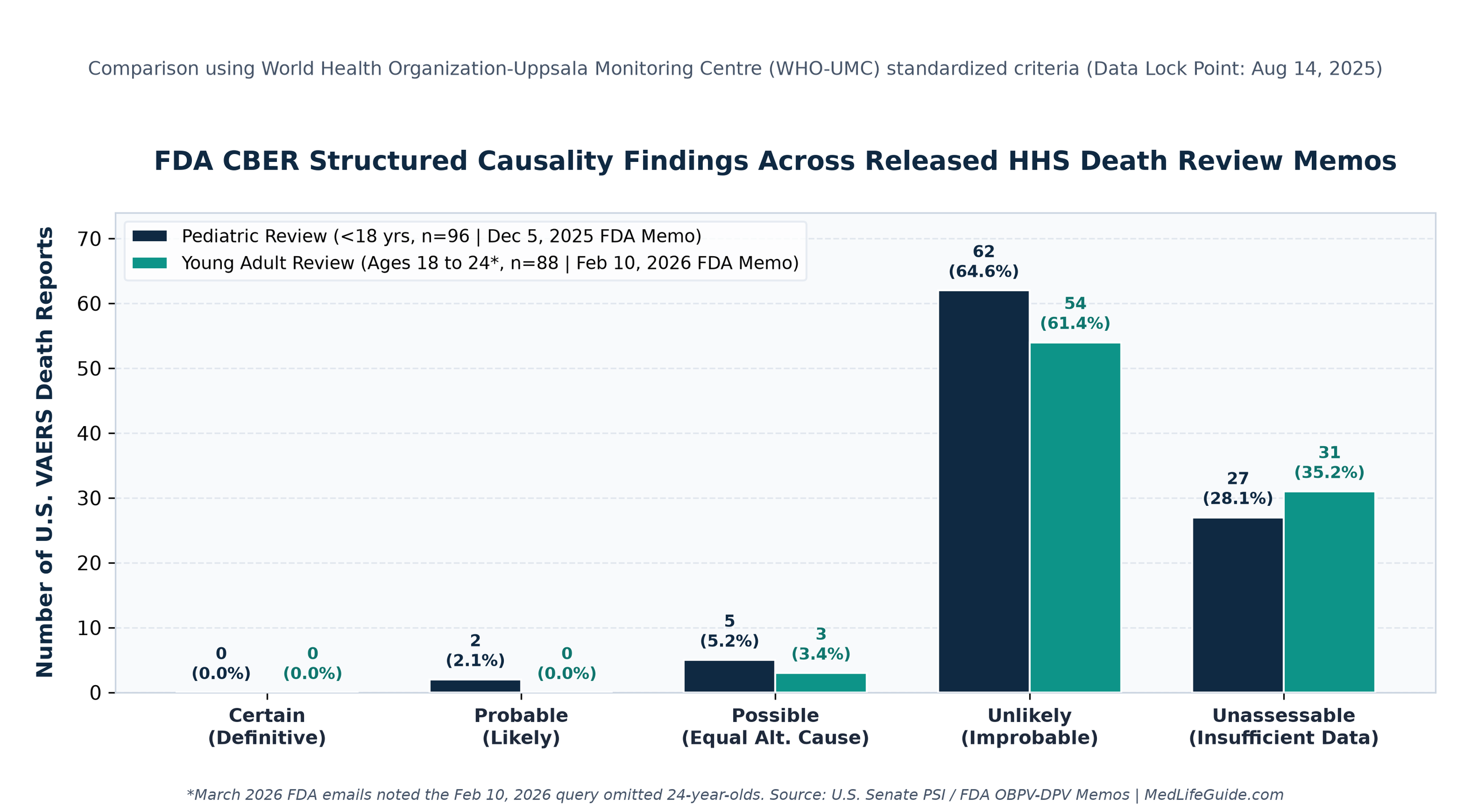
At the specific request of CBER Director Dr. Vinay Prasad, however, 12 FDA pharmacovigilance reviewers and leadership officials conducted a structured, case-level causality assessment of all domestic VAERS death reports for currently available COVID-19 vaccine brands in individuals aged 18 to 24 as of the August 14, 2025 data lock point. Out of the 88 unique U.S. reports retrieved:
- Pfizer-BioNTech (Comirnaty): 52 reports (59%), consisting of 49 monovalent doses and 3 reports with unspecified formulation.
- Moderna (Spikevax): 34 reports (39%), consisting of 27 monovalent doses, 1 bivalent dose, and 6 reports with unspecified formulation.
- Unknown COVID-19 Vaccine Brand: 2 reports (2%).
- Novavax (Nuvaxovid) and Moderna Next-Generation (Mnexspike): 0 reports retrieved in this age bracket through August 14, 2025.
To minimize single-reviewer bias, FDA medical officers evaluated every available clinical record, death certificate, and autopsy report as a group, consulting a pediatric cardiologist for cardiac fatalities, and assigned each case to one of six standardized categories created by the World Health Organization-Uppsala Monitoring Centre (WHO-UMC). Because media headlines routinely conflate ‘possible’ with ‘proven,’ reviewing the exact WHO-UMC definitions used inside the FDA memo is essential.
| WHO-UMC Category | Official Criteria Applied by FDA Reviewers | Pediatric (<18 yrs, n=96) | Young Adult (18 to 24*, n=88) |
|---|---|---|---|
| Certain | Plausible timing; event cannot be explained by concurrent disease or other drugs/chemicals; pharmacologically or pathologically definitive. | 0 (0.0%) | 0 (0.0%) |
| Probable / Likely | Reasonable time relationship to vaccination; unlikely to be attributed to concurrent disease or other drugs/infections. | 2 (2.1%) | 0 (0.0%) |
| Possible | Reasonable time relationship to vaccination, BUT could also be explained by concurrent disease, infection, or other drugs (equally plausible alternative cause). | 5 (5.2%) | 3 (3.4%) |
| Unlikely | Timing makes a causal connection improbable (though not impossible), OR underlying disease/other exposures provide plausible explanations. | 62 (64.6%) | 54 (61.4%) |
| Conditional / Unclassified | Event reported, but additional data are currently under active examination. | 0 (0.0%) | 0 (0.0%) |
| Unassessable / Unclassifiable | Insufficient, missing, or contradictory clinical/autopsy records that cannot be verified or supplemented. | 27 (28.1%) | 31 (35.2%) |
Clinical and Autopsy Breakdown of the Three Young Women Rated ‘Possible’
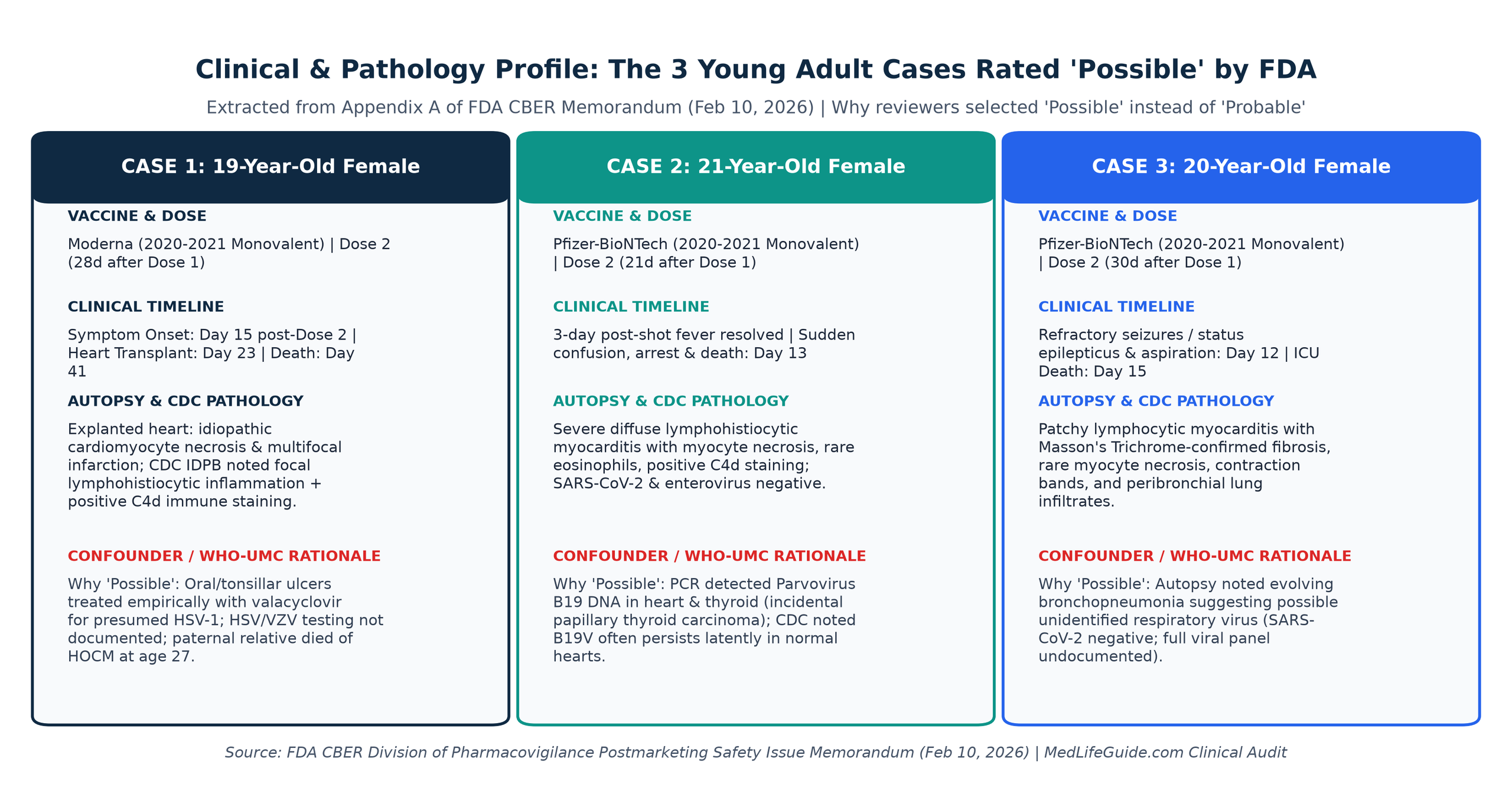
One detail in the February 10, 2026 memo immediately stood out to cardiologists and epidemiologists alike: all three young adult fatalities rated ‘possibly’ related to vaccination occurred in females (ages 19, 20, and 21), even though population-wide surveillance has consistently shown that COVID-19 vaccine myocarditis occurs most frequently in adolescent and young adult males aged 12 to 24 within the first seven days after a second mRNA dose. Furthermore, in all three young women, severe cardiac or neurologic crisis emerged between 12 and 15 days after their second monovalent mRNA injection in 2021. Looking closely at Appendix A of the FDA memorandum shows both the severity of their heart injury and the exact medical ambiguities that prevented FDA reviewers from rating the cases ‘probable’ or ‘certain.’
- Case 1 (19-Year-Old Female, Moderna Dose 2 in May 2021): Previously healthy aside from a family history of a paternal relative dying of hypertrophic cardiomyopathy at age 27, she received her second Moderna dose 28 days after her first. Around Days 7 to 14 post-vaccination, she developed hoarseness, sore throat, fevers, dizziness, resting heart rate above 140 beats per minute, and painful gum and tonsillar ulcers treated empirically with valacyclovir for presumed herpes simplex virus type 1 (HSV-1). On Day 15, she arrived at the emergency department in severe distress with a left ventricular ejection fraction (EF) of 37%, suffered bradycardic arrest requiring cardiopulmonary resuscitation, and progressed to cardiogenic shock (EF 5%) despite an intra-aortic balloon pump. She underwent an emergency heart transplant on Day 23 post-vaccination, yet died on Day 41 from multiorgan and primary graft failure. Pathology of her explanted native heart showed extensive idiopathic cardiomyocyte necrosis, while CDC Infectious Diseases Pathology Branch (IDPB) testing found focal lymphohistiocytic inflammation and positive C4d immunostaining (a marker of immune-mediated tissue injury) alongside negative PCR tests for SARS-CoV-2, enteroviruses, and Parvovirus B19. Because HSV-1 and varicella-zoster virus were never tested on heart tissue (and empiric valacyclovir could have cleared viral antigen), FDA reviewers rated vaccine causality ‘possible.’
- Case 2 (21-Year-Old Female, Pfizer-BioNTech Dose 2 in 2021): With a medical history of hypothyroidism and obesity, she experienced a three-day fever (101.6 degrees Fahrenheit) immediately after her second Pfizer-BioNTech dose (given 21 days after Dose 1), which resolved completely. She felt well until Day 12 post-vaccination, when she suddenly developed confusion, lightheadedness, seizure-like activity, and cardiac arrest. Despite multiple defibrillations and emergency care (echocardiogram EF 35% to 40%, elevated troponin of 4.89), she died on Day 13 in refractory ventricular tachycardia. Autopsy and CDC IDPB pathology revealed severe diffuse lymphohistiocytic myocarditis with myocyte necrosis, rare eosinophils, positive C4d immune staining, and an incidental papillary thyroid carcinoma, with negative SARS-CoV-2 and enterovirus tests. However, PCR detected Parvovirus B19 DNA in her myocardium and thyroid. Because Parvovirus B19 was listed as a plausible viral cause of myocarditis, FDA reviewers classified the death as ‘possible’ rather than ‘probable.’
- Case 3 (20-Year-Old Female, Pfizer-BioNTech Dose 2 in 2021): With a prior history of acid reflux and recurrent unexplained bile vomiting, she received her second Pfizer-BioNTech dose 30 days after her first. On Day 12 post-vaccination, her roommate witnessed brief shaking episodes that rapidly escalated into refractory status epilepticus accompanied by aspiration. Brain MRI showed no acute structural lesion, SARS-CoV-2 testing was negative, and despite intubation and vasopressors in a tertiary intensive care unit, she suffered cardiac arrest and died on Day 15. Cardiac autopsy demonstrated patchy lymphocytic myocarditis and perivascular myocardial fibrosis confirmed on Masson’s Trichrome stain, capable of triggering fatal arrhythmias. Simultaneously, lung microscopy showed peribronchial lymphocytic infiltrates consistent with an evolving viral bronchopneumonia, though no respiratory viral panel was documented to identify a pathogen. Given that dual clinical picture, reviewers assigned a rating of ‘possible.’
Why Parvovirus B19 Sparked an Internal Scientific Debate at the FDA
One of the most revealing scientific exchanges inside Senator Johnson’s November 2026 release appears in Enclosure A (Purple.pdf) and Enclosure B. Both in the pediatric review (where a 12-year-old girl’s death was downgraded from ‘probable’ to ‘possible’) and in Case 2 of the young adult review (the 21-year-old woman), career pharmacovigilance officers treated PCR detection of Parvovirus B19 DNA in heart muscle at autopsy as an ‘equally likely’ alternative viral cause of fatal myocarditis.
On December 10, 2025, Dr. Tracy Beth Hoeg, then Incoming Acting Director of the Center for Drug Evaluation and Research (CDER), challenged that assumption in an email to Dr. Vinay Prasad and Dr. Meghna Alimchandani. Citing peer-reviewed cardiac pathology studies indexed in the National Library of Medicine (PMC2620852) and adolescent seroprevalence research (PMC3327426), Dr. Hoeg pointed out that roughly one-third to one-half of adolescents have already been exposed to Parvovirus B19, more than 95% of infections leave lifelong latent viral DNA in heart tissue, and 67% of adult autopsies without any myocarditis or cardiomyopathy incidentally test positive for Parvovirus B19 in the myocardium. Even the CDC’s own pathology report in Case 2 explicitly cautioned that the clinical significance of Parvovirus B19 PCR in heart tissue was ‘unclear’ due to long-term persistence in healthy hearts. Dr. Alimchandani replied that career DPV scientists needed independence to sign their own consensus assessment while acknowledging that other experts reviewing the exact same autopsy could reach a higher or lower causality tier.
What Happened to the Other 85 Death Reports (and Why 24-Year-Olds Were Left Out)
Focusing solely on the three flagged cases overlooks an equally important clinical finding in the remaining 85 young adult VAERS death reports. Why did FDA reviewers classify 54 deaths (61.4%) as ‘unlikely’ related to vaccination and 31 deaths (35.2%) as ‘unassessable’?
- Why 54 Cases Were Rated ‘Unlikely’: When medical records and autopsies were available, reviewers frequently uncovered well-established non-vaccine causes of death in 18-to-24-year-olds. Section 3 of the FDA memorandum details congenital and structural causes of sudden cardiac death (such as hypertrophic cardiomyopathy, arrhythmogenic right ventricular dysplasia, congenital coronary anomalies, and myocardial bridging), fatal pulmonary thromboembolism in patients with preexisting clotting risk factors (such as genetic thrombophilia, oral contraceptive use, prolonged immobility, or trauma), Sudden Unexpected Death in Epilepsy (SUDEP), severe underlying chronic kidney or metabolic illness, accidental drug intoxication, and suicide (which federal mortality statistics rank among the leading causes of death in ages 15 to 24).
- Why 31 Cases Were Rated ‘Unassessable’: More than one-third of the domestic young adult death reports lacked basic clinical verification. In many filings, vaccination dates or death dates were missing, emergency room records were unavailable, or no autopsy was performed. Without tissue histology or verified clinical timelines, WHO-UMC rules prohibit reviewers from guessing either for or against vaccine involvement.
Staffing Bottlenecks, the Missing 24-Year-Olds, and the Deferred Boxed Warning
While the clinical pathology inside the February 10, 2026 memo reflects methodical case review, the administrative emails in Enclosures A, B, D, and E document serious operational friction inside the FDA:
- 1. The Stalled Fatal Myocarditis Label Update: On December 5, 2025, after identifying 7 probable or possible pediatric deaths (5 involving myocarditis), FDA’s Division of Pharmacovigilance formally concluded that fatal outcomes from vaccine-associated myocarditis constituted ‘new safety information’ under Section 505-1(b)(3) of the Federal Food, Drug, and Cosmetic Act and recommended triggering a class-wide Safety Labeling Change (SLC), including a boxed warning. However, in a December 12, 2025 email exchange (Enclosure B), Dr. Alimchandani noted that the Office of Vaccines Research and Review (OVRR) had not reached consensus on boxed-warning language, the Safety Working Group meeting item had been canceled, and action was deferred until reviewers could evaluate more than 600 adult VAERS death reports in ages 18 to 40. Dr. Prasad wrote back: “Boxed warning is the minimum. I will just write an override memo siding with DPV.” Yet the records released to date do not clarify why a boxed warning was still not finalized months later.
- 2. Six Planned Documents and Four Review Teams in Limbo: On December 9, 2025, CBER and CDER officials mapped out an ambitious plan to evaluate roughly 625 U.S. VAERS death reports in adults aged 18 to 40 by dividing them into batches of ~156 cases across four review teams (one CBER DPV team and three 10-reviewer teams detailed from CDER’s Office of Surveillance and Epidemiology, supported by four CDER cardiologists). That effort was supposed to produce four team memos, one overarching executive summary memo, and a sixth disagreement report led by Dr. Hoeg. As of Senator Johnson’s November 2026 release, only the 18-to-24 memo is confirmed complete in the public record.
- 3. Omitting 24-Year-Olds and Refusing Reviewer Reassignment: Notice that Dr. Alimchandani’s December 9, 2025 planning email estimated roughly 118 VAERS death reports in ages 18 to 24, whereas the February 10, 2026 memo analyzed only 88. On March 3, 2026, CBER official Dr. Alyson Haslam discovered why: the query for the ’18-24′ memo had inadvertently left out 24-year-olds entirely. When Dr. Haslam asked CDER on March 6, 2026 to temporarily detail co-author CAPT Adamma Mba-Jonas back to CBER to add the missing 24-year-old cases, CDER official Dr. Lynne P. Yao declined on March 10, 2026, explaining that CDER’s severely understaffed Maternal Health Team had just 7 clinical reviewers juggling more than 100 active drug-safety consults.
Allegations Involving OVRR Director Dr. David Kaslow
Senator Johnson’s November 20, 2026 letter also requests internal emails, text messages, and media communications involving Dr. David Kaslow, Director of FDA’s Office of Vaccines Research and Review. Citing a November 17, 2026 report in The Disinformation Chronicle, Senator Johnson wrote that insiders accused Dr. Kaslow of disclosing confidential internal agency deliberations to outside parties and potentially helping stall internal probes into mRNA COVID-19 vaccine deaths, copying the letter to the HHS Office of Inspector General. Readers should weigh this point carefully: as of November 25, 2026, those claims remain unverified allegations subject to oversight review, and HHS has until December 11, 2026 to respond to the subcommittee’s document demand.
Verified Video Briefings and Primary Oversight Footage
For readers and clinicians who prefer to evaluate congressional testimony and primary oversight discussions alongside written FDA memoranda, the verified broadcasts below provide direct context on how the Senate Permanent Subcommittee on Investigations has questioned federal pharmacovigilance methods:
| Source Channel | Verified Video Resource (Direct Link) | What Viewers Will Learn |
|---|---|---|
| Senate PSI Official Video Archive (ronjohnson.senate.gov) | Sen. Johnson Full COVID-19 Oversight & Patient Testimony Archive | Official U.S. Senate video portal hosting full-length roundtables and subcommittee oversight briefings referenced in Chairman Johnson’s 2026 press releases. |
| Senate PSI Hearing Broadcast (YouTube Live Archive) | U.S. Senator Ron Johnson Hosts: Voices of the Vaccine Injured (Senate PSI Hearing) | Full official Senate hearing stream examining post-vaccination adverse event reporting, VAERS follow-up gaps, and patient compensation challenges. |
| 2026 Senate PSI Vaccine Safety Signals Hearing Coverage (YouTube) | Senate Permanent Subcommittee on Investigations 2026 Hearing on COVID-19 Vaccine Safety Monitoring | Covers the subcommittee’s questioning on early 2021 VAERS statistical signal detection (proportional reporting ratios vs. empirical Bayesian data mining) and timing of myocarditis label warnings. |
Public Questions and Clinical Debates From Reddit and Quora
Whenever internal vaccine safety records enter the news cycle, thousands of Americans turn to online medical and public forums to sort out conflicting claims. Reviewing documented discussions across physician and regulatory communities on Reddit’s r/medicine, r/RegulatoryClinWriting, r/politics, and Quora threads on VAERS death reports highlights four recurring points of confusion that deserve clear clinical answers.
- Public Forum Question 1: ‘If 38,000+ deaths are listed in VAERS worldwide, why did FDA only find a handful of probable or possible cases in children and young adults?’ In public Reddit and Quora debates, some users assume every VAERS filing represents a confirmed vaccine fatality, while others dismiss all VAERS filings as fake. Both extremes miss how passive surveillance works. Roughly 8,000 people die every day in the United States from all causes combined, and during the 2021 mass rollout, EUA rules legally required clinicians to report deaths occurring after vaccination even when the cause was advanced cancer, trauma, or underlying heart disease. At the same time, when FDA medical officers pulled actual autopsies for young people (where background natural mortality is very low), they confirmed that rare fatal myocarditis cases do appear in VAERS and merited formal ‘new safety information’ review.
- Public Forum Question 2: ‘Clinicians on r/medicine and r/RegulatoryClinWriting asked why Dr. Prasad’s November 2025 memo cited 10 child deaths without publishing case histories.’ When Dr. Prasad’s initial November 28, 2025 email leaked, physicians and regulatory writers criticized the lack of patient ages, timelines, and peer-reviewed data, warning that VAERS is a hypothesis-generating tool rather than a standalone policy tool. The subsequent Senate release of the full December 5, 2025 and February 10, 2026 DPV memoranda resolved much of that mystery: career FDA reviewers had compiled detailed case-level autopsy narratives (refining the 10 preliminary pediatric cases down to 2 probable and 5 possible), yet those clinical appendices remained locked inside internal agency files until congressional oversight forced their disclosure.
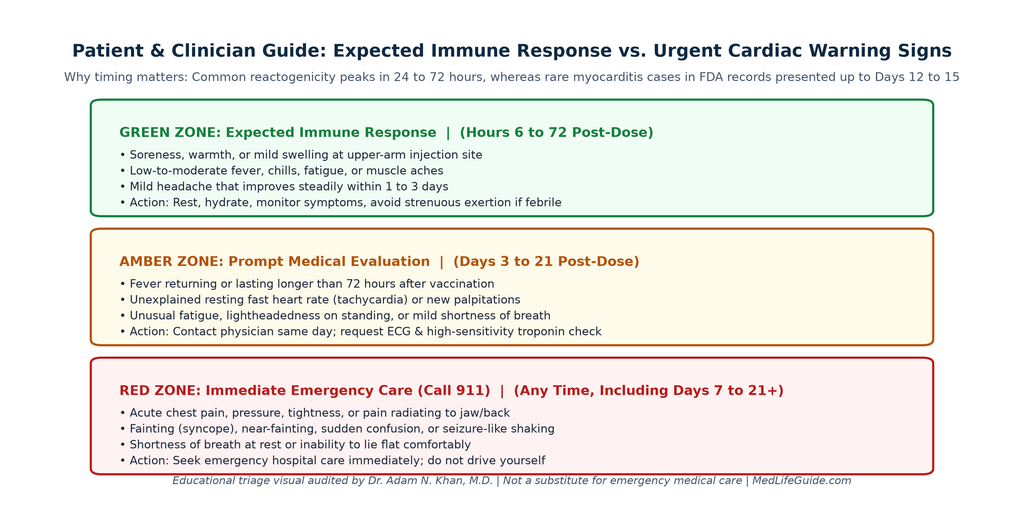
- Public Forum Question 3: ‘Why did the three young women in the FDA memo deteriorate at Days 12 to 15 instead of within 48 hours of the shot?’ Many readers confuse immediate post-shot reactogenicity with immune-mediated myocarditis. As detailed in our clinical guide to Pfizer COVID-19 vaccine side effects, common symptoms like sore arm, chills, and brief fever peak within 24 to 72 hours due to innate cytokine signaling. Adaptive or immune-complex tissue inflammation in the heart muscle can take several days to two weeks to evolve, or may initially masquerade as viral congestion, stomach upset, or dizziness before triggering dangerous heart-rhythm disturbances.
- Public Forum Question 4: ‘How does myocarditis risk from mRNA vaccination compare with myocarditis from COVID-19 or other viral infections?’ Large population-based cohort studies cited inside the FDA’s own February 2026 reference list (including nationwide French, Nordic, U.S., and UK analyses) consistently show two truths that coexist without contradiction: mRNA COVID-19 vaccines carry a real, measurable rare risk of myocarditis (highest after Dose 2 of original 2020-2021 monovalent formulations, particularly when doses were spaced only 3 to 4 weeks apart), while acute SARS-CoV-2 infection and common respiratory pathogens such as adenovirus infections also cause viral myocarditis and cardiovascular complications at substantial rates. Readers comparing age-stratified pediatric and adolescent numbers can review our mRNA COVID-19 vaccines in children myocarditis study breakdown alongside our COVID-19 vaccine effectiveness chart to see how risk-benefit balance shifts dramatically between a healthy 19-year-old and a 75-year-old with chronic heart or kidney disease.
Practical Symptom Timeline and Cardiac Safety Checklist for Patients and Families
Most cases of post-vaccine myocarditis documented in multicenter longitudinal registries (such as the U.S. MACiV study) are mild to moderate and resolve with rest and anti-inflammatory care. However, the three fatal young adult cases in the February 2026 FDA memorandum underscore why early recognition during the first three weeks after any mRNA dose is vital, including for young women whose cardiac symptoms are sometimes misattributed to anxiety, allergies, or routine stomach bugs. Notice in Case 1 that a resting heart rate exceeding 140 beats per minute and positional dizziness preceded cardiac arrest by 48 hours, and in Case 3 sudden shaking or syncope-like collapse reflected an underlying cardiac conduction disturbance.
Important Clinical Nuance and Who Needs Individualized Advice: General population statistics cannot make a personal vaccination decision for you. Young adults aged 12 to 29 (especially those who already recovered from a recent SARS-CoV-2 infection, where spacing doses or discussing individualized necessity reduces myocarditis risk) face a very different baseline equation than older adults or patients managing high blood pressure (hypertension), diabetes, chronic kidney disease, or immunocompromising therapy. In addition, anyone who previously developed myocarditis or pericarditis within three weeks of an mRNA COVID-19 vaccine dose is generally advised by federal clinical guidance not to receive subsequent doses of any mRNA COVID-19 vaccine unless specifically cleared by a cardiologist and infectious disease specialist.
Your Realistic Next Step
If you are weighing an upcoming COVID-19 dose for yourself, a teenager, or a college-aged family member, take two concrete steps before scheduling: First, write down the date of your most recent confirmed COVID-19 infection, your current cardiovascular or metabolic conditions, and any family history of early cardiomyopathy or arrhythmia, and ask your primary care physician to calculate your personal benefit-risk profile (including whether a longer interval between doses or a non-mRNA protein-subunit option is appropriate). Second, if anyone in your household has received a vaccine within the past 21 days and develops chest tightness, unexplained resting rapid heartbeat, fainting, or shortness of breath, bring them for a prompt 12-lead electrocardiogram (ECG) and high-sensitivity cardiac troponin blood test rather than waiting to ‘sleep it off.’ You can also track HHS’s upcoming December 11, 2026 document deadline directly on the Senate Permanent Subcommittee on Investigations portal as the remaining adult review records become public.
Frequently Asked Questions
No. Out of the 88 U.S. VAERS death reports among 18-to-24-year-olds reviewed through August 14, 2025, FDA medical officers classified zero deaths as ‘certain’ or ‘probable,’ 54 deaths (61.4%) as ‘unlikely’ related to vaccination, and 31 deaths (35.2%) as ‘unassessable’ due to insufficient records. Only three cases (3.4%), all involving young women who developed myocarditis or acute myocardial necrosis after a second mRNA dose in 2021, were classified as ‘possibly’ related.
All three young women received their second primary-series dose of the original 2020-2021 monovalent mRNA formulation (two Pfizer-BioNTech, one Moderna) spaced 21 to 30 days after Dose 1 during peak 2021 mass vaccination. Subsequent surveillance indicates lower myocarditis reporting rates with updated annual formulations, smaller antigen doses in certain products, wider intervals between doses, and far fewer two-dose primary series administered to young adults.
Current FDA prescribing information for Comirnaty and Spikevax already includes a dedicated Warnings and Precautions section detailing postmarketing myocarditis and pericarditis risks, highest in males aged 12 to 24. A boxed warning (‘black box’) is the FDA’s strongest prominence alert placed at the very top of a drug label, typically reserved for risks that can lead to death or permanent injury. Internal December 2025 emails show FDA’s Division of Pharmacovigilance recommended adding fatal myocarditis and a boxed warning, whereas OVRR had not agreed and discussions were deferred pending review of adult deaths aged 18 to 40.
Internal FDA emails from March 2026 show that the database query used to generate the February 10, 2026 ’18-24′ memorandum inadvertently omitted individuals who were 24 years old. When CBER requested that co-author CAPT Adamma Mba-Jonas be temporarily detailed back from CDER to add the missing 24-year-old cases, CDER leadership declined on March 10, 2026 because its seven-reviewer Maternal Health Team was already managing over 100 active drug-safety consults.
Clinicians evaluate suspected myocarditis using a 12-lead electrocardiogram (ECG) to detect rhythm or ST-segment abnormalities, a high-sensitivity blood troponin test to measure heart-muscle cell injury, inflammatory markers (C-reactive protein and erythrocyte sedimentation rate), an echocardiogram to check heart pumping strength (ejection fraction), and, when indicated, a cardiac MRI with late gadolinium enhancement to visualize myocardial inflammation or scarring.
Author Review & Clinical Verification Statement
| Medical Reviewer Audit: Dr. Adam N. Khan, M.D.“When government pharmacovigilance memos surface in political news, patients deserve calm, uncompromising scientific accuracy rather than either alarmism or dismissal. I have audited this MedLifeGuide analysis against the primary FDA CBER Division of Pharmacovigilance memoranda, the World Health Organization-Uppsala Monitoring Centre causality framework, and peer-reviewed cardiology pathology standards to ensure every figure, histologic finding, limitation, and emergency cardiac warning sign is stated clearly and responsibly.”Reviewer Credentials: Dr. Adam N. Khan, M.D., Doctor of Medicine (King Edward Medical University), Post-Graduate Residency in Internal Medicine (Mayo Hospital), Active PMDC/PMC Licensed Physician, Member of the Association of Medical Writers and Editors, and Contributor to the International Federation of Health Literacy Advocates. | Review Date: November 25, 2026. |
Medical Disclaimer
| Important Educational & Clinical Safety Notice (MedLifeGuide.com) 1. Informational Purpose Only (No Medical Advice): The content provided in this article, including text, tables, clinical graphics, and physician review notes on MedLifeGuide.com, is strictly for general educational and informational purposes. It is not a substitute for personalized professional medical advice, clinical diagnosis, or treatment. 2. No Doctor-Patient Relationship: Medical auditing by Dr. Adam N. Khan, M.D., verifies alignment with published primary documentation and clinical literature; it does not establish a doctor-patient relationship between you and MedLifeGuide or any of its contributors. 3. Consult Your Healthcare Provider: Always consult your physician, cardiologist, or qualified healthcare provider regarding vaccination decisions, medication changes, or personal risk factors. Never disregard professional medical advice or delay seeking medical evaluation because of information read online. 4. Medical Emergencies: If you or someone near you experiences acute chest pain, pressure, shortness of breath, fainting, sudden confusion, or seizure-like activity, call 911 (or your local emergency number) or go to the nearest hospital emergency department immediately. |
Sources and Official Primary Records
- U.S. Senate Permanent Subcommittee on Investigations Press Release: Chairman Johnson Releases Internal FDA Memo on COVID-19 Vaccine Deaths and Seeks More HHS Records in Letter to Secretary Kennedy. Office of U.S. Senator Ron Johnson, published November 23, 2026. https://www.ronjohnson.senate.gov/2026/11/23/chairman-johnson-releases-internal-fda-memo-on-covid-19-vaccine-deaths-and-seeks-more-hhs-records-in-letter-to-secretary-kennedy/
- Official Senate Oversight Letter & Enclosures A and B: Letter from Chairman Ron Johnson to HHS Secretary Robert F. Kennedy, Jr. Regarding FDA Internal Review of COVID-19 Vaccine Deaths, U.S. Senate Committee on Homeland Security and Governmental Affairs / Permanent Subcommittee on Investigations, dated November 20, 2026. https://www.ronjohnson.senate.gov/wp-content/uploads/2026/11/2026-11-20-RHJ-to-HHS-re-FDA-review-of-COVID-19-vaccine-deaths.pdf
- FDA CBER Young Adult VAERS Death Review Memorandum (Enclosure C): Postmarketing Safety Issue Memorandum: U.S. VAERS Deaths in Individuals Between the Ages of 18 and 24 Years Following COVID-19 Vaccines, U.S. Food and Drug Administration, Center for Biologics Evaluation and Research, Division of Pharmacovigilance (DPV/OBPV), dated February 10, 2026. https://www.ronjohnson.senate.gov/wp-content/uploads/2026/11/Yellow.pdf
- FDA CBER/CDER Adult Review Planning & Parvovirus B19 Emails (Enclosure A): Internal HHS/FDA Email Correspondence: ‘RE: VAERS deaths following COVID-19 vaccines – PROJECT’ (Dr. Vinay Prasad, Dr. Meghna Alimchandani, Dr. Tracy Beth Hoeg), dated December 8 to 10, 2025. https://www.ronjohnson.senate.gov/wp-content/uploads/2026/11/Purple.pdf
- FDA CBER/CDER Staffing & Omitted 24-Year-Olds Emails (Enclosures D & E): Internal HHS/FDA Email Correspondence: ‘RE: Help with updated report in CBER’ (Dr. Alyson Haslam, Dr. Lynne P. Yao, Dr. Janet Maynard), dated March 6 to 10, 2026. https://www.ronjohnson.senate.gov/wp-content/uploads/2026/11/Blue.pdf
- FDA CBER Pediatric VAERS Death Review Memorandum: Postmarketing Safety Issue Memorandum: Analysis of U.S. VAERS Pediatric Death Reports Following COVID-19 Vaccines (n=96), U.S. Food and Drug Administration (DPV/OBPV), dated December 5, 2025 (released by Senate PSI May 11, 2026). https://www.ronjohnson.senate.gov/wp-content/uploads/2026/05/2026-05-11-RHJ-to-HHS-re-C19-vaccine-records-memo.pdf
- Senate PSI Initial Oversight Inquiry Letter: Letter from Chairman Ron Johnson to HHS Secretary Robert F. Kennedy, Jr. Requesting Records on Pediatric COVID-19 Vaccine Death Reviews, dated December 15, 2025. https://www.ronjohnson.senate.gov/wp-content/uploads/2026/05/2025-12-15-RHJ-to-HHS18.pdf
- Myocardial Parvovirus B19 Persistence Autopsy Study: Schenk T, Enders M, Pollak S, Hahn R, Huzly D. High Prevalence of Human Parvovirus B19 DNA in Myocardial Autopsy Samples from Subjects Without Myocarditis or Dilated Cardiomyopathy. Journal of Clinical Microbiology / NIH PubMed Central (PMC2620852), 2009. https://pmc.ncbi.nlm.nih.gov/articles/PMC2620852/
- Adolescent Parvovirus B19 Seroprevalence Study: Rohrer C, Gartner B, Sauerbrei A, et al. Seroprevalence of Parvovirus B19 in Germany: Age-Specific Epidemiology. Epidemiology & Infection / NIH PubMed Central (PMC3327426). https://pmc.ncbi.nlm.nih.gov/articles/PMC3327426/
- Documented Clinician & Public Forum Discussions Analyzed: Reddit r/medicine (‘Experts say top FDA official’s claim that Covid vaccines caused kids’ deaths requires more evidence’, Dec 2025); r/RegulatoryClinWriting (‘FDA CBER Director Vinay Prasad Proposes Path Forward’, Dec 2025); Quora (‘Are the VAERS reports about the COVID vaccine deaths true?’). https://www.reddit.com/r/medicine/comments/1pdsgxs/experts_say_top_fda_officials_claim_that_covid/
- Moz Page Authority Methodology (SEO Architecture Reference): Ellis M, Cameron J. What Is Page Authority? How Do I Influence Page Authority? Moz SEO Learning Center, updated November 18, 2024. https://moz.com/learn/seo/page-authority