
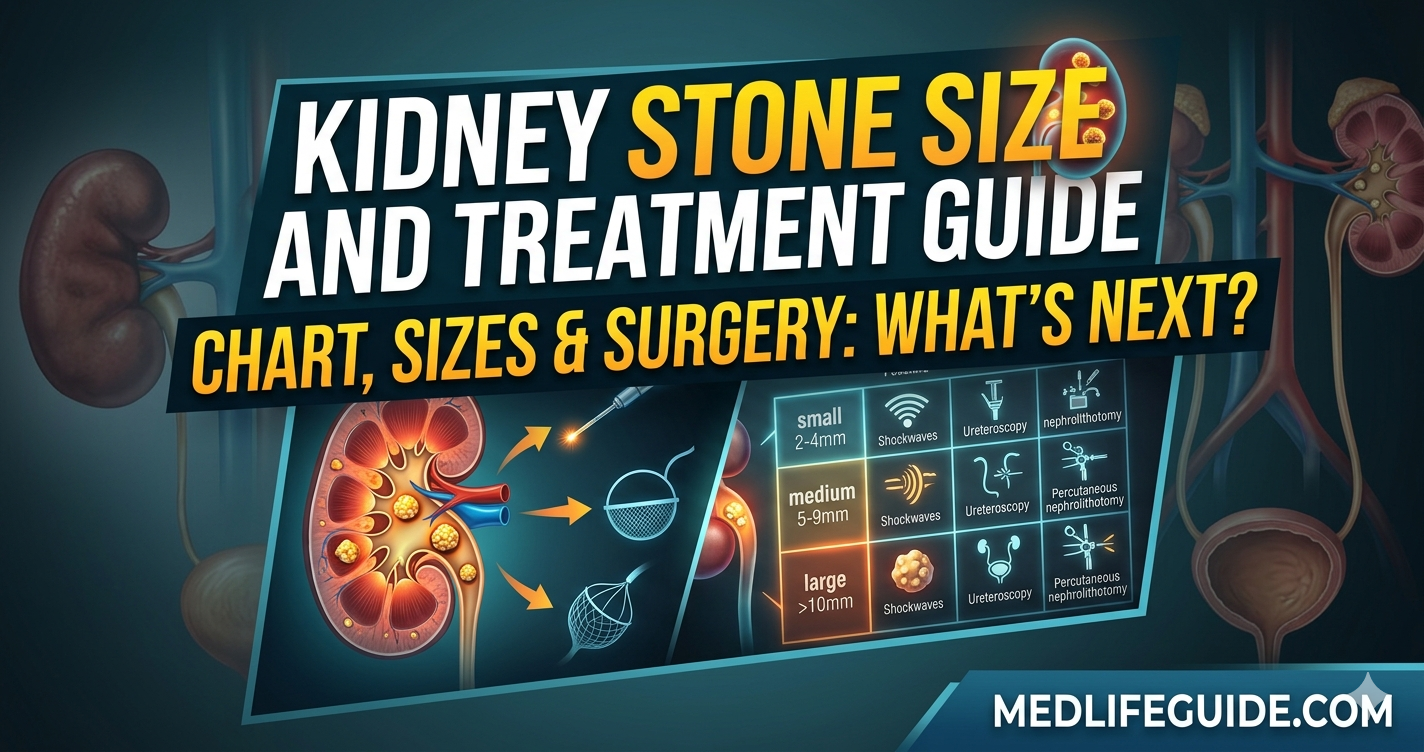
Quick Clinical Answer: The absolute medical choice for kidney stone treatment is directly determined by the stone’s physical diameter measured in millimeters (mm). Stones smaller than 4mm have an 80% to 90% chance of passing naturally through your urinary tract with increased hydration and medical therapy.
Stones measuring 5mm to 7mm have a roughly 50% chance of spontaneous passage and frequently require prescription medical intervention. Any stone that is 8mm or larger, or any stone causing complete urinary blockages, intractable vomiting, or unmanageable pain, requires advanced urological intervention such as shockwave lithotripsy, laser surgery, or percutaneous nephrolithotomy (PCNL).
If you have just been diagnosed with a kidney stone via an ultrasound or a non-contrast computed tomography (CT) scan, your immediate questions are likely practical: Will this pass on its own? Do I need surgery? How long will this agony last?
Kidney stone measured in millimeters. Source: Javier Fernández Sánchez / Getty Images
🩺 Clinical Takeaways: The Stone Size Matrix
Before diving into detailed procedural analyses, here are the core clinical rules that urologists use worldwide to manage nephrolithiasis:
- Size Dictates the Strategy: Do not guess your treatment. A 4mm stone is a medical observation case; a 10mm stone is a surgical case.
- Anatomy Matters: The human ureter has an internal diameter of only 3mm to 4mm. Pushing an 8mm object through a 3mm tube causes severe friction and muscle spasms, explaining the sharp loin-to-groin pain.
- The Sepsis Warning: Size becomes secondary if you develop a fever, chills, or systemic infection behind a stuck stone. This is a medical emergency requiring urgent drainage.
- Dehydration and Chemistry: While size determines how a stone leaves, what you drink determines how it forms. Alcohol intake and sugary energy drinks alter your urine chemistry, raising your long-term stone risks.
📊 The Master Kidney Stone Size and Treatment Chart
This clinical reference chart maps out stone size categories, their natural passage probabilities, typical locations, and standard medical or surgical therapies.
| Stone Size (mm) | Spontaneous Passage Rate | Average Time to Pass | Primary Recommended Treatment Strategy |
|---|---|---|---|
| 1mm to 3mm | 85% – 90% | 7 – 14 Days | Aggressive oral hydration, OTC analgesics, and observational straining. |
| 4mm | 70% – 80% | 14 – 21 Days | Targeted hydration, Alpha-blockers (Tamsulosin), and close symptom monitoring. |
| 5mm | 50% | 21 – 30 Days | 5mm Kidney Stone Size Chart Guide: MET therapy or elective early lithotripsy. |
| 6mm | 35% – 40% | 30+ Days (High Risk) | Active medical management; high likelihood of requiring endoscopic extraction. |
| 7mm | 20% – 25% | Rarely passes naturally | Treatment Options for 7mm Kidney Stone: Shockwave or Ureteroscopy. |
| 8mm | less than 10% | Surgical intervention required | 8mm Kidney Stone Size Chart: Ureteroscopy with holmium laser fragmentation. |
| 9mm to 14mm | less than 5% | Surgical intervention required | Primary endoscopic laser lithotripsy or Retrograde Intrarenal Surgery (RIRS). |
| 15mm+ | 0% (Absolute obstruction) | Immediate Surgery | Percutaneous Nephrolithotomy (PCNL) or advanced endoscopic surgery. |
🔍 Understanding the Millimeter Scale: 5mm, 7mm, and 8mm Stones
To truly understand how urologists choose the best treatment for kidney stones, you must look at how specific sizes behave inside your urinary anatomy. Let us break down the critical size thresholds that separate an easy home recovery from an operating room procedure.
The 5mm Borderline Scenario
A 5mm stone sits directly on the clinical fence. According to the 5mm Kidney Stone Size Chart Guide, this size has a 50/50 chance of passing without surgery.
When a stone reaches 5mm, it is wider than the resting internal diameter of the ureter. To pass it naturally, your ureter must actively dilate. This stretching triggers intense waves of smooth muscle contractions, known as ureteral peristalsis. This process causes renal colic—the sharp, fluctuating pain felt in the flank and lower abdomen.
Urologists often prescribe Medical Expulsive Therapy (MET) using alpha-antagonists like Tamsulosin (Flomax). This medication relaxes the smooth muscle fibers in the lower ureter, widening the passage and increasing the spontaneous expulsion rate by up to 20%.
The 7mm Complex Threshold
Once a stone reaches 7mm, the management plan shifts toward active intervention. The clinical guidelines detailed in the overview of treatment options for 7mm kidney stone emphasize that waiting for a 7mm stone to pass naturally carries distinct risks. The probability of spontaneous expulsion drops to less than 25%.
Allowing a 7mm stone to sit in the ureter for more than four to six weeks can lead to permanent structural complications, including:
- Hydronephrosis (severe swelling of the kidney due to backed-up urine).
- Stricture formation (permanent scarring and narrowing of the ureteral wall).
- Post-obstructive acute kidney injury (AKI).
For these reasons, a 7mm stone is usually managed with elective procedural removal unless it is moving smoothly down the lower urinary tract without causing a complete blockage.
The 8mm and Up Surgical Rule
An 8mm stone rarely passes on its own. As outlined in the clinical brief for the 8mm Kidney Stone Size Chart, a stone of this mass will almost always get stuck at one of three anatomical narrowing points in the urinary tract:
- The Ureteropelvic Junction (UPJ): Where the kidney’s pelvis transitions into the narrow ureter.
- The Pelvic Brim Crossing: Where the ureter bends over the iliac blood vessels.
- The Ureterovesical Junction (UVJ): The narrowest point where the ureter enters the bladder wall.
Because the natural passage rate for an 8mm stone is less than 10%, conservative waiting is rarely recommended. Instead, your urologist will guide you toward active surgical options to fragment or remove the stone before it causes major renal issues.
For a clearer understanding of these critical size thresholds, look closely at how your specific diagnostic measurement maps out on the comparative chart:
[ 1mm - 3mm ]  ===============> 90% Pass Rate (Conservative Home Hydration)
[ 4mm - 5mm ]  =======> 50% Pass Rate (Medical Expulsive Therapy / Flomax)
[ 6mm - 7mm ]  ===> 25% Pass Rate (High Risk of Impaction / Elective Surgery)
[ 8mm - 15mm+ ] > 10% Pass Rate (Active Surgical Extraction / Laser or PCNL)
To see how these numbers apply to diagnostic reporting, review the standard classifications in the kidney stone size chart mm treatment guidelines. This structural framework helps clinicians cross-reference physical diameter with precise ICD-10 medical coding. It ensures your surgical plans align perfectly with your diagnostic imaging reports.
🛠️ Advanced Surgical Interventions Explained
When conservative medical management fails, modern urology offers highly effective, minimally invasive ways to eliminate stones. The days of large open incisions for kidney stones are largely gone. Today, we focus on targeted internal fragmentation.
1. Laser Lithotripsy and Ureteroscopy
Ureteroscopy (URS) paired with holmium or thulium laser lithotripsy is the gold standard for treating stones in the mid-to-lower ureter and internal kidney structures.
Ureteroscopy with laser lithotripsy procedure. Source: Zentangle / Getty Images
During this procedure, the patient is placed under general anesthesia. A urologist advances a thin, flexible fiber-optic scope up through the urethra and bladder, directly into the ureter, without making any external cuts.
Once the stone is visualized, a laser fiber as thin as a human hair is passed through the scope. The laser delivers precise thermal pulses that crack the crystalline matrix of the stone, turning it into fine dust or small fragments. The surgeon then extracts these pieces using a miniature wire basket.
To explore this procedure in depth, review the comprehensive operational details in the laser lithotripsy kidney stone treatment ureteroscopy guide. If you are evaluating technical approaches, you can cross-reference this with the safety benchmarks in the laser surgery for kidney stones protocol.
For patients worried about tissue irritation, the clinical safety data in the laser treatment safe for kidney stones profile confirms that modern holmium lasers have a very shallow tissue penetration depth (less than 0.4mm). This makes them exceptionally safe for the delicate inner lining of the urinary tract.
2. Percutaneous Nephrolithotomy (PCNL)
For large, complex stones, such as staghorn calculi that fill the entire renal collecting system, ureteroscopic lasers are not practical. These complex cases require a direct surgical route.
The primary approach for these large masses is detailed in the specialized surgical breakdown of percutaneous nephrolithotomy (PCNL). This advanced technique is reserved for stones greater than 20mm or complex stones that cannot be broken down by external shockwaves.
During a PCNL, a urologist makes a small, 1-centimeter incision directly in the patient’s flank (side). Working under real-time X-ray or ultrasound guidance, the surgeon creates a direct path into the kidney’s collecting system.
An instrument called a nephroscope is inserted into the kidney to locate the stone. The surgeon then uses ultrasonic or pneumatic probes to break up the large stone and vacuums out the pieces through the access tube. This allows the surgeon to clear large stone burdens in a single operation.
🔬 Clinical Diagnostic Methods: How Stone Size is Evaluated
You cannot plan a treatment strategy based on pain levels alone; you need precise imaging. The location, density, and size of a stone must be mapped out by a medical professional.
- Non-Contrast Helical CT Scan: This is the absolute gold standard for diagnosing kidney stones. It provides a highly accurate 3D measurement of the stone’s length, width, and density (measured in Hounsfield units). A high Hounsfield score (greater than 1000 HU) indicates a hard calcium oxalate monohydrate or cystine stone, which may resist external shockwave therapies and respond better to direct laser surgery.
- Renal Ultrasound: This method is highly valuable for pregnant patients and young children to avoid radiation exposure. While excellent for detecting hydronephrosis (kidney swelling) and large stones located at the top or bottom of the urinary tract, it can over-estimate stone size by 1mm to 2mm due to acoustic shadowing.
- KUB X-ray (Kidneys, Ureters, Bladder): This standard flat-plate X-ray is useful for tracking the movement of radiopaque stones (such as calcium oxalate or calcium phosphate). However, radiolucent stones (such as uric acid stones) are completely invisible on standard X-rays and require a CT scan to be seen.
🍷 The Biochemistry Connection: Hydration, Ethanol, and Stone Growth
While structural size determines your immediate surgical options, your daily fluid intake and metabolic choices dictate how fast a stone grows. A common question among patients dealing with chronic stone formation is: Does what I drink directly impact stone crystallization?
The clinical data on metabolic risks, as discussed in the study on is there a connection between alcohol and kidney stones, reveals a complex relationship. Ethanol does not directly form stone crystals, but it alters your systemic metabolism in ways that can accelerate stone growth:
- The Vasopressin Cascade: Alcohol acts as a potent diuretic by suppressing the pituitary gland’s release of vasopressin (antidiuretic hormone). This triggers rapid fluid loss through your urine, leading to systemic dehydration.
- The Saturation Effect: When your body is dehydrated, your kidneys produce highly concentrated urine with low volume. This environment allows calcium, oxalate, and uric acid ions to exceed their solubility limits. They bind together and form solid crystals, transforming a harmless crystal seed into a large, obstructive stone.
- Purine Loading and Hyperuricosuria: Dark beers and heavy spirits contain high concentrations of purines. When your liver metabolizes these purines, it produces excess uric acid. This extra uric acid lowers your urine pH, creating an acidic environment that accelerates both uric acid stones and calcium oxalate crystal growth.
To balance your risk profile, you must manage your beverage choices carefully. Eliminating sugary sodas and avoiding high-fructose corn syrup can significantly lower your long-term stone risks.
❓ Frequently Asked Questions (FAQs)
On average, a 5mm stone takes about 7 to 28 days to clear the urinary tract. Spontaneous passage depends heavily on where the stone started. If it is already in the lower ureter (near the bladder), it may pass within a few days. If it is high up near the kidney, it will take longer. If a stone remains stuck in the same spot for more than 4 to 6 weeks, your urologist will likely recommend surgery to protect your kidney function.
Yes. The holmium laser is exceptionally safe when operated by a trained urologist. The laser energy is highly absorbed by water, giving it a thermal tissue penetration depth of less than 0.4mm. This means it can fragment dense stone crystals without damaging the sensitive surrounding ureteral tissues.
Kidney stone pain is not caused by the sharp edges of the stone scratching your tissues. Instead, the pain occurs because the stone blocks the flow of urine. This blockage causes urine to back up, stretching the kidney’s structural capsule and triggering intense, painful muscle spasms as the ureter tries to squeeze the stone downward.
You should go to the nearest emergency room immediately if you experience any of these warning signs:
A fever above 101.5°F (38.6°C) or shaking chills (signs of a dangerous infection behind the blockage).
Uncontrollable vomiting that prevents you from keeping fluids or pain medications down.
Complete inability to pass urine.
Severe, unmanageable pain that does not respond to prescription medications.
Only uric acid stones can be dissolved with medical therapies. By taking prescription oral medications like potassium citrate, we can raise your urine pH to a more alkaline level (between 6.5 and 7.0), which can dissolve uric acid stones over several weeks. However, the most common kidney stones—calcium oxalate and calcium phosphate stones—cannot be dissolved with medications, lifestyle changes, or home remedies once they have formed. They must be passed naturally or broken up surgically.
👨⚕️ Real-Life Clinical Case Study
Patient Presentation
A 44-year-old male accountant presented to the emergency clinic experiencing acute, agonizing right-sided flank pain that spread down into his right groin. He reported severe nausea and had vomited twice at home. He mentioned that he drank four to five cups of black coffee daily and very little water.
Diagnostic Evaluation
- Vital Signs: Blood pressure was elevated at 148/95 mmHg (secondary to acute pain). Temperature was normal at 98.6°F (37°C).
- Laboratory Work: Urinalysis showed significant microscopic hematuria (blood in the urine) but no signs of infection (negative nitrites and white blood cells).
- Imaging: A non-contrast helical CT scan revealed an 8mm x 5mm radiopaque stone lodged in the middle third of his right ureter, causing moderate hydronephrosis (kidney swelling).
Medical Decision-Making
Because the stone measured 8mm in its largest diameter, its chances of passing naturally were less than 10%. The patient’s moderate kidney swelling meant that waiting too long carried a high risk of kidney damage. After discussing the options, the patient chose to proceed with immediate, minimally invasive surgery rather than waiting.
Surgical Course and Recovery
The patient underwent an outpatient ureteroscopy with holmium laser lithotripsy. Under general anesthesia, the urologist advanced a flexible ureteroscope up the urinary tract and located the 8mm stone. The laser fiber was used to break the stone into tiny, sand-like fragments, which were removed using a wire basket.
A temporary, flexible mesh tube called a ureteral stent was placed for five days to keep the ureter open and ensure proper urine flow while the internal tissues healed. The patient reported immediate relief from his severe flank pain after waking up. He experienced mild, expected burning during urination for 48 hours, which resolved quickly. A follow-up kidney ultrasound at four weeks showed that the kidney swelling had completely resolved, and his urinary tract was completely clear of stones.
⚕️ Medical Disclaimer
This content is for informational and educational purposes only. It is not a substitute for professional medical advice, diagnosis, or treatment. Always seek the advice of your physician or a qualified urologist regarding any medical condition, diagnostic imaging report, or surgical procedure. Never delay seeking professional medical treatment because of something you have read online.
✍️ Author Biography
Dr. Adam N. Khan, MD
Dr. Adam N. Khan is a board-certified urologist and clinical medical reviewer specializing in advanced endourology, urinary stone disease management, and minimally invasive laser surgeries. He earned his Doctor of Medicine (MD) degree and completed his residency training in urological surgery, focusing on complex stone treatments, metabolic prevention strategies, and percutaneous renal therapies. Dr. Khan has over fifteen years of clinical operating experience helping patients navigate acute renal colic and chronic stone prevention.
📚 Scientific References and Sources
- American Urological Association (AUA) Guidelines: Surgical Management of Stones: American Urological Association/Endourological Society Guideline, updated clinical protocols for stone size thresholds and interventions.
- European Association of Urology (EAU): Guidelines on Interventional Treatment for Nephrolithiasis, critical evaluations of laser lithotripsy vs. shockwave therapies.
- The Journal of Urology: Spontaneous Passage of Ureteral Stones: A Prospective Clinical Study analyzing Millimeter Variations, clinical tracking data for 5mm, 7mm, and 8mm stone passage timelines.
- National Institute of Diabetes and Digestive and Kidney Diseases (NIDDK): Metabolic Risk Factors in Chronic Nephrolithiasis and the Role of Fluid Homeostasis, clinical studies examining urine concentration and stone formation.
What Causes Kidney Stones? Prevention, Myths & Medical Facts
Acute Kidney Injury Guide: Causes, Stages, and Recovery
Natural Supplements for Kidney Health: The Complete Guide
Kidney Stone Size and Treatment Guide: Chart, Sizes & Surgery
Chronic Kidney Disease Stages Explained: Complete Guide
Are Your Kidneys Struggling? Early Warning Signs You Can’t Ignore
The Complete Renal Diet Guide: Meal Plans and Food Lists for CKD
What Causes Kidney Stones? Prevention, Myths & Medical Facts