
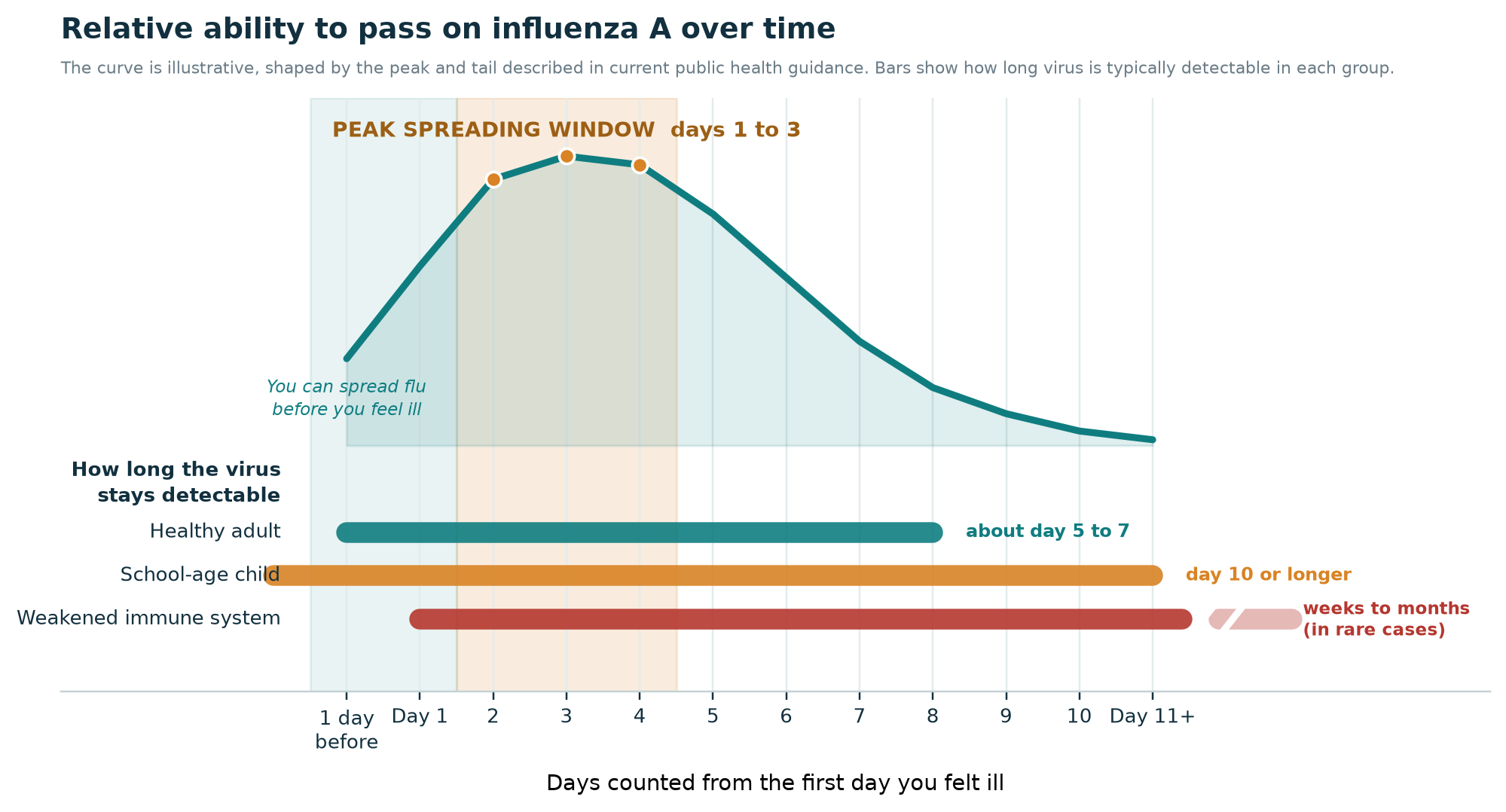
Most people stop being a real risk to others between day 5 and day 7. The two days that catch people out are day 4 and the day before you felt ill.
By the MedLifeGuide Editorial Team | Medically reviewed by Dr. Adam N. Khan, M.D | Last reviewed November 4, 2026 | Approximate reading time 11 minutes
Influenza A is most contagious during the first three to four days of illness. In most healthy adults, the amount of virus you are putting out drops to a low level somewhere between day 5 and day 7 after symptoms start. You were also able to pass it on for about 24 hours before you felt anything at all.
Those three facts, and not a single countdown, are what should drive your decisions this week. The rest of this guide is the detail behind them: what your fever does and does not tell you, why the “day 5” line quietly fails for children and for people with weakened immune systems, where US and UK guidance genuinely disagree, and the one practical measure that changes the odds for the people you live with.
If you already know you have influenza A, the existing MedLifeGuide breakdown of [type A flu symptoms, treatment and prevention] covers what the illness does to you. This page covers something different: what you do to other people, and for how long.
DIRECT ANSWER
Most healthy adults with influenza A are contagious from about one day before symptoms appear until roughly 5 to 7 days after symptoms begin, with the highest risk of spreading it in the first 3 to 4 days. Children and people with weakened immune systems can stay contagious for longer.
The short answer, in numbers
Here is the whole timeline in one view. These are typical values across populations, not a prediction about you as an individual.
| Stage | Typical timing | What it means for other people |
|---|---|---|
| Incubation | 1 to 4 days after exposure, average about 2 | You are not yet spreading virus in a meaningful way. |
| Before symptoms | About 24 hours before the first symptom | You can already pass flu on. This window is essentially impossible to control because you do not know you are in it. |
| Peak contagiousness | Days 1 to 3 or 1 to 4 of illness | This is the highest-risk window. Fever usually runs alongside it. |
| Typical end for healthy adults | Day 5 to day 7 | Most adults are past the point where they are shedding much live virus. |
| Children | Often day 10 or longer | Children shed earlier before symptoms and for longer after them. |
| Weakened immune system | Weeks to months in some cases | The standard window does not apply. Medical advice should drive decisions. |
One clarification before any of this is useful. Being detectable and being contagious are two different things, and almost every article on this topic blurs them. That distinction is the key to the rest of the page.
Why contagious is not one clean date
Three separate clocks are running at once, and they do not agree with each other.
- The symptom clock. When you started feeling ill. This is the clock your workplace, your school and every guideline uses, because it is the only one you can observe.
- The shedding clock. How long virus can be found in your nose and throat. This is what laboratory studies measure.
- The transmission clock. When you can actually infect someone. This is the one you care about, and it is the hardest to measure.
The shedding clock runs longer than the transmission clock, and that gap causes most of the confusion online. Standard laboratory testing looks for viral genetic material, which can linger in your respiratory tract after the virus has stopped being able to infect anyone. Testing for live, viable virus by culture gives a shorter window. Studies of influenza A (H1N1) patients found virus detectable for about six days on average by genetic testing, against roughly four days by culture, meaning the average gap between the two methods was about two days.
So when you read that influenza virus can be detected for five to seven days, that is a statement about detection, not about you being a danger to your colleagues on day six. It is why a lingering cough for two or three weeks does not mean three weeks of isolation.
The finding that should update every page on this topic
In September 2026, a CDC-led team published a household study in the American Journal of Epidemiology covering 1,294 people with symptomatic influenza across the 2023 to 2024 and 2024 to 2025 seasons. Participants logged symptoms and took daily nasal swabs. Two results matter here.
- Peak viral RNA shedding happened a median of four days after symptoms began. For 69 to 80 percent of participants, depending on how shedding was measured, that peak fell inside the recommended precaution window. By day six, 97 to 100 percent had peaked.
- Only 21 percent of participants isolated from household members at any point, for a median of two days. Fewer than 1 percent kept it up for the full recommended period.
Read those together and you get the practical lesson of this entire topic. The day your body is releasing the most virus is often the day you start to feel human again and want your life back. That is the day four trap, and no ranking page currently warns you about it.
The study has real limits and its authors were explicit about them. It measured viral genetic material, not infectiousness, and called for further work using virus culture. Participants came from three US states, most were children, and 70 percent had not had a flu vaccine that season, so the group is not a mirror of the general adult population. Isolation was self-reported. It is strong evidence about timing and behaviour. It is not proof that day four is your most dangerous day.
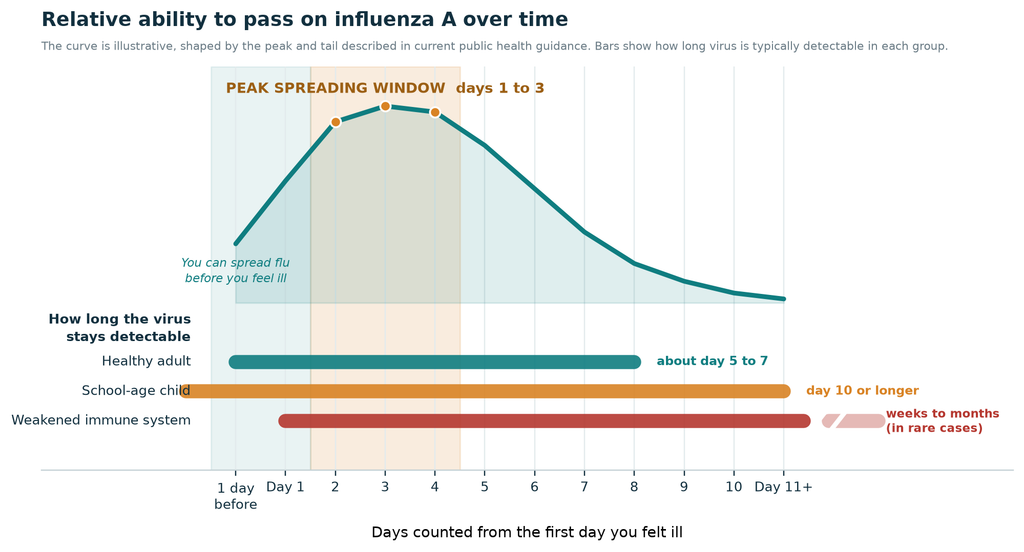
Figure 1. Relative ability to pass on influenza A over time, with typical detection windows by group. The curve is illustrative, shaped by the peak and tail described in current public health guidance. Not to scale.
Alt text: Line chart showing influenza A contagiousness peaking in the first three days of illness and falling away by day five to seven, with longer detection windows shown for children and for people with weakened immune systems.
Influenza A, day by day
Count from the first day you felt ill. If your first symptom was a cough at 4pm on Tuesday, then Wednesday is day 2.
One day before symptoms
You can transmit flu here, and it is not a theoretical risk. Roughly a third of infected people have detectable virus the day before symptoms. You cannot act on this window because you do not know it exists, which is the honest reason flu spreads so efficiently. It is also the strongest argument for staying home at the very first sign of illness rather than waiting to see whether it gets worse.
Days 1 to 3
Peak transmission. Fever, body aches and exhaustion usually arrive fast and hard. If you do one thing on this list, do this: do not spend these days in a shared room with other people. The risk you create here is disproportionate to any inconvenience you avoid.
Days 4 to 5
This is where most people make their mistake. The fever may break, the aches ease, and the temptation to return to normal activity becomes very strong. But this is also around the median peak of viral shedding in the household data above. If you have been fever-free for a full 24 hours without fever-reducing medicine and your other symptoms are clearly improving, current US guidance permits a return to normal activity, with added precautions for five more days. That is the rule, and it is a reasonable one. Just do not read it as a clearance certificate.
Days 6 to 7
Most healthy adults are now past the meaningful transmission window. Viable virus by culture is usually gone by day four to six. If you are still running a fever at this point, you are in the minority, and fever at day 7 is a reason to speak to a clinician rather than to keep waiting.
Week 2 and beyond
A dry cough and heavy fatigue commonly persist for one to two weeks after everything else settles, and a cough can outlast that. This is irritated, healing airway, not active infection. You are very unlikely to be spreading flu at this stage. If you are coughing, the honest answer to “am I contagious” is: probably not from flu, but you should still cover the cough and wash your hands, because you can pick up and pass on something else while your defences are down.
The fever rule, explained properly
The single most misapplied sentence on the internet is the one about fever. Current US guidance for respiratory viruses, influenza included, sets two conditions that must both be true for at least 24 hours before you return to normal activities.
THE TWO-CONDITION TEST
Condition one: your symptoms are getting better overall. Condition two: you have not had a fever, and you are not using fever-reducing medicine. Both must hold for at least 24 hours. Getting one right and the other wrong does not count.
Notice that it is an AND, not an OR. People routinely satisfy one half and treat the rule as met. They stopped feeling feverish, but they still feel wrecked. Or they feel broadly better, but they are topping up with ibuprofen every six hours.
The medication trap
If you are keeping your temperature down with ibuprofen or acetaminophen, you have not been fever-free for 24 hours. You have been medicated for 24 hours. The clock only starts after your last dose wears off and your temperature stays normal on its own. This is worth saying out loud to anyone who is trying to work out whether they can go back tomorrow, because it is the difference between an accurate answer and a confident wrong one.
What if you never had a fever at all
Not everyone with influenza A runs a temperature, particularly adults and older people. If you had muscle aches, a dry cough, a sore throat and sudden exhaustion but no fever, the fever half of the rule is trivially satisfied and useless to you. Fall back on the symptom half: is the overall direction clearly upward, and has it been that way for a full day? If yes, you can resume normal activity with the same five days of added precautions. If you are unsure, treat the day of your worst symptoms as the reference point and give it a little longer.
Fever is a proxy. It is a good proxy because it usually tracks viral shedding, which is why every guideline leans on it. It is not a test, and treating it as one is how people end up back at work on their worst shedding day.
Where the guidance actually conflicts
This is the part you will not find on the pages currently ranking, and it is the part that matters if you are not American. Public health agencies are answering different questions. The US guidance is designed to give one rule that works across flu, COVID and RSV. The UK guidance is written to tell an individual whether to stay home, and deliberately refuses to name a number of days. These genuinely differ, and neither is wrong.
| Source | Contagious period given | Return-to-normal rule | Style |
|---|---|---|---|
| US CDC | Most contagious in the first 3 to 4 days; detectable from 1 day before symptoms to 5 to 7 days after; longer in children and people with weakened immunity. | Resume normal activity once symptoms are improving overall AND you have had no fever for 24 hours without fever-reducing medicine. Then take added precautions for 5 days, because you may still be able to spread it. | Symptom-based, no fixed day count |
| UK NHS | More likely to pass flu on in the first 5 days after infection. Flu germs can live on hands and surfaces for 24 hours. | Try to stay at home and avoid contact with others if you have a high temperature, feel hot, cold or shivery, or do not feel well enough for your normal activities. | Symptom-based, no fixed day count |
| UKHSA education settings | Not stated as a day count. | Children and young people who are unwell with a high temperature should stay home and return when they no longer have a high temperature and are well enough to attend. Mild cold-like symptoms alone do not require exclusion. | Exclusion-based |
| WHO and ECDC | Incubation about 2 days, range 1 to 4. Virus usually found from 1 day before to 5 to 7 days after symptom onset, longer in young children, older people and those with weakened immunity. | No single return rule. ECDC notes that the transmission role of people with sub-clinical infection is not conclusively established. | Descriptive |
Two practical consequences follow. First, if you are in the US, follow the CDC two-condition test. If you are in the UK, follow the NHS rule, which is simpler and, in practice, usually keeps you home slightly longer if your temperature is stubborn. Second, if your workplace, your child’s school or your country has a stricter rule than either of these, the stricter rule governs your day. Clinical guidance sets a floor, not a ceiling, and no guideline is written with your manager in mind.
A related warning: a number of pages still present “isolate for five days, then mask for five more” as current advice for flu. That was the COVID-era isolation rule. Current CDC respiratory guidance replaced it with the symptom-and-fever approach above. If you see a page quoting the older rule as today’s flu advice, treat its other claims with caution too.
Who stays contagious longer, and by how much
The 5 to 7 day figure is an average for healthy adults. Several groups sit outside it, and the difference is measured in days or weeks, not hours.
| Group | Typical window | What changes in practice |
|---|---|---|
| Healthy adults under 65 | 1 day before symptoms to about day 5 to 7 | The standard rule works. Follow the two-condition test and the five days of added precautions. |
| Children under 5, and school-age children | Can shed for 10 days or longer | Expect a longer window and more early shedding. The child’s nursery or school exclusion policy, not the adult rule, decides the return date. |
| People with weakened immune systems | Weeks, and in rare documented cases months | The standard window does not apply. Decisions should be made with the treating clinician, particularly for anyone on chemotherapy, steroids, or after transplant. |
| Adults 65 and over, and care home residents | Often longer than the standard window | Older adults and residents with risk factors for prolonged shedding may need infection control measures beyond five days. Visiting decisions should follow the care home’s own policy. |
| People with severe illness or hospital care | Often longer than the standard window | Hospital infection control teams use their own criteria, usually linked to symptoms and fever rather than a fixed count. |
Children are the real engine of household spread
Two numbers explain why flu tears through schools and then through homes. In a household transmission study in Nicaragua, 69 percent of children aged 0 to 5 and 67 percent of children aged 6 to 15 showed viral shedding before symptoms appeared, against 45 percent of adults. Children also started shedding earlier and stopped later. The practical implication is uncomfortable: a child who seems fine at breakfast may already be infectious, and a child who seems better on day six may still be.
What does not reliably change your window
Two popular beliefs deserve a correction.
- Vaccination. Annual flu vaccination reduces your chance of getting flu and reduces the severity if you do. Whether it meaningfully shortens how long you shed virus is genuinely unresolved, and credible sources point in different directions. Do not treat your vaccination status as a reason to relax the return-to-activity rule.
- Antivirals. Oseltamivir (Tamiflu) shortens illness in otherwise healthy adults by roughly a day, and the Cochrane review evidence puts the benefit at under a day for symptom relief. Some trials, notably a randomised placebo-controlled trial in Bangladesh, found reduced viral shedding even when treatment started more than 48 hours after symptoms. But the claim that antivirals reliably stop you transmitting flu is not supported by the trial data. Antivirals are valuable for people at high risk of complications, and they are not a substitute for staying away from people while you are unwell.
Does influenza A differ from influenza B, and does the subtype matter
For the question you actually asked, the answer is no. The contagious window is broadly the same for influenza A and influenza B, and public health guidance does not set a different timeline for the two.
Where they differ is severity, and the difference is age-dependent rather than absolute. Influenza A has historically been the more severe of the two in adults, and H3N2 seasons have been associated with more hospitalisation and deaths among older adults and young children. But in a 2024 comparison of hospitalised children, influenza B was linked to more headache and abdominal pain, particularly in children aged 3 to 9, while children under 2 with influenza A were far more likely to need intensive care, at 23.6 percent against 4.0 percent. Another review noted that young children tend to have more severe influenza B illness than adults do.
So “it is only flu B” is not a safe assumption in a household with a toddler, and “I have flu A so B would be mild for me” is not information you can use. The letter on the test result tells you something about population risk. It tells you very little about your own week.
Flu, cold, COVID and RSV at a glance
If you have not tested and are working out what you have, the timelines differ enough to matter for who you protect and when.
| Illness | Contagious from | Peak | Typical window |
|---|---|---|---|
| Influenza A or B | About 1 day before symptoms | First 3 to 4 days | 5 to 7 days in adults; 10 or more in children |
| Common cold | A day or so before symptoms | First 2 to 3 days | About a week, sometimes longer |
| COVID-19 | Can spread with no symptoms at all, often before onset | Varies widely by person and variant | No single day count. Use the symptom and fever rule. |
| RSV | 1 to 2 days before symptoms | Early in illness | Usually 3 to 8 days. Some infants and immunocompromised people spread it for far longer. |
If the distinction between COVID and flu matters for your household, the MedLifeGuide [symptom comparison chart for 2026 strains] sets the two side by side. For treatment decisions, a test is more useful than a symptom list, because antivirals for flu and for COVID are different drugs.
If you test negative, are you in the clear
Probably not, and the reason is the test rather than you. Rapid antigen flu tests have a sensitivity of roughly 50 to 70 percent when compared with PCR or viral culture. In plain terms, they miss between three and five cases out of every ten. Specificity is high, around 95 to 99 percent, so a positive result is usually trustworthy. It is the negative result that misleads.
False negatives are most likely exactly when flu is everywhere, which is when you most want to believe the test. Rapid antigen tests are also less sensitive for influenza B than for influenza A. Rapid molecular tests done in a clinic have far higher sensitivity, typically in the 90 to 100 percent range, and are a different category altogether from the 15-minute lateral flow test.
THE RULE THAT FOLLOWS
A negative rapid test does not reset your contagious clock. If you have flu symptoms in a household where someone else has tested positive, or during a period of high community flu activity, manage it as flu regardless of a negative antigen result. The test changes your treatment options. It does not change how long you should stay away from people.
Your seven-day playbook
Generic hygiene advice is not useful once you are already ill. These are the decisions people actually face, with a realistic answer for each.
At home, when a separate room is not an option
Textbook advice assumes a spare bedroom and a second bathroom. The household study above found that only about a fifth of people isolated from the people they lived with at all, and most of those managed two days. So aim for harm reduction rather than perfect separation, and put your effort where it counts.
- Air first. Ventilation is the highest-leverage measure available to you, and it costs nothing. Open windows in the rooms you occupy, keep them open for a while after you leave, and use an extractor fan or a HEPA unit where you have one. This is also the first thing the CDC recommends for cleaner air in homes.
- Protect the most vulnerable person in the house, not the house as a whole. If someone there is pregnant, over 65, on chemotherapy or steroids, or a young infant, direct your masking and distance effort at them.
- Mask when you share a room, not constantly. A well-fitted mask when you are in the same room as others reduces the dose they receive. It is most useful on days one to four.
- Give the bathroom five minutes. Leave the fan running and the window open after you use it, and keep your own towel separate.
- Do not share the bed if your partner is in a high-risk group. This is the single most common transmission route that people underestimate.
At work
The friction here is rarely medical. Reddit threads on this topic are full of people returning on day four because they fear their employer more than the virus, and a number of them describe ending up off again a week later. If you have to negotiate, negotiate with the strongest card you have: the specific threshold.
A short message works: “I have influenza A. Public health guidance is that I stay home until my symptoms are clearly improving and I have been fever-free for 24 hours without medication, then take extra precautions for five more days. I expect to be back on Thursday and I will mask in shared spaces and avoid the in-person meeting that week.” That is specific, dated and hard to argue with. “I am still sick” is not.
If you work with vulnerable people, in healthcare, childcare or a care home, the infection control policy of your workplace overrides any general rule in this article, and those policies are usually more conservative by design.
School and childcare
In England, the exclusion standard for education and childcare settings is that a child who is unwell with a high temperature stays home and returns when the temperature has gone and they are well enough to attend. A runny nose or mild cough on its own is not a reason to exclude. In the US, the same two-condition principle applies as for adults. Practically, do not send a child back on the strength of a normal temperature reading after a dose of children’s paracetamol.
Care homes, hospitals and new babies
Do not visit on days one to seven if you can avoid it, and do not visit at all in the first three days. If the visit cannot move, ask the home or ward what their current policy is, because many set their own rules that are stricter than national guidance, then mask properly for the whole visit and keep it short. A newborn in the household is the same calculation: wait.
Flights and long journeys
If you are still within the five-to-seven-day window and you have a choice, move the trip. Airline policies vary, and none of them are designed to protect the person in seat 24B. If you must travel, mask continuously, keep your hands clean, and avoid eating near other people. The practical risk on a flight is sustained close contact in a shared air volume, which is precisely what a well-fitted mask is for.
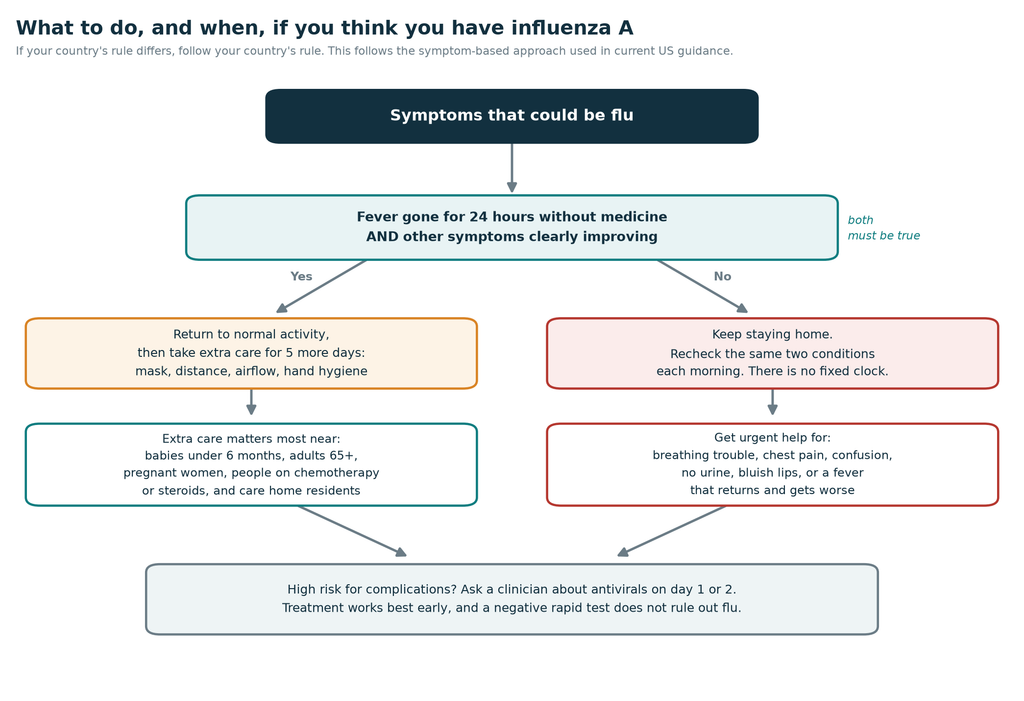
Figure 2. A decision flow for the first week of influenza A, based on the symptom-and-fever approach used in current US guidance. Follow your own country’s rule where it differs.
Alt text: Decision flowchart for influenza A showing the two-condition return test, the five days of added precautions, groups needing extra care, and emergency warning signs.
When to stop managing this at home
Most people recover without medical care. A minority do not, and the signals that matter are specific. Seek emergency care for any of the following, in yourself or in a child.
| Adults | Children |
|---|---|
| Difficulty breathing or shortness of breath | Fast breathing or trouble breathing, or ribs pulling in with each breath |
| Persistent pain or pressure in the chest or abdomen | Chest pain, or severe muscle pain such that the child refuses to walk |
| Persistent dizziness, confusion, or difficulty waking | Not alert or not interacting when awake |
| Seizures | Seizures |
| Not urinating | Dehydration: no urine for 8 hours, dry mouth, no tears when crying |
| Severe muscle pain, or severe weakness or unsteadiness | Bluish lips or face |
| Fever or cough that improves and then returns or gets worse | Fever above 104F not controlled by fever-reducing medicine, or any fever in a baby under 12 weeks |
| Worsening of an existing chronic condition | Fever or cough that improves and then returns or gets worse |
Two situations deserve a same-day call rather than a wait-and-see approach. The first is being in a higher-risk group: pregnancy and up to two weeks after birth, age 65 and over, children under 5 and especially under 2, and anyone with a long-term condition affecting the heart, lungs, kidneys, liver, blood, brain or metabolism, or with a weakened immune system. The second is symptoms that improve and then worsen with a returning fever, which may point to a secondary bacterial infection and needs a clinical assessment rather than another day in bed.
If you are in a higher-risk group, contact a clinician promptly rather than waiting to see how it goes. Flu antivirals work best when started within two days of getting sick, and guidance is explicit that treatment decisions for higher-risk people should not wait for laboratory confirmation. Later treatment can still help, particularly for people who are very unwell.
One caution particular to readers with kidney disease: dehydration from fever and reduced food intake can be more consequential for you, and some over-the-counter flu remedies are not appropriate with impaired kidney function. The MedLifeGuide guides to [early warning signs of kidney problems] and to a [kidney-friendly diet plan for chronic kidney disease] are the right starting points, and your own clinician should guide any medication choice.
Six things most articles get wrong
If you have read three other pages on this topic already, you have probably met all six.
- Treating day five as a finish line. It is a typical value for healthy adults, not a deadline that clears you.
- Equating fever-free with not contagious. It is the threshold for resuming normal activity, and current guidance explicitly says you may still be able to spread the virus after you feel better.
- Quoting the retired five-day isolation rule as current flu guidance. That rule has been superseded.
- Claiming antivirals stop you being contagious. The evidence for shortening illness is modest and the evidence for interrupting transmission is thin.
- Ignoring children entirely, or mentioning them in half a sentence. Children shed earlier and longer than adults, and they are usually the index case in a household.
- Forgetting the day before symptoms. Every page mentions it in passing and none of them tells you what to do about it, which is to act on the first symptom rather than waiting for confirmation.
Frequently asked questions
The incubation period is one to four days, averaging about two. Because you can shed virus from roughly a day before symptoms appear, you could be passing flu on within about one to three days of being exposed, before you have any reason to suspect it.
Only if both conditions have held for at least 24 hours: your symptoms are improving overall, and you have had no fever while taking no fever-reducing medicine. If both are true, current US guidance allows a return with added precautions for five more days. If you are still using ibuprofen to keep your temperature normal, the clock has not started.
Yes. Not everyone with influenza A develops a fever, and contagiousness begins before symptoms of any kind. Use your overall symptom trajectory instead: once the direction has been clearly upward for a full day, you can resume normal activity with the same five days of added precautions.
Not in any way that changes your week. The contagious window is broadly the same. The two differ in severity by age group, with influenza A causing more severe illness in children under 2 and influenza B capable of causing significant illness in older children.
Yes. Immunity is specific to the strain you met, and more than one influenza A subtype, such as H1N1 and H3N2, can circulate in the same season, alongside influenza B. A second illness a few weeks later is more likely to be a different virus than a relapse of the first, which is one reason a returning fever deserves a clinical review.
The one thing to do tonight
Write down two things: the date your first symptom appeared, and whether you had a fever without medicine at any point. Put it somewhere you will see it tomorrow. Every rule in this article converts into a decision from those two facts, which means you can answer the question “can I go back” in about ten seconds instead of reading another article. If your first symptom was four days ago and your fever broke this morning, you already know your answer is not yet. If your first symptom was eight days ago and you are just left with a cough, you already know the cough is not the contagious part.
For the wider picture of what influenza A does to the body and when treatment helps, the MedLifeGuide [guide to type A flu symptoms, treatment and prevention] sits alongside this page. This one is about the people around you.
Author review
This article was drafted by the MedLifeGuide editorial team and is scheduled for review by a licensed physician before publication.
| Written by | MedLifeGuide Editorial Team |
| Medically reviewed by | Dr. Adam N. Khan, MD |
| Review date | November 4, 2026 |
| Next scheduled review | November 4, 2026 plus 12 months, or sooner if CDC or NHS guidance changes |
| Evidence cut-off | November 2026 |
| Primary sources | US Centers for Disease Control and Prevention, UK National Health Service, UK Health Security Agency, World Health Organization, European Centre for Disease Prevention and Control, American Journal of Epidemiology, Cochrane Library |
Reviewer checklist before sign-off:
- Confirm the CDC two-condition return rule and the five days of added precautions against the live version of the CDC respiratory virus guidance page, since this is the claim readers will act on.
- Confirm the NHS wording on the first five days and the high temperature rule against the live NHS flu page.
- Confirm whether any national guidance has changed since November 2026, and update the jurisdiction table if so.
- Confirm the Cochrane and Bangladesh trial characterisation of antiviral benefit, and remove the shedding claim if the reviewer considers it overstated for a general audience.
- Confirm the emergency warning signs table matches the current CDC list word for word in substance.
- Add a short reviewer note if there is a clinical nuance you want a patient to understand that the draft has not captured.
Medical disclaimer
This article is for general education. It is not medical advice, it is not a diagnosis, and it does not replace an assessment by a licensed clinician who knows your history.
Contagiousness timelines describe populations, not individuals. Your own situation may differ because of your age, your immune status, pregnancy, a long-term condition, the strain you have caught, or a treatment you are taking. If you are in a higher-risk group, or if you are making a decision about someone who is, ask a clinician rather than relying on this page.
Guidance from public health agencies changes. The US and UK positions summarised here were current as of November 2026. If your national guidance, your workplace policy or your child’s school policy is stricter than what is written here, follow the stricter rule.
If you are seriously unwell, do not use this article to decide whether to wait. Seek emergency care. In the US, call 911 or go to the nearest emergency department. In the UK, call 999 or use NHS 111 for urgent advice.
MedLifeGuide does not provide prescriptions, and nothing here should be read as a recommendation to start, stop or change any medication, including antivirals or over-the-counter fever reducers.
Sources
Numbered markers are deliberately omitted from the article paragraphs, as instructed. Each source below is the one that supports the relevant claims in the article. Primary and official sources are listed first. Nothing here is a search results page, an anonymous content farm, or a competitor cited for its ranking.
1. Centers for Disease Control and Prevention. About Influenza. (Page reviewed 2026.) https://www.cdc.gov/flu/about/index.html
2. Centers for Disease Control and Prevention. Key Facts About Influenza (Flu). https://archive.cdc.gov/www_cdc_gov/flu/about/keyfacts.htm
3. Centers for Disease Control and Prevention. Influenza, CDC Yellow Book. https://www.cdc.gov/yellow-book/hcp/travel-associated-infections-diseases/influenza.html
4. Centers for Disease Control and Prevention. Preventing Spread of Respiratory Viruses When You’re Sick. Updated 18 August 2025. https://www.cdc.gov/respiratory-viruses/prevention/precautions-when-sick.html
5. Centers for Disease Control and Prevention. About Respiratory Illnesses: when to seek emergency care. https://www.cdc.gov/respiratory-viruses/about/index.html
6. Centers for Disease Control and Prevention. Preventing Respiratory Illnesses (cleaner air and core prevention strategies). Updated 18 August 2025. https://www.cdc.gov/respiratory-viruses/prevention/index.html
7. Centers for Disease Control and Prevention. Information for Clinicians on Rapid Diagnostic Testing for Influenza. https://www.cdc.gov/flu/hcp/testing-methods/rapidclin.html
8. Centers for Disease Control and Prevention. Infection Prevention and Control Strategies for Seasonal Influenza in Healthcare Settings. https://www.cdc.gov/flu/hcp/infection-control/healthcare-settings.html
9. World Health Organization. Influenza (seasonal) fact sheet. 28 February 2025. https://www.who.int/news-room/fact-sheets/detail/influenza-(seasonal)
10. European Centre for Disease Prevention and Control. Factsheet about seasonal influenza. https://www.ecdc.europa.eu/en/seasonal-influenza/facts/factsheet
11. National Health Service (UK). Flu. Page last reviewed 3 February 2026. https://www.nhs.uk/conditions/flu/
12. American Journal of Epidemiology. Influenza mitigation recommendations, symptoms, and viral RNA shedding durations, 2023-2024 and 2024-2025 seasons. 2026. https://academic.oup.com/aje/advance-article-abstract/doi/10.1093/aje/kwag219/8789970
13. CIDRAP, University of Minnesota. Few people with the flu isolate for the recommended period. September 2026. https://www.cidrap.umn.edu/influenza-general/few-people-flu-isolate-recommended-period
14. Pediatric Infectious Disease Journal. The Timeline of Influenza Virus Shedding in Children and Adults in a Household Transmission Study of Influenza in Managua, Nicaragua. 2016. https://journals.lww.com/pidj/fulltext/2016/05000/the_timeline_of_influenza_virus_shedding_in.29.aspx
15. Killingley B, et al. The environmental deposition of influenza virus from patients infected with influenza A(H1N1)pdm09. Journal of Infection and Public Health. 2016. https://www.sciencedirect.com/science/article/pii/S1876034115001926
16. Medscape. Viral Shedding Prolonged in Children With H1N1 Flu (IDSA 47th Annual Meeting report). 2009. https://www.medscape.com/viewarticle/711619
17. Cochrane Library. Regulatory information on trials of oseltamivir (Tamiflu) and zanamivir (Relenza) for influenza in adults and children. https://www.cochrane.org/evidence/CD008965_regulatory-information-trials-oseltamivir-tamiflu-and-zanamivir-relenza-influenza-adults-and
18. Cochrane Library. Neuraminidase inhibitors for preventing and treating influenza in children. https://www.cochrane.org/evidence/CD002744_neuraminidase-inhibitors-preventing-and-treating-influenza-children
19. CIDRAP, University of Minnesota. Studies: Oseltamivir use drops as evidence of benefits grows (Bangladesh randomised controlled trial). https://www.cidrap.umn.edu/h1n1-2009-pandemic-influenza/studies-oseltamivir-use-drops-evidence-benefits-grows
20. Comparison of Clinical Presentations and Disease Severity of Children Hospitalized with Influenza A and B. PMC. 2024. https://pmc.ncbi.nlm.nih.gov/articles/PMC11332444
21. Influenza B infections in children: A review. PMC. 2020. https://pmc.ncbi.nlm.nih.gov/articles/PMC7769779/
22. Public health advice for educational settings, summarising UKHSA guidance on health protection in children and young people settings. [VERIFY the current gov.uk URL for the UKHSA chapter before publishing, and cite the UKHSA original rather than this summary.] https://cyps.northyorks.gov.uk/sites/default/files/Noticeboard/Red%20bag/Attachments/2022/Public%20Health%20COVID-19%20advice%20for%20educational%20settings%20v1.7%2020.04.22.pdf
Experience sources
Consulted for the human experience brief in Part 4. These are not cited as clinical evidence anywhere in the article.
E1. Reddit r/flu. When to go back to work? February 2025. https://www.reddit.com/r/flu/comments/1ig4qx8/when_to_go_back_to_work/
E2. Reddit r/flu. DO NOT PUSH RECOVERY. February 2025. https://www.reddit.com/r/flu/comments/1ir1yh2/do_not_push_recovery/
E3. Reddit r/flu. Rebound Flu A? January 2025. https://www.reddit.com/r/flu/comments/1hrj47b/rebound_flu_a/
E4. Reddit r/AskIreland. This new flu is the worst I’ve ever had. How many days did it take you to recover? December 2025. https://www.reddit.com/r/AskIreland/comments/1ptxby2/this_new_flu_is_the_worst_ive_ever_had_how_many/
E5. Reddit r/ColumbiYEAH. If you’ve gotten flu A already, how long did it last? December 2025. https://www.reddit.com/r/ColumbiYEAH/comments/1pz3vqv/if_youve_gotten_flu_a_already_how_long_did_it_last/
E6. Reddit r/doctorsUK. How many days off for flu? February 2024. https://www.reddit.com/r/doctorsUK/comments/1aj9rq4/how_many_days_off_for_flu/
End of document. MedLifeGuide editorial research, November 2026.