
Last Updated: September 18, 2026 | Medically Reviewed Sources: FDA, CDC, Cleveland Clinic, Johns Hopkins, Cochrane Database
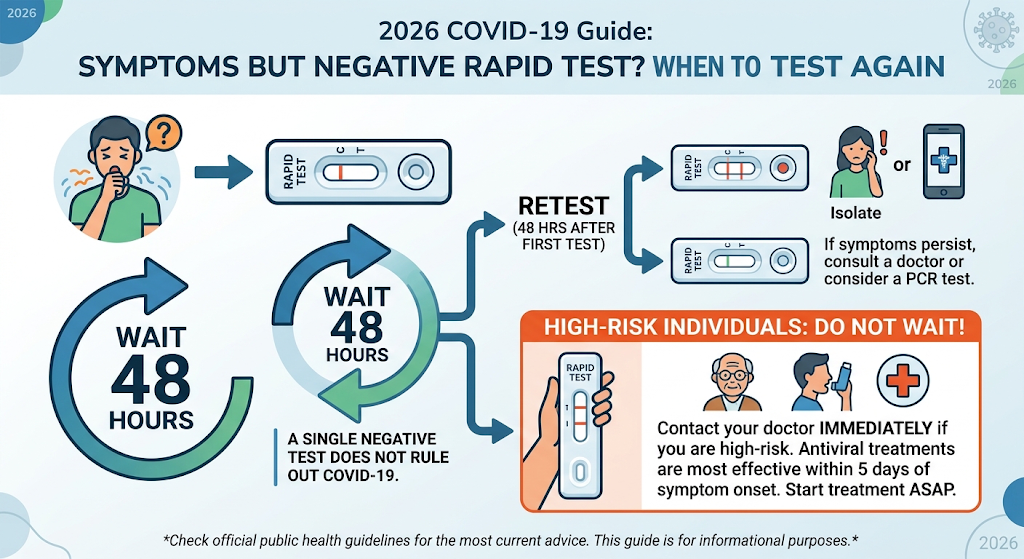
Quick Answer: If you have COVID symptoms and your rapid test is negative, retest in 48 hours. A single negative test does NOT rule out COVID-19. If you’re high-risk, contact your doctor immediately don’t wait for a positive result, because antiviral treatments work best within 5 days of symptom onset.
You woke up with a scratchy throat. By afternoon, the body aches kicked in. You swabbed your nose, waited 15 minutes, and the test shows one line: negative.
So you’re in the clear, right?
Not necessarily. In 2026, a negative rapid test on your first day of symptoms is less reliable than most people realize and understanding why could protect your health, your family, and in some cases, save your life.
This guide covers everything the top health sites aren’t telling you: why your test might be wrong, exactly when to retest, when to call your doctor, and what to do if the tests keep coming back negative.
Why Your Day-1 Test Can Be Wrong (The Science)
The Immune-Primed Diagnostic Gap
Here’s something most testing guides don’t explain: your immune system has changed the game.
In 2020 and 2021, when most people encountered SARS-CoV-2 for the first time, the virus had time to multiply unchecked before the body mounted a defense. Viral loads typically peaked around the time symptoms appeared, making early rapid tests reasonably accurate.
That’s no longer how it works.
After years of vaccinations and prior infections, most people’s immune systems are now primed to respond within hours of encountering the virus. This means:
- Your immune system attacks the virus immediately, causing inflammation and symptoms (sore throat, fever, fatigue)
- The virus hasn’t had time to multiply to levels detectable by rapid antigen tests
- Result: You feel sick, but the test says negative
As Prof. Joshua Schiffer, an infectious disease researcher at Fred Hutch Cancer Center, explains: “Disease symptoms are in large part mediated by an effective immune response, and because that immune response ignites very, very early during infection, it has become quite common for people to report symptoms before their tests turn positive.”
The Viral Load Curve Explained
Think of it like a roller coaster:
textSymptoms     ████████████████████████████████████████████████
Viral Load   ░░░░░▓▓▓▓█████████████████████▓▓▓▓░░░░░░░░░░░
Rapid Test   ❌ ❌   ✅  ✅  ✅  ✅  ✅  ✅  ✅  ❌  ❌  ❌
             Day 1  2   3   4   5   6   7   8   9  10  11  12
                      ↑               ↑
                Test turns      Viral load peaks
                positive        (best detection window)
- Day 1-2 of symptoms: Viral load is climbing but may still be below the test’s detection threshold. This is when false negatives are most common.
- Day 3-5 of symptoms: Viral load typically peaks. Rapid tests are most accurate during this window.
- Day 5+: Viral load begins declining. You may start testing negative even if you’re still mildly symptomatic.
A 2023 study published in the Annals of Internal Medicine found that viral loads in vaccinated and previously-infected individuals tend to peak four days after symptom onset — not at symptom onset as in earlier pandemic waves.
Why This Matters for You
A negative test on Day 1 of symptoms has a meaningful false-negative rate. The FDA, CDC, and every major health authority now treats a single negative antigen result as inconclusive — not as proof you don’t have COVID.
The FDA explicitly states: “A negative result using at-home COVID-19 antigen test means the test did not detect the virus that causes COVID-19, but it does not rule out COVID-19.”
The Exact Retesting Schedule: Your Day-by-Day Timeline
This is the schedule recommended by the FDA and printed on every authorized home test kit. If you have COVID-like symptoms:
If You Have Symptoms:
| Day | Action | Why |
|---|---|---|
| Day 1 | Take your first rapid antigen test immediately | A positive result is highly reliable. Trust it. A negative result is inconclusive. |
| Day 2 | Do NOT retest yet | Testing too soon just repeats the same uncertainty. Viral levels haven’t changed enough. |
| Day 3 | Take your second rapid test (48 hours after first) | Viral load is climbing toward peak. This is your best chance to catch it on antigen. |
| Day 4-5 | If still negative but still sick → get a PCR or multiplex test | Viral load is at or near peak. If antigen tests miss it now, you likely need molecular testing — or you may have a different illness. |
If You Were Exposed but Have No Symptoms:
| Day | Action |
|---|---|
| Day 0 | Exposure occurs |
| Days 1-4 | Do NOT test yet — too early for reliable results |
| Day 5 | Take your first rapid test |
| Day 7 | Take your second rapid test (48 hours later) |
| Day 9 | Take your third rapid test (48 hours later) |
| All negative? | Low likelihood of COVID, but monitor for symptoms for a few more days |
Important Rules:
- A positive at ANY point = trust it. False positives on antigen tests are extremely rare.
- Use the same brand for all tests in your series if possible (consistency improves comparison).
- Test in the morning if possible — viral concentrations in nasal secretions can be higher after sleeping.
- Don’t eat, drink, or brush teeth for 30 minutes before a throat swab (if your test allows it).
What If You Keep Testing Negative? Decision Tree
This is the scenario nobody talks about, and it’s the most frustrating: you’ve tested negative twice, you still feel terrible, and you don’t know what to do.
Here’s your decision tree:
Scenario A: Two Negative Tests, Symptoms Improving
→ You likely had a different respiratory virus (cold, flu, RSV). Continue standard care.
- Rest, hydrate, manage symptoms with acetaminophen or ibuprofen
- No further COVID testing needed unless symptoms worsen
- Consider a combo test (COVID + Flu + RSV) if you want a definitive answer
Scenario B: Two Negative Tests, Symptoms Same or Worse
→ Get a PCR/molecular test. The antigen tests may be missing your infection.
- Schedule a PCR test at a pharmacy, urgent care, or your doctor’s office
- Ask for a multiplex respiratory panel that tests for COVID, Flu A/B, and RSV simultaneously
- Continue isolating and masking around others until you have answers
Scenario C: Two Negative Tests, You Were Exposed to Confirmed COVID
→ Assume you have COVID despite the negative results. Take precautions.
- The FDA explicitly says: “Assume you have COVID-19 and your initial test did not detect the virus”
- Mask around others for 10 days from symptom onset
- Get a PCR test to confirm
- If you’re high-risk, contact your doctor NOW — don’t wait for confirmation
Scenario D: Three+ Negative Tests Over 5+ Days, Symptoms Persisting
→ It’s very likely NOT COVID. Focus on identifying the actual cause.
- Request a comprehensive respiratory panel from your doctor
- Consider: influenza, RSV, adenovirus, rhinovirus, bacterial infection (strep), or even seasonal allergies
- If you have a severe sore throat with fever and minimal cough, ask about a strep test — bacterial infections are treatable and shouldn’t be missed
The Bottom Line
As Dr. Andrew Pekosz, virologist at Johns Hopkins, states: “If you are feeling symptomatic and you test negative for COVID-19, usually the most likely reason is you’re infected with something else besides COVID-19.”
Multiple viruses circulate simultaneously, especially during fall and winter. A negative COVID test doesn’t mean you’re not sick — it means you probably need to look for a different cause.
The Hidden Danger: Missing the Treatment Window
This section could save your life or the life of someone you love.
Here’s what none of the top-ranking articles mention: antiviral medications like Paxlovid must be started within 5 days of SYMPTOM ONSET — not 5 days from your positive test.
Why This Matters
Every day you spend waiting for a positive test result burns your treatment window:
| Scenario | Treatment Started | Hospitalization Reduction |
|---|---|---|
| Paxlovid on Day 1-3 of symptoms | Optimal | 87-89% reduction |
| Paxlovid on Day 4-5 of symptoms | Still effective | Meaningful benefit |
| Paxlovid on Day 6+ of symptoms | Window closed | Minimal benefit |
If you test negative on Day 1, assume it’s “just a cold,” don’t retest until Day 5, and finally test positive — you may have already missed the optimal treatment window.
Who Needs to Act Fast?
Paxlovid is recommended for adults with at least one risk factor for severe COVID-19:
- Age 50 and older (risk increases significantly at 65+)
- Diabetes (Type 1 or Type 2)
- Obesity (BMI ≥ 25)
- Chronic lung disease (COPD, moderate-to-severe asthma)
- Chronic kidney disease
- Chronic liver disease
- Cardiovascular disease
- Hypertension
- Immunocompromised (from medications or medical conditions)
- Pregnancy
- Current or former smoker
- Sickle cell disease
- Active cancer
- Neurodevelopmental disorders
What You Should Do If You’re High-Risk
- Test immediately when symptoms start
- If negative AND you’re in a risk group, call your doctor on Day 1 — don’t wait for a positive test
- Your doctor can order a rapid PCR AND assess Paxlovid eligibility in the same visit
- If you test positive on Day 3, you can start Paxlovid immediately instead of calling for the first time
Getting Paxlovid Fast
- Telehealth visits (around $79) can assess eligibility and send a prescription to your pharmacy within hours
- Test-to-Treat locations provide testing AND same-day prescriptions at the same site
- PAXCESS program (Pfizer’s patient assistance) provides free Paxlovid to eligible uninsured and Medicare/Medicaid patients through December 2026
- Retail price without insurance: approximately $1,390-$1,447 per 5-day course
- With insurance or PAXCESS copay card: often $0
The Clock Starts With Symptoms, Not Your Test
Remember: the 5-day window starts when you first feel sick, not when you get your positive result. If you felt symptoms on Monday but didn’t test positive until Thursday, you only have until Saturday to start treatment.
Don’t let serial negative tests give you false confidence if you’re in a high-risk group.
It Might Not Be COVID: Combo Tests for Flu, RSV & More
Here’s something none of the top-ranking pages mention: if your COVID test is negative, you can now test for multiple respiratory viruses at once with a single home test.
FDA-Cleared Combo Home Tests Available in 2026
| Test Name | What It Detects | Results Time | Approximate Cost |
|---|---|---|---|
| Flowflex Plus COVID-19 and Flu A/B Home Test | SARS-CoV-2 + Influenza A + Influenza B | 15 minutes | ~$9-10 per test |
| Flowflex Plus RSV + Flu A/B + COVID Home Test | SARS-CoV-2 + Flu A/B + RSV | 15 minutes | ~$9-10 per test |
| WELLlife COVID-19 / Influenza A&B Home Test | SARS-CoV-2 + Influenza A + Influenza B | 15 minutes | ~$9 per test |
| iHealth Flu A&B / COVID-19 / RSV Rapid Test | SARS-CoV-2 + Flu A/B + RSV | 15 minutes | ~$9 per test |
| BinaxNOW COVID-19/Flu A&B Combo Self Test | SARS-CoV-2 + Influenza A + Influenza B | 15 minutes | ~$10-12 per test |
Why This Matters
If you’re sick and testing negative for COVID, you might have:
- Influenza — Tamiflu (oseltamivir) works best within 48 hours of symptom onset
- RSV — Especially dangerous for infants, older adults, and immunocompromised people
- A combination of viruses — Co-infections are more common than people realize
A combo test gives you a definitive answer in 15 minutes instead of leaving you guessing.
Ask Your Doctor About Multiplex PCR Panels
If you go to a clinic or urgent care, many now offer multiplex respiratory panels that test for 5+ pathogens simultaneously:
- SARS-CoV-2 (COVID-19)
- Influenza A and B
- RSV
- Adenovirus
- Rhinovirus
- Parainfluenza
- Human metapneumovirus
These are especially valuable if you’re high-risk, because the treatment differs for each virus. What works for COVID doesn’t work for flu, and vice versa.
Can You Still Spread COVID With a Negative Test?
Short answer: Yes, possibly.
A negative rapid test means the virus wasn’t detected in your nose at the moment you swabbed. It does NOT mean:
- You don’t have the virus elsewhere in your respiratory tract
- You aren’t shedding enough virus to infect someone
- You’re safe to visit your immunocompromised grandmother
The Science of Viral Shedding
Research published in Clinical Infectious Diseases found that some patients intermittently shed low levels of viable virus — undetectable by standard rapid tests — yet potentially sufficient for transmission under close contact conditions.
Key findings:
- PCR tests can detect dead viral RNA fragments for weeks after you’re no longer infectious (these positives are NOT contagious)
- Rapid antigen tests correlate better with active infection but may miss low-level shedding
- Live virus has been recovered from some antigen-negative samples, though this is uncommon
- Immunocompromised individuals may shed infectious virus for 29+ days (median), far longer than the general population
What This Means for Your Behavior
If you have symptoms (regardless of test result):
- ✅ Stay home when possible
- ✅ Wear a high-quality mask (N95, KN95, or KF94) if you must be around others
- ✅ Improve ventilation (open windows, use air purifiers)
- ✅ Avoid close contact with high-risk people until you’re clearly improving and fever-free for 24 hours
- ✅ Practice good hand hygiene
If visiting someone vulnerable (even with a negative test):
- Test as close to the visit as possible (same day, ideally within hours)
- Add a 48-hour pre-visit quarantine if possible
- Wear a mask during the visit
- Keep the visit well-ventilated or outdoors
- If you have ANY symptoms, reschedule — a negative test isn’t enough reassurance
How to Read Your Test Correctly: Faint Lines & Evaporation Lines
One of the most confusing moments in home testing: Is that a faint positive line, or just an artifact?
The Rules Are Simpler Than You Think
| What You See | What It Means | What To Do |
|---|---|---|
| Two clear lines (C + T) | Positive | You have COVID. Isolate and contact your doctor if high-risk. |
| Faint colored line at T (within time window) | Positive | Treat as positive. A faint line is still a line. |
| Control line only | Negative | Retest in 48 hours if symptomatic. |
| No control line | Invalid | Discard and retest with a new kit. |
| Gray/colorless line appearing AFTER the time window | Evaporation line | Ignore. This is an artifact, not a positive result. |
The Critical Detail: Time Window
Every rapid test has a specified read time — usually “read at 15 minutes, do not read after 30 minutes.”
- Reading at 10 minutes? You might miss a line that’s still developing.
- Reading at 25 minutes? You’re seeing an unreliable result.
- Reading at 45+ minutes? Any line you see is almost certainly an evaporation artifact.
Set a timer. Read your test at exactly the time the instructions specify.
How to Tell a Faint Positive from an Evaporation Line
| Feature | Faint Positive | Evaporation Line |
|---|---|---|
| Color | Pink, purple, or blue (same color as control line) | Gray, colorless, or transparent |
| Timing | Appears within the stated read window | Appears after the read window |
| Texture | Colored, defined edge | Indentation or shadow in the strip |
| Location | Exactly where the T line should be | May be offset or uneven |
Key principle: A positive line should be the same color as the control line, even if it’s much lighter. If it’s gray or colorless, it’s likely an artifact.
What a Faint Line Does NOT Mean
- ❌ It does NOT mean you have a “mild” infection
- ❌ It does NOT mean you’re “barely” contagious
- ❌ Line darkness does NOT correlate with viral load in a reliable way
A faint positive simply means the test detected antigen near its detection threshold. This often happens early in infection or if viral load is variable. Treat any colored line within the time window as a definitive positive.
Are Your Expired Tests Still Good?
If you have a drawer full of COVID tests from 2022-2024, don’t throw them away yet. Many tests have had their expiration dates extended by 15-24 months.
How to Check If Your Test Is Still Valid
Step 1: Find the lot number on your test box (usually near the expiration date, labeled “LOT”)
Step 2: Visit the FDA’s list of extended expiration dates at:fda.gov/medical-devices/coronavirus-covid-19-and-medical-devices/home-otc-covid-19-diagnostic-tests
Step 3: Search for your test manufacturer and lot number
Step 4: Compare your printed expiration date to the extended date
| If… | Then… |
|---|---|
| Your test has an extended expiration date and you’re within it | ✅ Use it — the FDA has confirmed it’s still accurate |
| Your test is beyond the extended expiration date | ❌ Don’t use it — results may be unreliable |
| Your test has no extension listed | ❌ Don’t use it — it’s genuinely expired |
What Happens If You Use an Expired Test?
- Antibodies in the test strip degrade over time, reducing sensitivity
- You’re more likely to get a false negative (the test misses the virus)
- You’re unlikely to get a false positive (expired tests don’t create phantom positives)
- Liquid reagents can evaporate, making the test chemically insufficient
Storage Matters
If you’re stocking up on tests:
- Store at room temperature (59-86°F / 15-30°C)
- Avoid extreme heat or freezing
- Keep in original packaging until use
- Don’t store in your car, garage, or anywhere temperature fluctuates
If You’re High-Risk: A Different Testing Playbook
If you’re immunocompromised, over 65, or have chronic health conditions, the standard “test and wait” approach may not be safe enough for you.
How Your Testing Timeline Differs
| Situation | General Population | High-Risk / Immunocompromised |
|---|---|---|
| First test | Day 1 of symptoms | Day 1 of symptoms |
| Retest if negative | Day 3 (48 hours later) | Day 2-3 AND contact your doctor |
| PCR consideration | After 2 negative rapid tests | Immediately if symptomatic |
| Isolation duration | Until fever-free 24 hrs + improving symptoms | At least 10 days + consult your specialist |
| Clearance to end isolation | Symptom-based (no test required) | 2 negative tests 48 hrs apart + symptom resolution |
Special Concerns for Immunocompromised Individuals
A 2026 prospective study found that immunocompromised patients cleared viable SARS-CoV-2 in a median of 29 days — compared to much faster clearance for influenza (4.5 days). Some individuals have shed infectious virus for months.
This means:
- Your rapid test may stay positive longer than the typical 10-day window
- A negative test may not mean you’re no longer infectious as reliably as it does for others
- You may need clinician-guided clearance (serial PCR or antigen testing with clinical evaluation) rather than relying on home tests alone
When to Call Your Doctor Immediately
Don’t wait for serial home tests if you:
- Are on immunosuppressive medications (transplant drugs, chemotherapy, high-dose steroids, biologics)
- Have an organ transplant
- Have advanced HIV
- Are undergoing cancer treatment
- Have significant heart or lung disease
- Are pregnant
Your doctor can:
- Order a rapid PCR for same-day or next-day results
- Start Paxlovid immediately if you’re positive (saving treatment days)
- Monitor for complications that home tests can’t detect
- Guide your isolation timeline based on your specific condition
Where to Get Free or Low-Cost Tests in 2026
Serial testing (2-3 tests over 5 days) can cost $20-45 at retail. Here’s how to reduce or eliminate that cost:
Free Options
| Source | What You Get | How to Access |
|---|---|---|
| COVIDTests.gov | 4 free rapid antigen tests per household | Visit the website, enter your address, tests ship in 7-12 days |
| Insurance (private/Medicare) | Up to 8 free at-home tests per month per person | Check your plan’s website or call the number on your insurance card |
| Community health centers | Free testing (PCR and/or rapid) | Find locations at HRSA.gov |
| Test-to-Treat sites | Free test + same-day Paxlovid prescription if positive | Find sites at CDC’s Test-to-Treat locator |
| Local health departments | Varies by jurisdiction | Check your city/county health department website |
| Workplace/school programs | Many employers and schools stock free test kits | Ask your HR department or campus health center |
Insurance Coverage Details
- Private insurance: Most plans cover up to 8 at-home tests per month per enrolled person. Some plans require you to buy at specific pharmacies; others reimburse receipts up to $12-$15 per test.
- Medicare Part B: Covers lab-based tests when ordered by a healthcare provider. May not cover at-home OTC tests directly — check your plan.
- Medicare Advantage: Often covers at-home tests as a supplemental benefit. Contact your plan.
- Medicaid: Coverage varies by state. Many state programs still cover at-home tests.
FSA/HSA/HRA Eligibility
COVID tests are eligible medical expenses for:
- Flexible Spending Accounts (FSA)
- Health Savings Accounts (HSA)
- Health Reimbursement Arrangements (HRA)
Save your receipts and submit for reimbursement, or use your benefits debit card at the pharmacy.
Retail Prices (What You’ll Pay Without Coverage)
| Test Type | Approximate Cost |
|---|---|
| Single COVID rapid test | $8-12 |
| 2-pack COVID rapid tests | $15-25 |
| Combo COVID/Flu test | $9-15 per test |
| CVS/Walgreens drive-thru COVID test | $25-30 |
| PCR test (with provider visit) | $0-150 (depends on insurance) |
When to Stop Testing and Call Your Doctor
Testing has limits. Some situations require medical evaluation, not another swab.
Call Your Doctor If:
- You’ve had two negative rapid tests but symptoms are worsening
- You’re high-risk and have new COVID-like symptoms (don’t wait for test results)
- You need a PCR test for definitive diagnosis
- You want to know if you qualify for antiviral treatment
- You’re unsure whether your symptoms are COVID, flu, or something else
Go to Urgent Care or the ER If You Experience:
- 🚨 Shortness of breath at rest or difficulty breathing
- 🚨 Chest pain or pressure that’s new or worsening
- 🚨 Confusion or inability to stay awake
- 🚨 Blue lips, face, or nail beds
- 🚨 Oxygen saturation below 94% (if you have a pulse oximeter)
- 🚨 Persistent high fever (103°F / 39.4°C+) not responding to medication
- 🚨 Signs of dehydration (very dark urine, dizziness, inability to keep fluids down)
- 🚨 Symptoms getting worse after Day 5 instead of improving
The “Good Enough” Decision Rule
If you want a simple framework:
- Day 1: Test. If positive, you’re done — isolate and call your doctor if high-risk.
- Day 3: Retest if Day 1 was negative. If positive, isolate and call your doctor if high-risk.
- Day 4-5: If still negative but still sick, get a PCR or multiplex test. Continue isolating.
- Day 5+: If all tests negative and you’re improving, you likely had something other than COVID. Resume normal activities when fever-free for 24 hours.
- At any point: If you’re high-risk or getting worse, skip the home testing and go to your doctor.
Frequently Asked Questions
Test immediately on Day 1 of symptoms. A positive result is highly reliable at any point. However, a negative result on Day 1 is less reliable than later in the illness because viral load may not yet be high enough for detection.
Yes. The FDA states that a negative antigen test “does not rule out COVID-19.” This is especially true in the first 1-2 days of symptoms, when viral load is still climbing. Retesting 48 hours later is essential.
At minimum: two tests over three days if you have symptoms (FDA guidance). If both are negative and symptoms persist, consider a PCR test or multiplex respiratory panel. Three or more rapid tests with the same negative result, combined with improving symptoms, makes COVID very unlikely.
Possibly. A negative test means the virus wasn’t detected at that moment, but you may still have low-level viral shedding. If you have symptoms, act as if you could be contagious: mask around others, avoid vulnerable people, improve ventilation.
Yes. Any colored test line that appears within the stated read time — even a very faint one — is a positive result. Line darkness does not indicate severity of infection. A gray or colorless line appearing after the read time is likely an evaporation artifact and should be ignored.
Check the FDA’s extended expiration date list first. Many tests have been granted shelf-life extensions of 15-24 months. Find your test’s lot number and check at FDA.gov. If your test is within the extended window, it’s still accurate. If it’s beyond even the extended date, don’t use it.
Consider a PCR when:
You’ve had 2+ negative rapid tests but strong COVID symptoms
You need a definitive result for work, travel, or medical decisions
You’re immunocompromised
You’re being evaluated for antiviral treatment
Your doctor recommends it
Current CDC guidance (2026) focuses on symptom-based criteria rather than a fixed number of days. You can return to normal activities when:
You’ve been fever-free for at least 24 hours (without fever-reducing medication), AND
Your symptoms are improving overall
Continue wearing a mask around others for an additional 5 days after resuming activities.
Yes. FDA-cleared combo tests like the Flowflex Plus 4-in-1 and WELLlife COVID/Flu test have demonstrated performance comparable to single-pathogen rapid tests. They’re especially valuable during respiratory virus season when multiple viruses circulate simultaneously.
What’s the difference between Paxlovid, remdesivir, and molnupiravir?
| Treatment | How It’s Taken | Treatment Window | Who It’s For |
|---|---|---|---|
| Paxlovid (nirmatrelvir/ritonavir) | Oral pills, 5 days | Within 5 days of symptom onset | Adults + children 12+ at high risk |
| Remdesivir (Veklury) | IV infusion, 3 days | Within 7 days of symptom onset | Adults + children at high risk (when Paxlovid isn’t suitable) |
| Molnupiravir (Lagevrio) | Oral pills, 5 days | Within 5 days of symptom onset | Adults at high risk (when other options aren’t suitable) |
Sources
- U.S. Food and Drug Administration. “Understanding At-Home OTC COVID-19 Antigen Diagnostic Test Results.” FDA.gov, 2024.
- Centers for Disease Control and Prevention. “Testing for COVID-19.” CDC.gov, January 2026.
- Centers for Disease Control and Prevention. “Types of COVID-19 Treatment.” CDC.gov, February 2026.
- Cleveland Clinic. “Can You Still Use an Expired COVID-19 Test?” Health.ClevelandClinic.org, June 2025.
- Medical Daily. “One Negative Home COVID Test Is Not an All Clear and the FDA Wants You to Swab Again.” September 2026.
- VitaLibrary. “Repeat Testing After a Negative Rapid Test: When It’s Worth Doing (COVID and Flu).” February 2026.
- Today.com. “Still Testing Positive for COVID-19 After 10 Days? What to Know.” November 2025.
- GoodRx. “When Should You Test for COVID-19?” December 2025.
- GAVI VaccinesWork. “Do COVID-19 tests still work?” February 2025.
- Pfizer. “Paxlovid Prescribing Information.” Revised February 2026.
- CDC. “Multiplex Tests to Detect Influenza, SARS-CoV-2, and RSV.” April 2026.
- American Society for Microbiology. “Analytical comparison of over-the-counter multiplex tests for influenza A, influenza B, and SARS-CoV-2.” April 2026.
- PubMed. “Disparate Kinetics of Viable Virus Shedding in Immunocompromised Patients.” March 2026.
- MedLifeGuide. “Is COVID Still Around in 2026? Symptoms, Status & Risks.” August 2026.
- TeleDirectMD. “COVID-19 Treatment Cost: Paxlovid Pricing, Online Doctor vs ER in 2026.” September 2026.
Disclaimer: This article is for general educational purposes and does not provide medical diagnosis, treatment, or individualized advice. Rapid test performance and appropriate next steps depend on timing, symptoms, medical history, and local guidance. If you are at higher risk of complications, feel worse instead of gradually improving, or have concerning symptoms (such as trouble breathing, chest pain, confusion, dehydration, or persistent high fever), seek urgent medical evaluation. For medication decisions especially antivirals contact a licensed clinician as early as possible.