
Medically Reviewed and Compiled by Dr. Adam N. Khan, MD.
Quick Takeaways
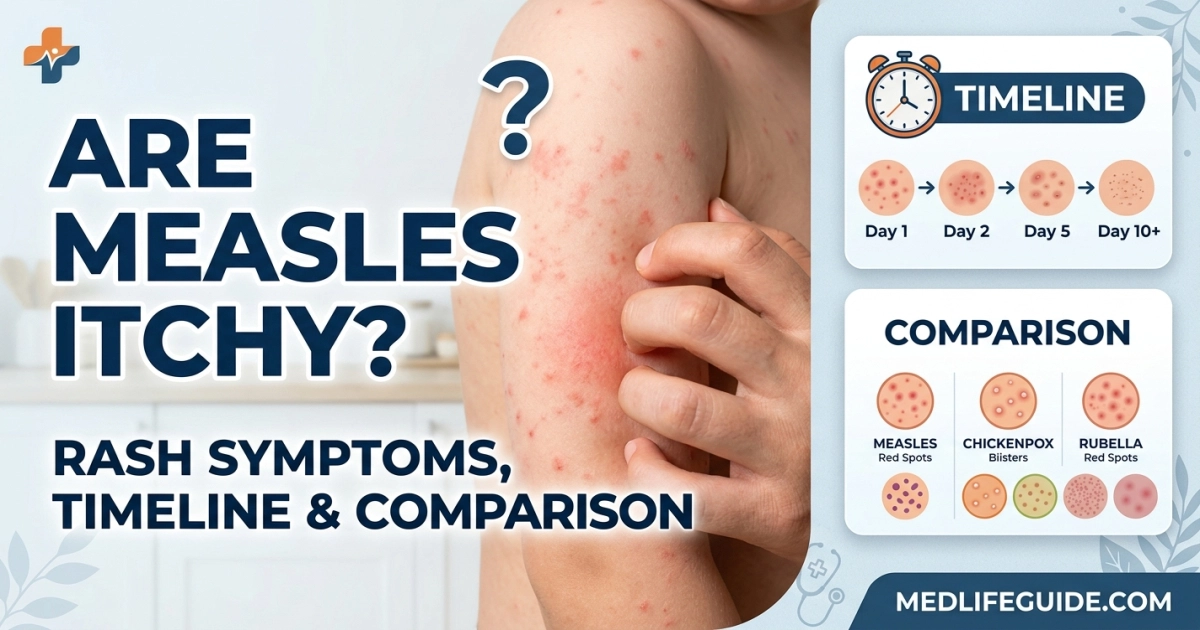
- Moderate, Late-Stage Itching: The measles rash is generally not intensely itchy when it first breaks out on the face, but it frequently becomes mildly to moderately itchy as the spots spread across the body and begin to fade.
- Downward Maculopapular Spread: Unlike localized rashes, measles follows a classic cephalocaudal pattern, starting at the hairline and ears before descending to the trunk, arms, and feet while fusing into blotchy red or hyperpigmented patches.
- High Contagiousness & Prodrome: Measles begins 7 to 14 days after exposure with high fever, cough, runny nose, and conjunctivitis (pink eye), spreading airborne up to 4 days before the rash appears.
EMERGENCY WARNING: Seek immediate emergency care (call 911 in the U.S. or go to the nearest emergency room) if a person with suspected or confirmed measles develops severe shortness of breath, rapid or labored breathing, persistent chest pain or pressure, extreme lethargy, confusion, inability to wake or stay awake, seizures, a stiff neck, or bluish/pale lips and nail beds.
1. Medical Overview and Pathophysiology: Why and How Measles Affects the Skin
Measles (also known as rubeola) is an extraordinarily contagious viral illness caused by the measles virus, a single-stranded RNA virus belonging to the Paramyxovirus family. The virus enters the body through the respiratory tract or the conjunctiva of the eyes via airborne respiratory droplets, which can remain infectious in stagnant air for up to two hours after an infected person leaves a room. Once inhaled, the virus infects local epithelial cells and regional lymphatic tissue, where it replicates rapidly before entering the bloodstream. This systemic circulation—known as viremia—disseminates the virus throughout the body, targeting lymphoid tissues, respiratory lining, and the skin’s microvascular endothelial cells.
The characteristic rash that defines measles is not caused directly by viral destruction of skin tissue. Instead, it is an immune-mediated inflammatory reaction. As the body’s adaptive immune response mobilizes, cytotoxic T-lymphocytes (specialized white blood cells) attack virus-infected endothelial cells lining the small blood vessels in the dermis layer of the skin. This cellular conflict triggers a localized release of inflammatory cytokines, causing vasodilation (widening of blood vessels) and mild fluid leakage (edema) in surrounding tissue.
This microvascular inflammatory cascade creates the classical maculopapular rash—a mixture of flat red spots (macules) and small, slightly raised bumps (papules). Because this skin reaction represents a cellular immune response, the intense histamine release seen in allergic reactions or hives is largely absent during the initial eruption. Consequently, while some patients—particularly older children and adults—report a mild, irritating, or prickly sensation as the rash spreads and the skin dries, measles is generally not as severely itchy as viral conditions like chickenpox or allergic urticaria.
2. Symptom Breakdown and Diagnostic Comparison
Understanding whether a rash is itchy, how it spreads, and what accompanying signs exist is critical for distinguishing measles from other common childhood and adult exanthems. Before the skin rash appears, measles presents with a distinct “prodrome” marked by the classic 3 Cs:
- Cough: A persistent, dry, and hacking cough.
- Coryza: Severe nasal congestion with a clear, heavy runny nose.
- Conjunctivitis: Red, watery, swollen eyes that are frequently sensitive to bright light (photophobia).
Two to three days after these initial symptoms, patients often develop Koplik spots—tiny, bluish-white sand-like specks on a bright red background inside the mouth on the inner cheek lining. These pathognomonic spots are unique to measles and appear shortly before the skin rash erupts.
For more detailed information on measles symptoms in children or measles symptoms in adults, please refer to our comprehensive guides.
Diagnostic Comparison Table
| Feature / Disease | Measles (Rubeola) | Chickenpox (Varicella) | Scarlet Fever | Allergic Hives (Urticaria) |
|---|---|---|---|---|
| Itchiness Level | Mild to Moderate (Usually late in rash stage) | Severe / Intense (Continuous, unbearable itching) | Mild to Absent (Feels rough, like sandpaper) | Severe / Extreme (Intense burning or itching) |
| Rash Type | Flat macules & raised papules; fuses into blotches | Teardrop fluid-filled vesicles on red bases that crust | Fine, red, rough papules blanching under pressure | Raised, migratory welts or wheals with pale centers |
| Spread Pattern | Cephalocaudal: Starts behind ears/hairline, moves down | Starts on chest/back/face, spreads outward randomly | Starts on neck/groin, concentrates in skin folds | Random appearance anywhere on the body; shifts rapidly |
| Prodrome Signs | High fever (>104°F), Cough, Coryza, Conjunctivitis, Koplik spots | Low fever, mild fatigue, mild headache | High fever, severe sore throat, “strawberry tongue” | No infectious prodrome; possible exposure to allergen |
| Skin Desquamation | Fine, bran-like peeling or brownish staining as it fades | Crusts and scabs fall off, leaving pink skin | Significant skin peeling (hands/feet) during recovery | None; skin returns to normal once swelling resolves |
3. Unique Clinical Takeaways
Clinicians and public health specialists emphasize key subtle insights regarding measles presentation and management that go beyond basic symptom checklists:
The “Vaccine-Modified” or Atypical Presentation in Partially Immune Persons: Individuals who have received only a single dose of the MMR vaccine or whose maternal antibodies have partially waned may contract “modified measles.” In these cases, the classic progression is blunted: the fever may remain low-grade, the 3 Cs may be mild or absent, Koplik spots may not form, and the rash may be sparsely distributed and unusually itchy due to altered immune complex deposition. Recognizing modified measles requires maintaining a high index of clinical suspicion despite a less severe appearance. Learn more about can you get measles if you are vaccinated.
Delayed Antigen/Antibody Window and False Negatives: Ordering serological antibody tests (Measles IgM) too early during the prodrome or within the first 72 hours of rash onset can lead to false-negative laboratory results. IgM antibodies often take up to 3 days post-rash eruption to reach detectable thresholds in serum. Consequently, concurrent RT-PCR swab testing (throat/nasopharyngeal) and urine collection should always be performed alongside serology during early evaluation to avoid missing a diagnosis.
Transient “Immune Amnesia” Post-Recovery: Recovering from measles carries a long-term immunological consequence known as viral-induced immune amnesia. The measles virus preferentially infects CD150+ memory B and T cells, destroying a significant percentage of the patient’s existing antibody repertoire built up against other previously encountered pathogens (such as influenza, strep, or pneumococcus). For months to years after recovering from measles, patients remain at a heightened risk for secondary bacterial pneumonia, otitis media, and gastrointestinal infections.
4. Day-by-Day Illness Progression Timeline
The clinical course of measles unfolds over a predictable 2- to 3-week sequence:
[Day 0: Exposure] ➔ [Days 7-14: Incubation (Silent)] ➔ [Days 10-12: Prodrome (Fever, 3 Cs)] ➔ [Days 12-13: Koplik Spots] ➔ [Days 14-18: Peak Rash & Fever] ➔ [Days 19-21+: Fading & Peeling]
Stage 1: Incubation Period (Days 0 to 10–14)
- Status: Completely asymptomatic.
- Clinical View: The virus replicates in local lymph nodes and enters the blood. The patient does not feel ill and cannot infect others during early incubation.
Stage 2: The Prodromal Phase (Days 10 to 14 / Illness Days 1 to 4)
- Status: Highly contagious.
- Symptoms: Fever begins (often rising to 102°F–104°F) alongside persistent dry coughing, heavy runny nose, and bloodshot, watery eyes.
- Key Marker: Around Day 12 to 13 (24 to 48 hours before the skin rash), Koplik spots appear inside the mouth.
Stage 3: Acute Eruption and Peak Rash Phase (Days 14 to 18 / Illness Days 5 to 8)
- Status: Peak clinical severity; highly contagious.
- Rash Movement: The rash breaks out behind the ears, along the hairline, and on the upper neck. Over the next 24 to 48 hours, it flows downward over the chest, abdomen, back, arms, hands, thighs, legs, and feet.
- Skin Texture & Sensation: Spots begin as individual flat red dots, then swell into raised bumps that merge into large, splotchy red or deep purple/brown patches. As the rash reaches its fullest extent on the feet, the patient’s fever spikes dramatically—sometimes exceeding 104°F or 105°F. Itching, if present, is usually mild to moderate at this stage as the skin becomes inflamed and warm.
Stage 4: Resolution, Fading, and Convalescence (Days 19+ / Illness Days 9+)
- Status: Contagiousness rapidly wanes by 4 days post-rash onset.
- Skin Changes: The rash fades in the exact order it appeared—leaving the face first and feet last. As it clears, it leaves behind a temporary brownish or copper-colored staining and fine, flour-like skin peeling (desquamation). Mild skin dryness and itching are common during this healing phase.
For more information on how long measles lasts and how long measles is contagious, see our detailed guides.
5. High-Risk Vulnerabilities and Special Populations
While measles can cause severe illness in anyone, specific groups face significantly elevated risks for life-threatening complications, hospitalization, and death:
Pediatric Patients (Under 5 Years Old)
Infants and toddlers under 5 years of age have immature respiratory and immune systems. Acute otitis media (bacterial ear infection) occurs in nearly 1 in 10 infected children. More critically, primary viral or secondary bacterial pneumonia affects up to 1 in 20 children with measles and represents the single leading cause of measles-related death in young infants. In rare cases (1 in 1,000), acute encephalitis (brain swelling) develops, which can lead to permanent intellectual disability, deafness, or fatal respiratory arrest. Learn about measles brain swelling risks.
Pregnant Women
Measles infection during pregnancy poses severe threats to maternal and fetal health. The live virus does not typically cause congenital malformations, but the systemic high fever and severe inflammatory load significantly increase the risk of spontaneous miscarriage, premature labor, low birth weight, and severe maternal respiratory distress requiring intensive care.
Immunocompromised Individuals
Patients with weakened immune systems—including those undergoing cancer chemotherapy, organ transplant recipients taking immunosuppressants, or individuals with advanced HIV/AIDS—are extraordinarily vulnerable. In these individuals, measles may present without the characteristic rash (since the skin reaction depends on active cellular immunity). However, they are at extreme risk for giant cell pneumonia and progressive subacute measles encephalitis, both of which carry high mortality rates.
Older Adults (Over 20–65 Years)
Adults who contract measles generally experience higher rates of severe systemic illness, prolonged high fevers, hepatitis, and respiratory failure requiring hospital admission compared to school-aged children.
6. Evidence-Based Diagnostic, Testing, and Medical Management Guidelines
Diagnostic & Testing Protocols
When a patient presents with a suspicious febrile rash illness, healthcare providers follow strict infection-control guidelines:
- Isolation Upon Arrival: Patients suspected of having measles must be placed immediately in an airborne infection isolation room (AIIR) or instructed to remain in their personal vehicle until evaluated, preventing exposure in waiting rooms.
- Laboratory Confirmation:
- RT-PCR Swab: A throat or nasopharyngeal swab collected using a synthetic swab placed in viral transport media is the preferred method for rapid viral detection.
- Serology (Serum IgM/IgG): Blood drawn to measure measles-specific IgM antibodies confirms acute infection, while a fourfold rise in IgG antibody titers between acute and convalescent serum samples establishes definitive proof.
- Urine Sample: Collecting a sterile urine sample for viral culture or PCR can detect viral shedding even if throat swabs are collected late in the course.
Medical Management & Therapeutics
There is no specific prescription antiviral medication approved to cure the measles virus. Treatment focuses on supportive care and preventing complications:
- High-Dose Vitamin A Therapy: The World Health Organization (WHO) and American Academy of Pediatrics (AAP) recommend administering high-dose oral Vitamin A (200,000 IU for children aged 12 months and older, lower doses for infants) on two consecutive days. Vitamin A restores immune mucosal barriers, speeds up eye and respiratory recovery, and reduces overall measles mortality by up to 50% in hospitalized patients.
- Fever Management: Over-the-counter antipyretics like acetaminophen or ibuprofen are prescribed to control high temperatures and relieve bodily discomfort. Aspirin must never be given to children or teenagers with viral infections due to the risk of Reye’s syndrome—a rare but fatal liver and brain condition.
- Secondary Antibiotics: Antibiotics are ineffective against the measles virus itself but are immediately indicated if secondary bacterial infections arise, such as bacterial pneumonia, tracheobronchitis, or otitis media.
For comprehensive guidance on best treatment for measles, visit our treatment guide.
7. Home Care, Isolation/Protection Protocols, and Recovery
Managing Rash and Skin Comfort at Home
While the measles rash is generally less itchy than chickenpox, skin dryness, mild itching, and warm discomfort during the fading stage can be managed effectively:
- Lukewarm Oatmeal Baths: Soaking in a lukewarm bath mixed with colloidal oatmeal helps soothe warm, inflamed skin without stripping natural moisture.
- Topical Emollients: Applying fragrance-free, hypoallergenic moisturizing creams or calamine lotion to drying skin can prevent cracking and reduce irritation.
- Avoid Harsh Soaps: Wash the skin gently using mild, fragrance-free cleansers and soft cotton towels; avoid scrubbing blotchy areas.
Strict Isolation and Quarantine Rules
Measles is infectious from 4 days before the rash appears until 4 full days after the rash erupts.
- Home Quarantine: The infected individual must remain isolated at home during this entire 8-day communicable window.
- Protecting Unvaccinated Household Members: Unvaccinated household contacts should be excluded from school, work, and public settings for 21 days following their last exposure.
- Post-Exposure Prophylaxis (PEP): Unvaccinated individuals exposed to measles can receive the live MMR vaccine within 72 hours of exposure, or Immune Globulin (IG) within 6 days of exposure, to prevent or lessen disease severity.
For the latest information on measles outbreaks in 2026 and Texas measles outbreak, stay informed through our outbreak coverage.
Supporting Overall Recovery
- Eye Protection: Because photophobia (light sensitivity) is common, keep room lighting dim, draw curtains, and avoid bright electronic screens.
- Aggressive Hydration: Maintain a high intake of fluids—such as water, electrolyte solutions, oral rehydration salts, and warm broths—to counteract fluid loss from high fever.
- Humidification: Using a cool-mist humidifier in the bedroom helps ease harsh coughing and soothes inflamed nasal passages.
Frequently Asked Questions (FAQs)
No, measles is generally much less itchy than chickenpox or hives; it typically presents as a mild, prickly or dry sensation, especially as the skin begins to heal and peel.
The measles rash classically begins at the hairline, behind the ears, and on the upper neck before spreading downward to the trunk, arms, and feet.
The rash typically lasts about 5 to 6 days, gradually fading in the order it appeared while leaving behind temporary brownish spots or mild skin flaking.
Yes, an infected person can spread the measles virus to others up to 4 days before the rash erupts and for 4 days after it appears. Learn more about how measles is spread.
The two-dose Measles, Mumps, and Rubella (MMR) vaccine is the safest and most effective protection, providing approximately 97% lifelong immunity against the virus.
About the Reviewer
Dr. Adam N. Khan, MD is a board-certified internal medicine physician dedicated to providing transparent, evidence-based patient education and public health guidance. He reports zero commercial conflicts of interest, financial disclosures, or affiliations with pharmaceutical manufacturers or medical device companies.