
Medically Reviewed and Compiled by Dr. Adam N. Khan, MD.
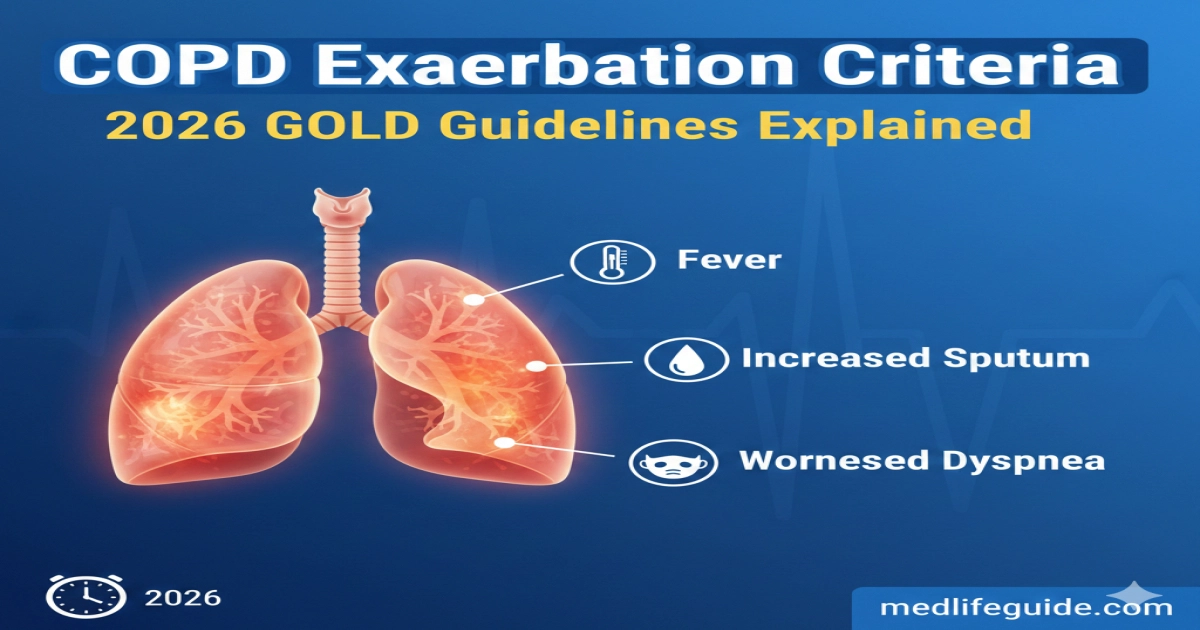
Quick Answer: A COPD exacerbation is an acute worsening of respiratory symptoms—such as shortness of breath, cough, and mucus production—that lasts for up to 14 days and often requires a change in medication. According to the 2026 GOLD Report and the Rome Proposal, doctors now use objective criteria like respiratory rate (over 24 breaths per minute), heart rate (over 95 beats per minute), and oxygen levels (below 92%) to classify these events as mild, moderate, or severe.
Understanding COPD Exacerbation Criteria: A 2026 Guide
If you live with Chronic Obstructive Pulmonary Disease (COPD), you are likely familiar with “flare-ups.” In medical terms, these are called exacerbations. Knowing exactly what defines an exacerbation is vital because even a single moderate event can permanently damage your lungs and increase your risk of heart problems.
The 2026 guidelines from the Global Initiative for Chronic Obstructive Lung Disease (GOLD) have shifted toward using more objective, measurable data to help patients and doctors act faster.

1. What is a COPD Exacerbation?
At its simplest, an exacerbation is a sudden “attack” where your breathing gets much worse than your usual day-to-day struggle.
Key Symptoms Include:
- Increased Shortness of Breath: You might feel breathless while doing activities that were easy yesterday, or even while resting.
- Coughing Changes: Your cough becomes more frequent or intense.
- Mucus (Sputum) Changes: You may notice more mucus, or it may change color (turning yellow, green, or brown) and become thicker.
- Physical Signs: You might breathe faster, have a racing heart, or feel extremely tired.
According to the latest 2026 GOLD updates, an event is considered an exacerbation if these symptoms worsen over a period of 14 days or less.
2. The New Severity Criteria (The Rome Proposal)
In the past, doctors judged severity based only on what medicine you needed. Today, the Rome Proposal provides a checklist of physical markers to pinpoint how serious the flare-up is.
| Feature | Mild | Moderate | Severe |
|---|---|---|---|
| Breathlessness (VAS Scale) | Less than 5/10 | 5/10 or higher | 5/10 or higher |
| Respiratory Rate | Under 24 breaths/min | 24 breaths/min or more | 24 breaths/min or more |
| Heart Rate | Under 95 beats/min | 95 beats/min or more | 95 beats/min or more |
| Oxygen Saturation | 92% or higher | Less than 92% | Less than 92% |
| Blood Gases | Normal | Normal or slight change | Acidosis (pH < 7.35) |
Note: For a “Moderate” rating, you typically need to meet at least three of these markers.
3. Why the “Rule of One” Matters in 2026
One of the biggest changes in the 2026 GOLD Report is the “Rule of One.” Previously, you needed two flare-ups in a year to be put in a higher-risk category. Now, just one moderate or severe exacerbation is enough for your doctor to consider “Group E” status and escalate your treatment.
This change exists because research shows that even one flare-up significantly raises your risk of a heart attack or stroke within the next 30 days.
4. When to Seek Help Immediately
If you experience any of these “Red Flags,” skip the phone call and go to the nearest emergency room or call emergency services:
- Confusion or Drowsiness: This often means your brain isn’t getting enough oxygen or is holding too much carbon dioxide.
- Blue Lips or Fingernails: A sign of dangerously low oxygen (cyanosis).
- Chest Pain: This could indicate a heart issue triggered by the strain on your lungs.
- Inability to Speak: If you can only speak in one- or two-word bursts between breaths.
5. Managing and Preventing Flare-ups
To keep your “disease activity” low, the 2026 guidelines emphasize:
- Triple Therapy: Many patients now benefit from a single inhaler containing three different medicines (LABA+LAMA+ICS).
- Biologics: For patients with high “eosinophil” counts (a type of white blood cell), new injectable drugs like Dupilumab are now an option.
- Vaccinations: Stay current on your Flu, COVID-19, and RSV shots. In 2026, the RSV vaccine is specifically recommended for those aged 50 and older with chronic lung disease.
Summary Points
- Exacerbation: A sudden worsening of symptoms lasting up to 14 days.
- Severity: Measured by heart rate, breathing rate, and oxygen levels.
- Risk: One moderate flare-up per year is enough to change your treatment plan.
- Prevention: Involves correct inhaler use, vaccines, and potentially biologics.