
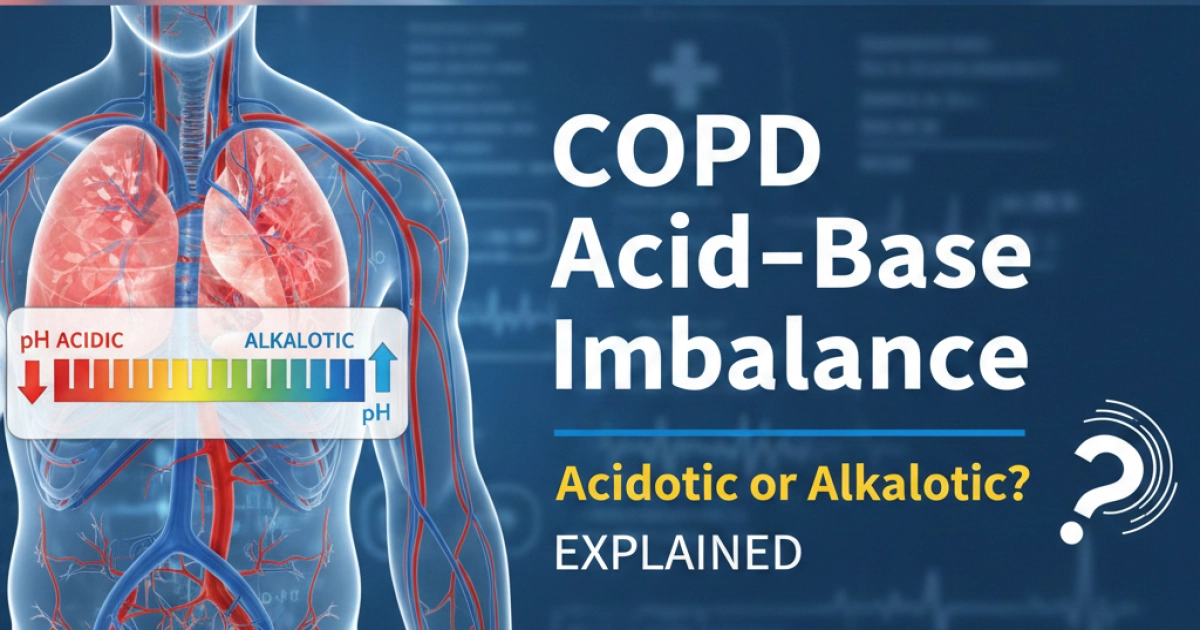
Chronic obstructive pulmonary disease (COPD) is a progressive respiratory disorder affecting ventilation, gas exchange, and acid‑base balance. A central clinical question is whether COPD patients tend toward acidosis (low blood pH) or alkalosis (high blood pH).
This article analyzes the pathophysiological mechanisms, typical arterial blood gas (ABG) profiles, compensatory adaptations, and clinical trajectories impacting acid‑base status in COPD. All content is anchored in authoritative, peer‑reviewed clinical and physiological sources.
Basic Principles of Acid‑Base Balance
Normal Acid‑Base Physiology
Arterial blood pH is maintained within a narrow range (7.35–7.45) by interactions between respiratory and metabolic systems. The lungs regulate carbon dioxide (CO₂), a primary acid load variable, while the kidneys manage bicarbonate (HCO₃⁻), a metabolic buffer. Abnormalities in ventilation directly alter CO₂ levels and, consequently, blood pH:
- Respiratory acidosis: Elevated PaCO₂ with low pH.
- Respiratory alkalosis: Low PaCO₂ with high pH.
- Metabolic acidosis/alkalosis: Changes in bicarbonate independent of respiratory cause.
COPD and Ventilation
COPD causes chronic airflow limitation and reduced alveolar ventilation. This impairment leads to CO₂ retention (hypercapnia)—a primary driver of respiratory acidosis if respiratory elimination fails to match CO₂ production.
Acid‑Base Status in COPD
Primary Acid‑Base Pattern in COPD
COPD patients typically demonstrate a primary respiratory acidosis due to chronic hypoventilation and CO₂ retention. Elevated PaCO₂ increases carbonic acid in the blood, lowering pH (<7.35).
In chronic respiratory acidosis, the kidneys gradually increase bicarbonate retention to buffer the acidosis. This metabolic compensation elevates HCO₃⁻ levels, often bringing pH closer to normal or within reference range, despite persistent hypercapnia.
Summary Pattern:
- Primary: Respiratory acidosis (high PaCO₂)
- Compensation: Metabolic (elevated HCO₃⁻)
- Net pH: Variable—often near normal in stable COPD with chronic compensation
Acute vs. Chronic Status
- Chronic COPD (stable):
Chronic hypercapnia with compensatory metabolic alkalosis (elevated bicarbonate) can produce near‑normal arterial pH—termed compensated respiratory acidosis. - Acute exacerbation:
Worsening airway obstruction or superimposed infection can cause acute on chronic respiratory acidosis, overwhelming compensatory mechanisms, resulting in an acidemic pH (<7.35).
Mixed Acid‑Base Disorders in COPD
COPD patients may also develop mixed acid‑base disorders due to concurrent metabolic conditions or treatments. For example:
- Respiratory acidosis with metabolic alkalosis: Common if diuretics are used or vomiting occurs.
- Respiratory acidosis with metabolic acidosis: Seen in severe hypoxia, renal failure, sepsis, or lactic acidosis.
Accurate diagnosis requires ABG interpretation, considering pH, PaCO₂, and HCO₃⁻ relative to expected compensation.
Clinical Implications of Acid‑Base Status
Prognostic Significance
The degree of acidemia in COPD exacerbations correlates with outcomes. Severe acidemia (pH ≤7.20) is associated with higher rates of noninvasive ventilation (NIV) failure and increased mortality versus milder acidemia.
Treatment Considerations
- Oxygen therapy must be titrated carefully; over‑oxygenation can worsen hypercapnia.
- Noninvasive ventilation supports CO₂ elimination.
- Manage comorbid metabolic disorders to avoid complicating acid‑base balance.
Tailoring therapy based on ABG patterns improves ventilatory management and reduces complications.
Unique Clinical Takeaways
1. Near‑Normal pH Does Not Exclude Significant Pathophysiology
Stable COPD patients often display compensated respiratory acidosis with near‑normal pH despite markedly elevated PaCO₂ and HCO₃⁻. This can mask the severity of ventilatory impairment and mislead clinicians if only pH is considered.
Actionable insight: Prioritize PaCO₂ and bicarbonate levels over isolated pH when assessing COPD patients for ventilatory failure.
2. Comorbid Conditions Commonly Generate Mixed Disorders
COPD often coexists with cardiac disease, renal dysfunction, or diuretic use. These factors produce complex mixtures of metabolic acidosis or alkalosis superimposed on chronic respiratory acidosis.
Actionable insight: Systematic ABG interpretation should include evaluation for mixed disturbances, not assume pure respiratory acidosis in all COPD patients.
3. Acute Exacerbations Can Unmask Hidden Acid‑Base Imbalances
Rapid deterioration (e.g., pneumonia or heart failure) can precipitate acute on chronic respiratory acidosis. These episodes may overwhelm renal compensation, resulting in true acidemia with clinical sequelae such as decreased consciousness or respiratory fatigue.
Actionable insight: ABG sampling in acute exacerbations should be immediate and repeated to detect dynamic shifts requiring urgent ventilatory support.