
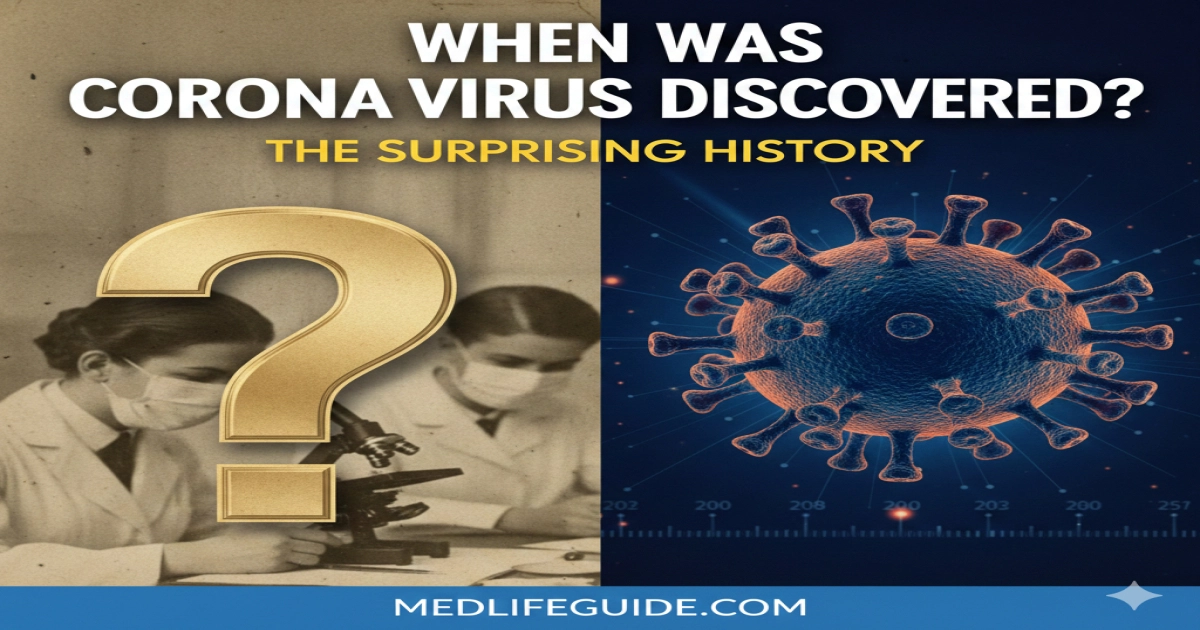
Quick Answer: The first coronavirus was discovered in animals in the 1930s (specifically in chickens). However, the first human coronavirus was not identified until 1965. Scientist June Almeida used an electron microscope to see the virus’s crown-like spikes, which led to the name “coronavirus” in 1968.
Medically Reviewed and Compiled by Dr. Adam N. Khan, MD.
Many people think the coronavirus is a brand-new threat that started in 2019. While the virus that caused the recent pandemic was new, the “coronavirus” family has actually been known to scientists for nearly a century.
To truly understand when coronavirus was discovered, we have to look at three different chapters in history: the first animal discovery, the first human discovery, and the discovery of the COVID-19 virus.
1. The Very First Discovery: Chickens in the 1930s
The story begins long before modern hospitals or digital tracking. In the late 1920s and early 1930s, farmers in North America noticed their baby chickens were getting very sick with gasping and breathing problems.
In 1931, researchers Arthur Schalk and M.C. Hawn first described this “gasping disease.” By 1937, scientists had successfully grown the virus in a lab. At the time, they didn’t call it a coronavirus. They called it Infectious Bronchitis Virus (IBV). It would take several more decades for scientists to realize that this chicken virus was part of a much larger family that also affected humans.
2. The First Human Discovery: The 1960s Breakthrough
For a long time, doctors believed the common cold was mostly caused by “rhinoviruses.” However, they couldn’t explain every cold case. In the mid-1960s, two different teams—one in the United Kingdom and one in the United States—found something new.
- 1965 (UK): Dr. David Tyrrell and his team at the Common Cold Research Unit studied a sample from a schoolboy with a cold. The sample was labeled B814. They couldn’t grow it like a normal cold virus, which made them realize it was unique.
- 1966 (USA): Dorothy Hamre and John Procknow at the University of Chicago found another new virus while studying medical students. They named this strain 229E.
The Woman Who Saw the “Crown”
While these doctors knew they had found new viruses, they didn’t know what they looked like. They sent their samples to June Almeida, a brilliant scientist in London who was a master at using electron microscopes.
In 1967, Almeida looked at the samples and saw something incredible. The virus particles were surrounded by tiny, halo-like spikes. She remembered seeing similar shapes in the chicken virus from the 1930s. Because the spikes looked like the “corona” (the atmosphere) of the sun or a royal crown, she and her colleagues named the family Coronavirus. The name became official in 1968.
3. The Modern Era: SARS, MERS, and COVID-19
For decades after Almeida’s discovery, coronaviruses were mostly known for causing mild sniffles. That changed in the 21st century when more dangerous versions “jumped” from animals to humans.
- SARS-CoV (2003): Discovered in China, this was the first time a coronavirus caused severe respiratory failure on a global scale.
- MERS-CoV (2012): This version was discovered in Saudi Arabia and was linked to contact with camels.
- SARS-CoV-2 (2019): This is the virus that causes COVID-19. It was first identified in December 2019 in Wuhan, China, after doctors noticed a group of people with “mysterious pneumonia.”
Why the Discovery Date Matters
Knowing that coronaviruses were discovered back in the 1960s (and the 1930s for animals) is important. It means that when COVID-19 appeared, scientists weren’t starting from zero. They already had 60 years of research on the “crown” shape, the spike proteins, and how these viruses behave. This long history is exactly why they were able to create vaccines and treatments much faster than in the past.
Key Summary Points:
- 1931: First animal coronavirus found in chickens.
- 1965: First human coronavirus (B814) identified.
- 1967: June Almeida captures the first images of the “crown” shape.
- 1968: The name “Coronavirus” is officially born.
- 2019: The specific virus causing COVID-19 is discovered.