
Medically Reviewed and Compiled by Dr. [Adam N. Khan], MD.
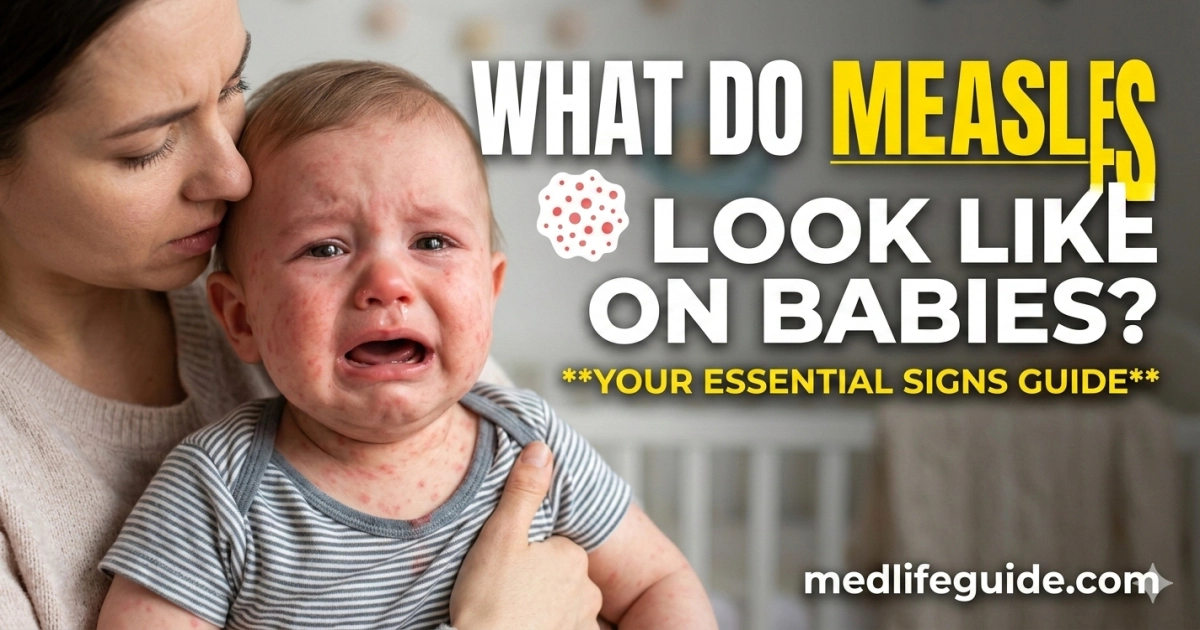
Measles in babies usually appears as a red, blotchy rash that starts on the face and spreads downward to the neck, chest, arms, and legs. The rash often follows fever, cough, red eyes, and small white spots inside the mouth called Koplik spots. The rash may look flat at first but can becom
Medically Reviewed and Compiled by Dr. [Adam N. Khan], MD.
Measles in babies usually appears as a red, blotchy rash that starts on the face and spreads downward to the neck, chest, arms, and legs. The rash often follows fever, cough, red eyes, and small white spots inside the mouth called Koplik spots. The rash may look flat at first but can become slightly raised and merge into larger red areas.
Understanding the exact appearance helps parents recognize the illness early and seek medical care quickly.
What Is Measles and Why Babies Are at High Risk
Measles is a highly contagious viral infection caused by the measles virus. It spreads through air when an infected person coughs, sneezes, or breathes.
According to the Centers for Disease Control and Prevention, measles infects up to 90% of unprotected people exposed to the virus.
Babies face higher risk because:
- Their immune system is still developing
- Most babies do not receive measles vaccine until 12 months of age
- They can develop more severe complications than older children
Early Warning Signs Before the Rash Appears
Measles does not begin with a rash immediately. Early symptoms appear first.
Stage 1: First Symptoms (Days 1–4)
These symptoms usually appear 7–14 days after exposure:
- High fever (often 101°F to 104°F)
- Persistent dry cough
- Runny nose
- Red, watery eyes
- Sensitivity to light
- Irritability
- Poor feeding
These symptoms often look like a severe cold.
According to Mayo Clinic, fever is often the first clear warning sign.
Koplik Spots: The First Visible Sign Inside the Mouth
Koplik spots appear before the skin rash and are a key diagnostic sign.
What Koplik Spots Look Like
- Tiny white spots
- Blue-white centers
- Red base around spots
- Found inside cheeks
- Appear like grains of salt
These spots usually appear 1–2 days before the rash.
They are considered a defining clinical feature of measles.
What the Measles Rash Looks Like on Babies
The measles rash has a predictable pattern and appearance.
Appearance of the Rash
The rash usually looks like:
- Red or reddish-brown spots
- Flat at first (macules)
- Some spots slightly raised (papules)
- Spots may merge together
- Skin may look blotchy
- Rash may blanch (turn white briefly when pressed)
The rash is not usually itchy at first.
Where the Rash Starts and How It Spreads
The rash follows a specific downward progression.
Day-by-Day Rash Spread Pattern
Day 1: Face and Head
- Starts at hairline
- Appears behind ears
- Spreads across face
- Moves to neck
Day 2: Upper Body
- Spreads to chest
- Covers upper back
- Moves to shoulders
- Extends to upper arms
Day 3: Lower Body
- Moves to abdomen
- Spreads to thighs
- Covers legs
- Reaches feet
According to the World Health Organization, this downward spread pattern is a defining feature of measles.
Color Changes of the Rash Over Time
The rash changes as the infection progresses.
Early Rash
- Bright red
- Clearly defined spots
Middle Stage
- Spots merge together
- Skin appears blotchy
- Rash darkens
Late Stage
- Turns brownish
- Gradually fades
- Skin may peel lightly
The rash usually lasts 5–7 days.
Additional Visible Symptoms in Babies
Measles affects more than just skin.
Eye Changes
Babies often develop:
- Red eyes
- Swollen eyelids
- Watery discharge
- Light sensitivity
This condition is called conjunctivitis.
Facial Appearance
Common facial signs include:
- Puffy face
- Tired expression
- Red eyelids
- Irritated appearance
Babies may appear visibly sick.
General Body Appearance
Babies often show:
- Low energy
- Weakness
- Reduced movement
- Poor feeding
- Dehydration signs
According to the American Academy of Pediatrics, reduced feeding in babies is a major warning sign.
Timeline of Measles Symptoms in Babies
| Stage | Time | What It Looks Like |
|---|---|---|
| Incubation | 7–14 days | No visible symptoms |
| Early symptoms | Days 1–4 | Fever, cough, red eyes |
| Koplik spots | Days 2–5 | White spots in mouth |
| Rash appears | Days 3–5 | Rash starts on face |
| Rash spreads | Days 4–6 | Moves downward |
| Recovery | Days 7–14 | Rash fades |
Unique Clinical Takeaways
This section highlights deeper clinical insights important for parents and clinicians.
1. Rash Starting at Hairline Is a Critical Diagnostic Clue
Many childhood rashes begin on the chest or body. Measles typically begins at the hairline and behind the ears.
This pattern helps distinguish measles from:
- Allergic rash (usually random distribution)
- Roseola (starts on chest)
- Heat rash (localized areas)
Hairline-origin rash strongly suggests measles infection.
2. Eye Inflammation Severity Reflects Infection Intensity
Babies with severe measles often show:
- Bright red eyes
- Continuous tearing
- Difficulty opening eyes
Eye inflammation occurs because measles virus infects respiratory and eye tissues.
According to the National Institutes of Health, conjunctivitis is one of the three classic signs of measles.
The three classic signs are:
- Cough
- Conjunctivitis
- Runny nose
This combination strongly indicates measles.
3. Rash Appears After Fever Peaks
Parents often expect rash first, but measles rash appears after high fever.
Typical sequence:
- Fever rises first
- Fever peaks
- Rash appears
- Fever gradually decreases
This sequence helps differentiate measles from other viral rashes.
4. Babies Under 12 Months Have Greater Complication Risk
Babies under 1 year face higher risk of severe illness because:
- Immune system is immature
- No full vaccine protection yet
- Virus spreads faster in body
Complications may include:
- Pneumonia
- Brain inflammation
- Ear infections
This makes early recognition critical.
5. Rash Progression Speed Is a Diagnostic Marker
Measles rash spreads quickly within 24–72 hours.
Slow-spreading rash suggests other conditions.
Rapid downward progression strongly supports measles diagnosis.
How Measles Rash Differs From Other Baby Rashes
Measles vs Roseola
| Feature | Measles | Roseola |
|---|---|---|
| Rash starts | Face | Chest |
| Fever timing | Before rash | Fever ends before rash |
| Eye redness | Common | Rare |
Measles vs Allergic Rash
| Feature | Measles | Allergy |
|---|---|---|
| Fever | High | Rare |
| Spread pattern | Downward | Random |
| Eye redness | Common | Rare |
Measles vs Heat Rash
| Feature | Measles | Heat rash |
|---|---|---|
| Location | Whole body | Warm areas |
| Fever | Yes | No |
| Spread | Predictable | Localized |
Dangerous Warning Signs That Require Immediate Medical Care
Parents should seek emergency care if baby shows:
- Trouble breathing
- Very high fever above 104°F
- Seizures
- Extreme sleepiness
- Refusing fluids
- Blue lips
- Severe dehydration
These symptoms may indicate serious complications.
Serious Complications of Measles in Babies
Measles can affect multiple organs.
Pneumonia
Most common cause of death in measles.
Symptoms include:
- Fast breathing
- Chest retractions
- Severe cough
Brain Inflammation (Encephalitis)
Symptoms include:
- Seizures
- Confusion
- Weakness
Occurs in about 1 in 1,000 measles cases.
Ear Infections
Can cause:
- Pain
- Hearing problems
- Irritability
How Doctors Diagnose Measles in Babies
Doctors use:
Physical Examination
Doctors check:
- Rash pattern
- Koplik spots
- Eye redness
Laboratory Tests
Tests may include:
- Blood test
- Nasal swab
- Throat swab
These confirm virus presence.
Treatment for Measles in Babies
There is no direct antiviral cure. Treatment focuses on supportive care.
Supportive Treatment Includes
- Fluids
- Fever control
- Rest
- Monitoring breathing
Vitamin A may be given in severe cases.
According to the World Health Organization, Vitamin A reduces measles complications.
Prevention Is the Most Effective Protection
The measles vaccine is the best prevention method.
Babies usually receive measles vaccine at:
- 12 months
- 15 months booster
Vaccination provides strong immunity.
When the Rash Starts to Heal
Recovery signs include:
- Rash fading
- Fever decreasing
- Energy returning
- Feeding improves
Skin may peel slightly during recovery.
Long-Term Outlook for Babies With Measles
Most babies recover fully with proper care.
Recovery usually takes:
- 2–3 weeks total
- Complications increase recovery time.
- Early medical care improves outcomes.
References and Citations
The following authoritative medical sources support the information presented:
- Centers for Disease Control and Prevention — Measles Clinical Overview and Symptoms
- World Health Organization — Measles Fact Sheets and Clinical Features
- American Academy of Pediatrics — Measles Guidance for Pediatric Care
- Mayo Clinic — Measles Symptoms and Causes
- National Institutes of Health — Measles Clinical and Immunologic Studies
Medical Disclaimer
This article is for educational purposes only and does not replace professional medical advice, diagnosis, or treatment. Always consult a licensed physician or pediatrician for medical concerns involving measles or any illness in babies.