
Medically Reviewed and Compiled by Dr. Adam N. Khan, MD.
Quick Answer
For most home and food service uses, you should calibrate your thermometer at least once a week or anytime it is dropped. In medical or industrial settings, calibration is typically required annually by a certified lab, though daily “check-ins” using an ice bath are recommended to ensure patient safety and data integrity.
Quick Answer
For most home and food service uses, you should calibrate your thermometer at least once a week or anytime it is dropped. In medical or industrial settings, calibration is typically required annually by a certified lab, though daily “check-ins” using an ice bath are recommended to ensure patient safety and data integrity.
Why Accuracy Isn’t Just a Number
Imagine you are roasting a chicken for a family dinner. Your thermometer reads 165°F, but it’s actually off by five degrees. That small error could be the difference between a delicious meal and a night of food poisoning. In a clinic, an inaccurate reading could lead a doctor to miss a fever in a child or over-treat a patient whose temperature is actually normal.
Calibration is simply the process of “tuning” your instrument. It ensures that the number you see on the screen matches reality. Over time, sensors wear out, batteries weaken, and internal components shift.
How Often is “Often Enough”?
There is no single rule for everyone because the “right” frequency depends on how you use the tool.
1. Food Service and Home Cooking
If you work in a kitchen, your thermometer is your shield against bacteria.
- Daily: If you use it constantly throughout a shift.
- Weekly: For the average home cook who uses it a few times a week.
- Immediately: If you drop it on a hard floor, expose it to extreme temperature swings (like going from a freezer to a boiling pot), or if the readings seem “weird.”
2. Medical and Healthcare Settings
Medical-grade thermometers are built to higher standards, but they still need care.
- Annual Professional Calibration: Most hospitals and clinics send their devices to a lab once a year to meet safety regulations.
- Monthly Self-Checks: It is a good habit for home users to check their digital ear or forehead thermometers against a known source once a month.
3. Industrial and Laboratory Use
In labs where a fraction of a degree matters for chemical reactions:
- Every 6 Months: Or as dictated by specific industry SOPs (Standard Operating Procedures).
Factors That Throw Off Your Reading
Think of your thermometer like a guitar string. Even if you don’t play it, it can go out of tune just by sitting in the case.
- Mechanical Shock: Dropping a thermometer is the fastest way to knock it out of alignment.
- Temperature Extremes: Storing a thermometer in a hot car or a freezing garage can damage the sensor.
- Battery Life: In digital models, a low battery often leads to erratic or “ghost” readings. Always swap the battery before assuming the device is broken.
- Age: Eventually, sensors simply lose their “stretch.” If a thermometer is over five years old and won’t stay calibrated, it’s time for a new one.
How to Test Accuracy at Home (The Ice Bath Method)
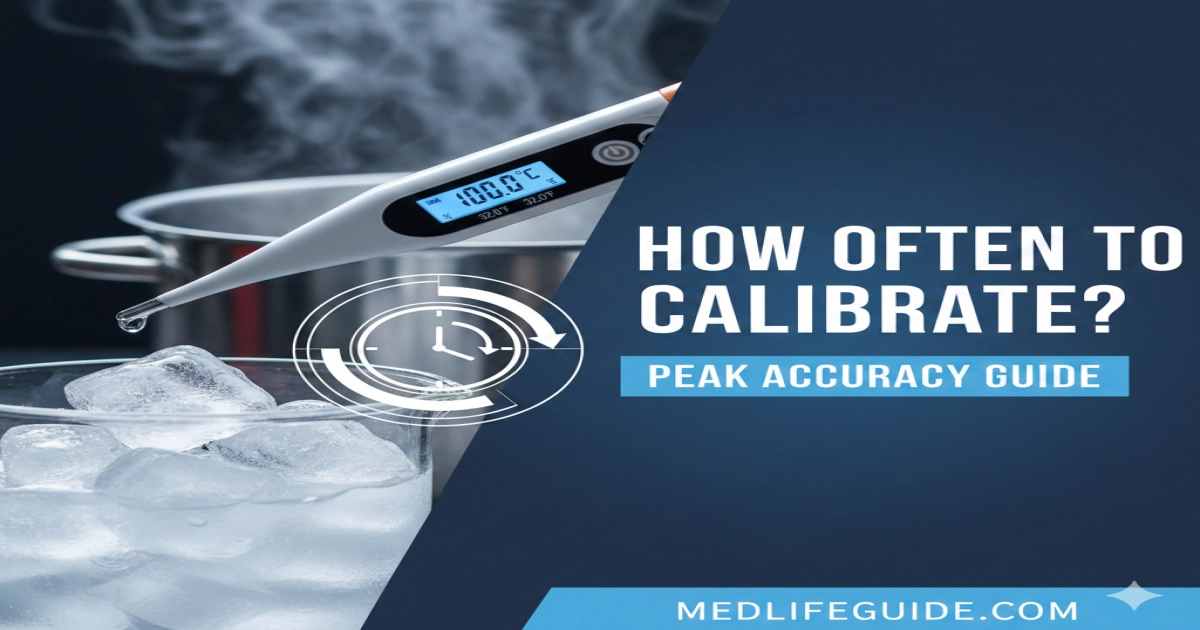
You don’t need a lab to see if your thermometer is lying to you. The most reliable way to check is the Ice Point Method. Water always freezes at 32°F (0°C) at sea level.
- Fill a glass with crushed ice. (Crushed works better than cubes because there are fewer air gaps).
- Add just enough cold water to blur the ice, but not so much that the ice floats.
- Insert the probe. Stir gently and make sure the tip doesn’t touch the bottom or sides of the glass.
- Wait 30 seconds. The reading should be exactly 32°F (0°C).
If it reads 34°F, you know your thermometer is running two degrees hot. Many digital models have a “Cal” or “Reset” button you can press while in the ice water to lock it back to 32°F.
The Risks of Ignoring Calibration
Skipping this simple task has real-world consequences. In the food industry, “The Danger Zone” is between 40°F and 140°F. This is where bacteria multiply the fastest. If your thermometer is off by just a few degrees, you might think your food is safe when it is actually sitting right in the middle of that danger zone.
In medicine, an uncalibrated thermometer can lead to “false negatives.” A patient might feel fine but actually have a low-grade fever that indicates a brewing infection.
Summary Checklist
- New Thermometer? Calibrate it before the first use.
- Dropped it? Calibrate it immediately.
- Used it for high heat? Check it before using it for cold storage.
- Daily user? Perform a weekly ice-bath check.
Keeping your thermometer calibrated is a small habit that ensures big safety. Whether you are a chef, a parent, or a scientist, the truth in the numbers is what keeps people healthy.