
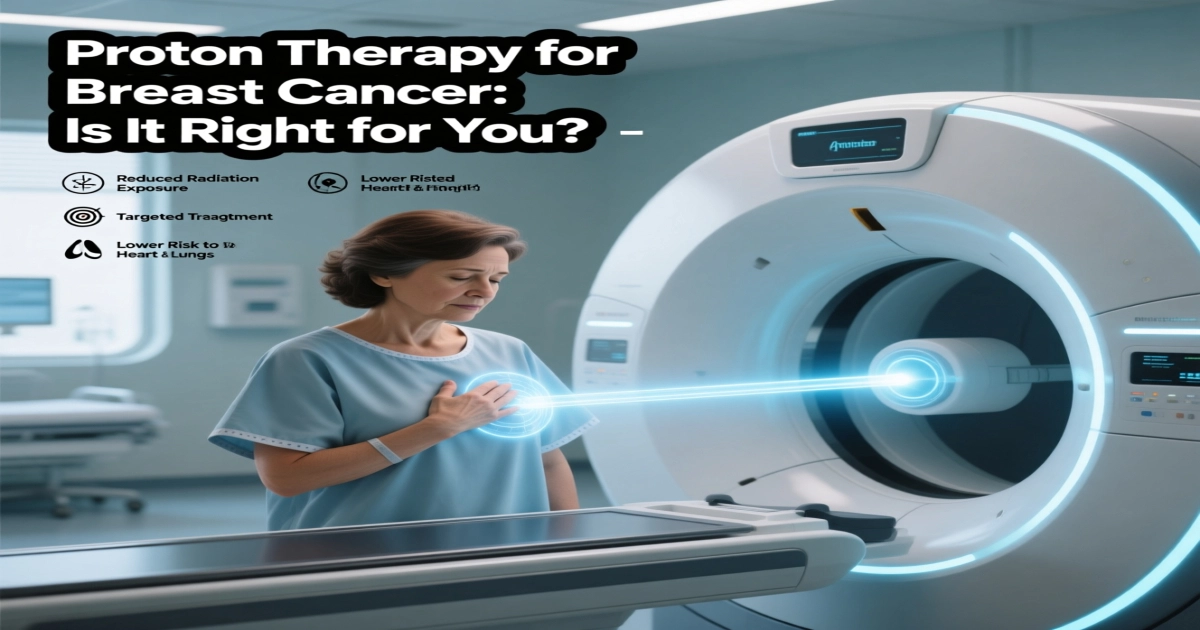
Breast cancer treatment has evolved far beyond a “one size fits all” approach. For many patients, the goal isn’t just to eliminate the cancer, but to protect the heart and lungs for a long, healthy life afterward.
Proton therapy represents the frontier of this precision medicine. This guide explores how it works, the specific benefits for left-sided breast cancer, and what to expect during treatment.
What is Proton Therapy for Breast Cancer?
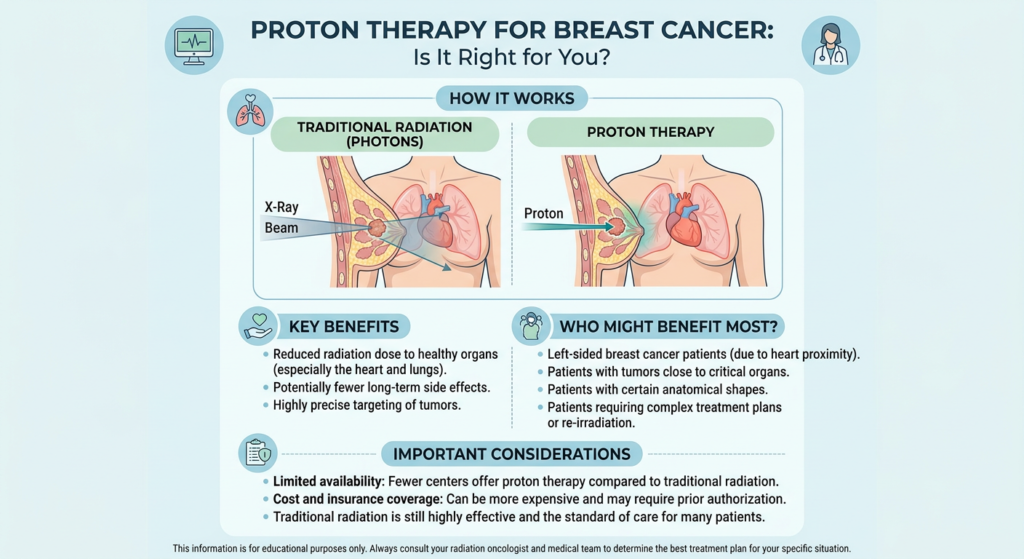
Proton therapy is a highly advanced form of external beam radiation. Unlike traditional X-rays (photons) that pass through the body, protons are heavy, positively charged particles.
Because of their mass, they can be manipulated to release the bulk of their energy at a specific depth—the tumor—and then stop completely. This phenomenon, known as the Bragg Peak, eliminates the “exit dose” that typically affects the organs behind the breast.
Key Benefits: Why Choose Protons?
- Superior Heart & Lung Protection: For patients with left-sided breast cancer, the heart sits directly behind the chest wall. Protons deliver nearly zero radiation to the heart and up to 50% less to the lungs compared to modern X-ray techniques.
- Precision via Pencil Beam Scanning (PBS): Think of PBS as a “magnetic paintbrush.” It deposits radiation millimeter by millimeter, “painting” the tumor while curving away from critical structures.
- Reduced Long-Term Toxicity: By sparing healthy tissue, patients may face a lower risk of secondary cancers and radiation-induced heart disease later in life.
Are You a Candidate for Proton Therapy?
While not every patient requires protons, a radiation oncologist may recommend it for:
- Left-Sided Breast Cancer: To minimize cardiac exposure.
- Lymph Node Involvement: When radiation must cover a larger, deeper area.
- Recurrent Cancer: If you have had radiation before, protons can target a specific area without “over-dosing” previously treated tissue.
- Younger Patients: Those with a long life expectancy benefit most from minimizing long-term organ damage.
The Treatment Experience: What to Expect
- Simulation (The Map): You will undergo a CT simulation where masks or molds are created to ensure you are in the exact same position every day.
- The Schedule: Usually, treatment involves daily sessions (Monday–Friday) for 3 to 6 weeks.
- The Session: The actual “beam-on” time is only 3–5 minutes. The rest of your 45-minute appointment is spent ensuring sub-millimeter alignment.
- Side Effects: Most patients continue their daily routines. Common effects include fatigue and a skin reaction similar to a mild sunburn.
Protons vs. Photons: A Quick Comparison
| Feature | Traditional Photon (X-Ray) | Proton Therapy |
| Exit Dose | Passes through the body | Stops at the tumor |
| Heart Risk | Low (with modern DIBH) | Minimal to Zero |
| Availability | Common | Specialized Centers |
| Insurance | Standard Coverage | Case-by-Case Basis |
Expert Note: While the “dosimetric” (mapping) benefits of protons are clear, large-scale clinical trials like RADCOMP are currently gathering data to further quantify the long-term survival advantages over modern photon techniques.
FAQ
Coverage varies. Many insurers cover it for recurrent cancer or complex anatomy, but others require a “peer-to-peer” review.
Both are highly effective at killing cancer. The primary advantage of protons is the reduction of side effects and protection of the heart.
No. The treatment is non-invasive and painless. You will not feel the beam during delivery.