
Medically Reviewed and Compiled by Dr. Adam N. Khan, MD.
Quick Summary: KF94 vs. KN95
If you are looking for a fast answer: KF94 and KN95 masks are nearly identical in protection. Both are high-quality respirators that filter out about 95% of tiny particles, including viruses and wildfire smoke.
Quick Summary: KF94 vs. KN95
If you are looking for a fast answer: KF94 and KN95 masks are nearly identical in protection. Both are high-quality respirators that filter out about 95% of tiny particles, including viruses and wildfire smoke.
The main difference is the fit and origin.
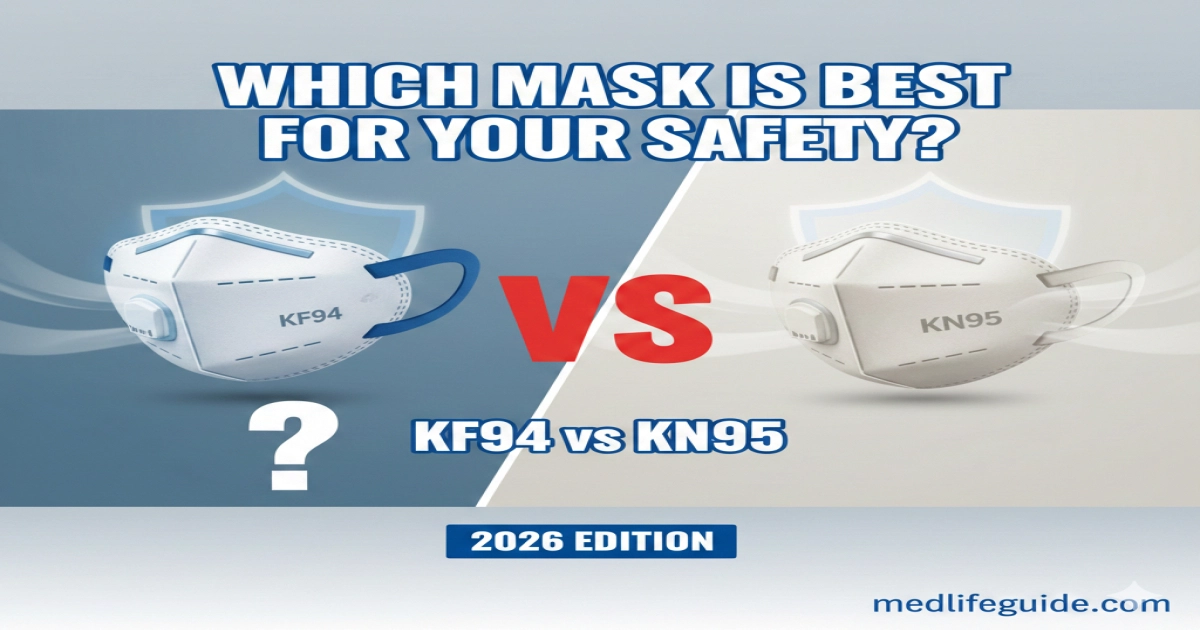
- KF94 masks come from South Korea and usually have a “boat-shape” design that stays away from your mouth, making it easier to talk.
- KN95 masks come from China and typically have a “v-shape” fold that fits snugly against the face.
Choose the one that fits your face shape best without leaving any gaps.
KF94 vs. KN95: Which Mask Should You Choose in 2026?
When you walk into a store or browse online for a mask today, you are likely to see two main labels: KF94 and KN95. While they might look similar sitting in their packaging, they come from different parts of the world and offer slightly different experiences for the person wearing them.
In 2026, we know more than ever about how these masks work. Whether you are trying to avoid a seasonal flu, protecting yourself from urban pollution, or dealing with wildfire smoke, understanding these two standards is key to staying healthy.
What Do the Names Actually Mean?
To understand these masks, we have to look at their “standard.” A standard is basically a set of rules that a country makes to ensure a product works the way it says it does.
- KN95 (The Chinese Standard): The “95” stands for 95%. This means the mask is designed to capture at least 95% of very small particles (0.3 microns). The “KN” refers to the Chinese regulatory standard (GB2626).
- KF94 (The South Korean Standard): “KF” stands for “Korean Filter.” The “94” means it is certified by the South Korean government to filter out at least 94% of particles.
While the KN95 technically has a 1% higher filtration requirement, in the real world, this difference is tiny. Most high-quality KF94 masks actually test at 97% or 98% efficiency, meaning both masks provide excellent protection compared to a standard cloth or blue surgical mask.
The Major Difference: Shape and Comfort
The biggest reason people choose one over the other isn’t the 1% difference in filtration—it’s how the mask feels on their face.
The KF94 “Boat” Shape
The KF94 is famous for its 3D “fish” or “boat” design. It has a top flap that rests on the nose and a bottom flap that tucks under the chin.
- Why people love it: Because of the middle panel, the mask stays away from your lips. This makes it much easier to speak clearly and breathe without the fabric “sucking in” every time you inhale.
- Who it’s for: People who talk a lot for work, wear lipstick, or feel claustrophobic in tighter masks.
The KN95 “V-Shape”
Most KN95 masks use a “bi-fold” or “bird’s beak” design. It is folded down the center, creating a point in front of your nose and mouth.
- Why people love it: It often feels very secure. Because it has fewer moving parts than the KF94, it is easy to pop on and off quickly.
- Who it’s for: People with smaller or more angular face shapes who want a very tight, simple seal.
How to Spot a “Fake” in 2026
Because these masks are so popular, there are many low-quality imitations on the market. Google’s health standards and medical experts like Dr. Khan emphasize that a mask only works if it is authentic. Here is how to check yours:
| Feature | KF94 (South Korea) | KN95 (China) |
| Markings | Usually no text on the mask itself. | Must be stamped with GB2626-2019. |
| Packaging | Should say “Made in Korea” and have an expiration date. | Should include a “Certificate of Quality” inside. |
| Ear Loops | Usually soft and stretchy; often adjustable. | Usually thicker; less likely to be adjustable. |
| The “NIOSH” Rule | Red Flag: If it says “NIOSH Approved,” it is a fake. | Red Flag: If it says “FDA Approved,” be very careful. |
Pro Tip: NIOSH (the U.S. safety agency) only approves N95 masks with head straps. They do not approve ear-loop masks like the KF94 or KN95. If you see a KF94 with a NIOSH logo, it is a counterfeit.
Breathability and Daily Use
One of the most common questions is: “Can I breathe easily in these?”
In the past, people thought the thicker the mask, the harder it was to breathe. However, modern 2026 manufacturing uses “electrostatic” filters. These use a tiny bit of static electricity to trap germs rather than just thick layers of fabric.
Most users find the KF94 slightly more breathable because the 3D shape creates a “chamber” of air in front of the mouth. The KN95 can sometimes feel “hotter” against the skin because the material sits closer to the face.
Which One is Better for Wildfire Smoke?
If you are dealing with “PM2.5” (fine dust from fires), both masks are excellent. Unlike cloth masks, which let small smoke particles right through the gaps in the fabric, the melt-blown layers in KF94s and KN95s trap those particles.
For the best protection during smoky days, look for a mask that has a foam nose bridge or a very strong metal wire. This prevents the “foggy glasses” effect and ensures smoke isn’t leaking in through the top.
Final Verdict: The Best Mask is the One That Fits
At the end of the day, a 99% effective mask is 0% effective if there is a gap next to your nose.
- Choose the KF94 if you have a wider face, wear glasses, or need to speak frequently.
- Choose the KN95 if you prefer a tighter, more traditional fit and have a face shape that works well with a center fold.
Whichever you choose, make sure it seals tightly against your skin. When you breathe in, the mask should slightly collapse inward—that’s how you know the air is going through the filter, not around it.