
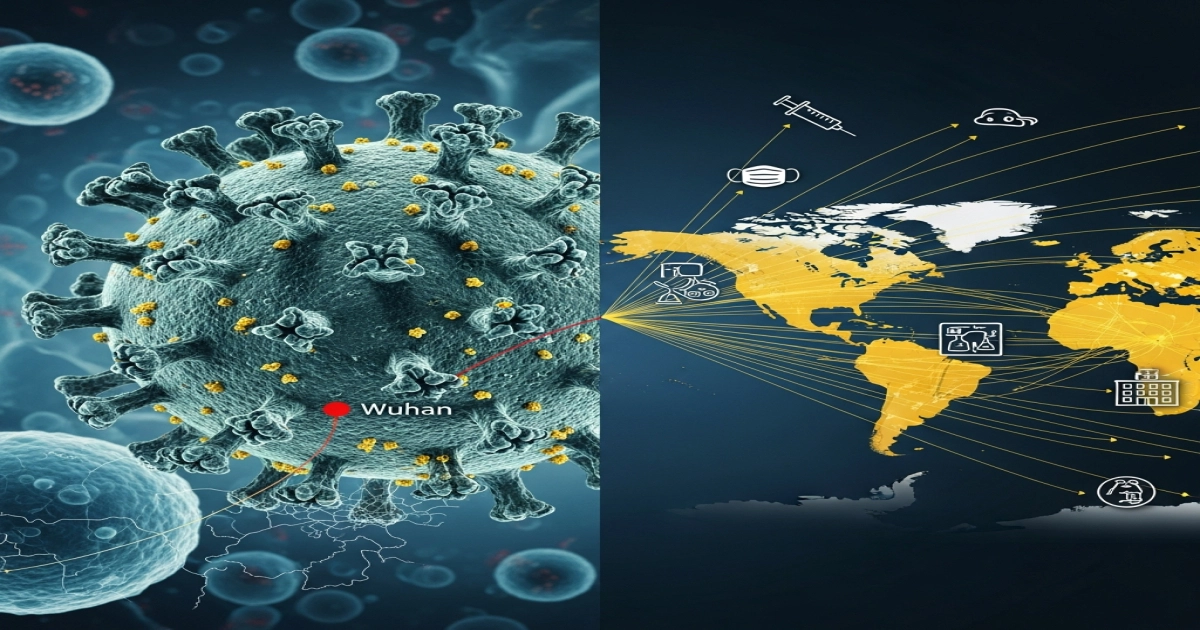
The coronavirus pandemic, caused by the SARS-CoV-2 virus, began in late 2019 and changed the course of modern history. From its first known cases in Wuhan, China, to the worldwide response that followed, the origins of COVID-19 remain both a scientific and social turning point. This guide explores how coronavirus started, what led to its rapid spread, an
The coronavirus pandemic, caused by the SARS-CoV-2 virus, began in late 2019 and changed the course of modern history. From its first known cases in Wuhan, China, to the worldwide response that followed, the origins of COVID-19 remain both a scientific and social turning point. This guide explores how coronavirus started, what led to its rapid spread, and how global systems evolved in response.
Also Read: How Long Does the COVID Vaccine Last in Your Body in 2025
The Beginning: What Is Coronavirus?
Coronaviruses are a group of viruses that can infect both animals and humans. They were first identified in the 1960s, but it was not until the 21st century that they began causing large-scale outbreaks. These viruses primarily affect the respiratory system and are named for their crown-like spikes visible under a microscope.
Before COVID-19, two major coronavirus outbreaks had already occurred:
- SARS-CoV (Severe Acute Respiratory Syndrome) in 2002–2003.
- MERS-CoV (Middle East Respiratory Syndrome) in 2012.
Both were serious but geographically contained. The third and most devastating outbreak, SARS-CoV-2, began in late 2019 and became the cause of the COVID-19 pandemic.
How Did Coronavirus Start?
The first cluster of pneumonia-like cases was detected in Wuhan, Hubei Province, China, in December 2019. The early patients were linked to the Huanan Seafood Wholesale Market, where live animals were also sold. This raised early suspicions that the virus may have jumped from an animal to humans — a process known as zoonotic transmission.

The virus was officially identified as a novel coronavirus on January 7, 2020, and was later named SARS-CoV-2 by the International Committee on Taxonomy of Viruses. The disease it caused was called COVID-19 (Coronavirus Disease 2019).
Scientific Investigations into the Origin
Researchers from around the world began studying the virus’s genetic structure. The genome of SARS-CoV-2 showed similarities to coronaviruses found in bats, suggesting a possible animal origin. However, the exact pathway from bats to humans remains debated.
Leading Theories About the Origin
- Natural Zoonotic Origin (Most Widely Supported):
The virus may have spread from bats to another intermediate host, possibly a pangolin, before infecting humans. This is consistent with how other coronaviruses emerged in the past. - Laboratory-Related Incident (Investigative Theory):
Some scientists and policymakers proposed that the virus could have accidentally escaped from a laboratory studying coronaviruses in Wuhan. While several reviews found no direct evidence, the theory remains under international investigation. - Environmental and Human Factors:
High-density urban environments, wildlife trade, and global travel networks accelerated the spread, regardless of origin.
Early Spread and Global Outbreak
By January 2020, cases began appearing outside China — first in Thailand, Japan, and South Korea. On January 30, 2020, the World Health Organization (WHO) declared the outbreak a Public Health Emergency of International Concern.
By March 11, 2020, as the virus spread across continents, the WHO officially declared COVID-19 a pandemic. Travel bans, lockdowns, and emergency health measures reshaped daily life worldwide.
The Global Response: A Timeline of Events
| Year | Key Events |
|---|---|
| 2019 (Dec) | First cluster of pneumonia cases identified in Wuhan. |
| 2020 (Jan) | Virus identified as SARS-CoV-2. First deaths reported. |
| 2020 (Mar) | WHO declares a global pandemic. Major economies impose lockdowns. |
| 2020 (Apr–Jun) | Hospitals overwhelmed, global testing and vaccine research begin. |
| 2020 (Dec) | First COVID-19 vaccines authorized for emergency use. |
| 2021–2022 | Mass vaccination campaigns and emergence of new variants (Delta, Omicron). |
| 2023–2024 | Global restrictions ease as immunity increases and treatments improve. |
The Role of Vaccines in Containing the Pandemic
Vaccines became the cornerstone of the fight against COVID-19. Pharmaceutical companies like Pfizer-BioNTech, Moderna, AstraZeneca, and Johnson & Johnson developed effective vaccines within a year a scientific milestone.
The global vaccination effort saved millions of lives. However, unequal distribution highlighted socioeconomic disparities, as wealthier nations received vaccines earlier than developing countries.
Variants and Evolution of the Virus
As the virus replicated, it mutated, giving rise to new variants. Some became dominant globally due to higher transmissibility.
- Alpha Variant (B.1.1.7) – First detected in the UK (2020)
- Delta Variant (B.1.617.2) – Emerged in India (2021), known for higher severity
- Omicron Variant (B.1.1.529) – Appeared in late 2021 with many mutations, more contagious but generally less severe
Ongoing genomic surveillance remains crucial in detecting future mutations and guiding vaccine updates.
Social and Economic Impact
The pandemic disrupted every sector of life:
- Health Systems: Hospitals faced overwhelming patient loads and equipment shortages.
- Economy: The International Monetary Fund estimated a global GDP contraction of over 3.5% in 2020.
- Education: Over 1.5 billion students faced school closures, accelerating the adoption of online learning.
- Work Culture: Remote work became the norm, giving rise to new digital professions and hybrid models.
The pandemic also exposed vulnerabilities in global health coordination and the importance of proactive pandemic preparedness.
The Role of Technology and AI
Technology became humanity’s most valuable ally during the pandemic. Artificial intelligence, big data, and predictive modeling played crucial roles in:
- Tracking virus spread through real-time dashboards
- Accelerating drug discovery and vaccine testing
- Automating healthcare systems and remote diagnostics
Telemedicine also transformed healthcare accessibility, enabling doctors to consult patients safely during lockdowns.
How COVID-19 Changed Medicine Forever
Before 2020, vaccine development often took 10–15 years. The COVID-19 crisis compressed that timeline to less than 12 months. mRNA technology, once experimental, became mainstream and laid the foundation for new vaccines targeting cancer, flu, and other infectious diseases.
This acceleration marked the beginning of a new medical era — one focused on speed, data sharing, and global collaboration.
Environmental Lessons from the Pandemic
While the world stopped, nature briefly healed. Satellite data showed reductions in air pollution and greenhouse gas emissions during 2020 lockdowns. The event revealed how human activity directly affects the planet, sparking renewed interest in sustainable living and global climate action.
Controversies and Misinformation
The pandemic also became a breeding ground for misinformation. False claims about vaccines, origins, and treatments spread widely on social media. Health organizations were forced to combat an “infodemic” alongside the virus itself.
This led to the rise of digital literacy campaigns, encouraging people to verify information through trusted sources like WHO, CDC, and peer-reviewed scientific journals.
The Long-Term Aftermath
COVID-19 has now transitioned from a pandemic to an endemic disease in most countries. This means the virus continues to circulate but at manageable levels.
Key lessons include:
- The world must invest in pandemic preparedness infrastructure.
- Public trust and accurate communication are vital for crisis management.
- Health equity remains one of the biggest global challenges.
What Scientists Have Learned
- Zoonotic Diseases Are Rising: Increased human-wildlife interaction raises risk for future spillovers.
- Global Cooperation Is Non-Negotiable: Health crises cannot be solved by nations acting alone.
- Innovation Saves Lives: The success of mRNA technology and global data sharing proved the power of scientific collaboration.
The Human Story
Beyond statistics and scientific reports, the coronavirus pandemic is also a deeply human story — one of loss, resilience, and adaptation. Families were separated, healthcare workers faced unimaginable stress, and millions of people rebuilt careers through remote work.
Yet, the shared experience of survival and innovation redefined humanity’s sense of connection.
The Trigger: From Outbreak to Transformation
The question “How did coronavirus start?” is not just historical; it defines how humanity prepares for the next crisis. The world’s response to COVID-19 reshaped medicine, work, and social systems permanently.
The RankBrain trigger here is insight: understanding the origin of coronavirus is not about blame but about building resilience preventing history from repeating itself.
People Also Ask
COVID-19 was declared a global pandemic by the WHO on March 11, 2020.
The most supported scientific theory suggests bats were the original host, possibly through an intermediate animal like a pangolin.
No. By 2024, it became endemic, meaning it still exists but is under control with vaccines and immunity.
The first confirmed patient was reported in Wuhan, China, in December 2019.