
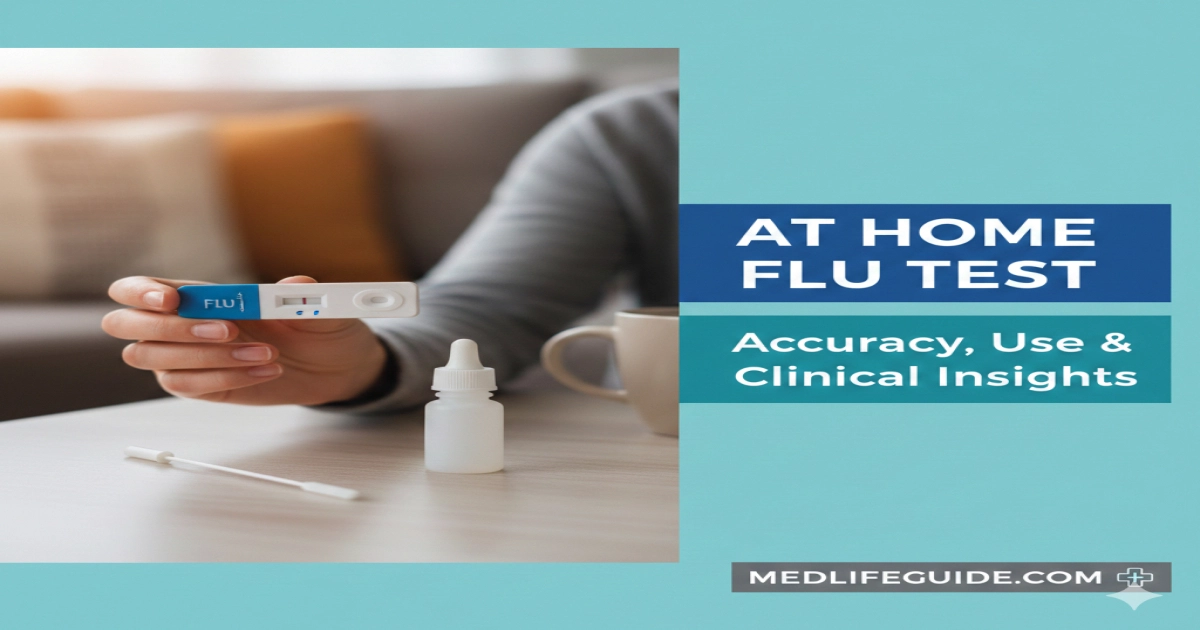
An at home flu test is a rapid diagnostic tool designed to detect influenza A and B viruses without visiting a clinic. These tests became widely known during the COVID-19 era, but influenza testing at home now serves a different clinical purpose: early recognition, timely isolation, and informed decisions about antiviral treatment.
This article explains how at home flu tests work, their accuracy, proper use, limitations, and when results should change medical decisions. It also includes clinical insights that are often missing from basic symptom-based flu guides.
What Is an At Home Flu Test?
An at home flu test is a self-administered diagnostic test that checks for influenza viral antigens in a nasal sample. Most available kits are:
- Rapid influenza diagnostic tests (RIDTs)
- Lateral flow antigen tests
- Single-use nasal swab kits
They are cleared by the U.S. FDA for non-prescription home use.
What the Test Detects
- Influenza A virus
- Influenza B virus
(Some kits detect both; some differentiate between them.)
These tests do not detect:
- COVID-19 (unless it is a combo test)
- RSV (unless specified)
- Other viral or bacterial causes of flu-like illness
How an At Home Flu Test Works
Step-by-Step Overview
- Nasal swab is inserted into the front of the nostril
- Swab is mixed with a test solution
- Sample is applied to the test strip
- Results appear within 10–30 minutes
The test identifies viral antigens, not antibodies. This means it works best when viral load is high.
Accuracy of At Home Flu Tests
Sensitivity and Specificity
- Specificity: High (false positives are uncommon)
- Sensitivity: Moderate (false negatives occur)
This means:
- A positive result is reliable
- A negative result does not rule out flu
Accuracy depends on:
- Timing of testing
- Correct sample collection
- Current flu strain prevalence
Best Time to Test
- Within 1–4 days of symptom onset
- Viral shedding is highest during this window
Testing after day 5 reduces detection rates.
Symptoms That Justify Using an At Home Flu Test
An at home flu test is most useful when these symptoms appear suddenly:
- Fever or chills
- Body aches
- Fatigue
- Dry cough
- Headache
- Sore throat
It is less useful for:
- Mild cold symptoms
- Isolated runny nose
- Symptoms lasting over one week
At Home Flu Test vs COVID-19 Test
| Feature | Flu Test | COVID-19 Test |
|---|---|---|
| Virus detected | Influenza A/B | SARS-CoV-2 |
| Antiviral treatment | Yes (oseltamivir) | Limited |
| Treatment window | 48 hours | Variable |
| Seasonality | Winter | Year-round |
Combo tests are available but must be interpreted carefully.
Who Should Use an At Home Flu Test?
Appropriate Users
- Adults with sudden flu-like symptoms
- Parents testing children (with supervision)
- Caregivers of high-risk individuals
- People deciding on work or school isolation
High-Risk Groups
Testing is especially relevant for:
- Adults over 65
- Pregnant individuals
- People with asthma, diabetes, or heart disease
- Immunocompromised patients
In these groups, test results can guide early antiviral treatment.
Limitations of At Home Flu Tests
Clinical Limitations
- Cannot assess disease severity
- Cannot detect pneumonia
- Cannot rule out co-infections
User-Related Errors
- Shallow swab insertion
- Testing too late
- Improper storage of kit
Negative results must always be interpreted alongside symptoms.
Unique Clinical Takeaways
1. False Negatives Are Clinically Common in Vaccinated Patients
Patients who received a seasonal flu vaccine may have:
- Lower viral loads
- Shorter viral shedding periods
This increases false-negative risk despite active infection. In high-risk patients, treatment decisions should not rely solely on a negative at home flu test.
Actionable Insight:
If symptoms are classic and less than 48 hours old, antiviral therapy may still be appropriate even with a negative test.
2. Flu Testing Changes Behavior More Than Outcomes
Clinical data shows that home flu testing:
- Improves self-isolation compliance
- Reduces unnecessary antibiotic use
- Does not significantly reduce complications alone
The benefit is behavioral and public health–oriented rather than curative.
Actionable Insight:
Use results to guide isolation and exposure prevention, not to self-manage severe symptoms.
3. Differentiating Flu From RSV and COVID-19 Matters for Children
Children under 5 often present with overlapping symptoms:
- RSV causes wheezing and feeding difficulty
- Flu causes higher fever and muscle pain
An at home flu test does not rule out RSV. In infants, respiratory distress requires clinical evaluation regardless of test results.
Actionable Insight:
In children with breathing difficulty, testing should not delay medical care.
When to Seek Medical Care After an At Home Flu Test
Seek Care Immediately If:
- Shortness of breath develops
- Chest pain occurs
- Fever persists beyond 3 days
- Confusion or severe weakness appears
- Symptoms worsen after initial improvement
Antiviral Treatment Window
Prescription antivirals work best when started within 48 hours of symptom onset.
A positive at home flu test can justify contacting a clinician promptly.
Storage and Expiration Considerations
- Store kits at room temperature
- Do not freeze
- Check expiration date
Expired kits have reduced accuracy and should not be used.
Public Health and Workplace Use
At home flu tests:
- Reduce unnecessary clinic visits
- Support outbreak control in schools and workplaces
- Are not a substitute for vaccination
Vaccination remains the primary prevention strategy.
Frequently Asked Questions
Can an at home flu test replace a doctor visit?
No. It is a screening tool, not a diagnostic evaluation for complications.
Can children use at home flu tests?
Yes, with adult supervision. Accuracy is lower in very young children.
Can flu and COVID happen together?
Yes. Co-infection is documented and requires medical oversight.
Medical Disclaimer
This article is for informational purposes only and does not replace professional medical advice, diagnosis, or treatment. Always consult a licensed healthcare provider for medical concerns or decisions regarding testing and treatment.